
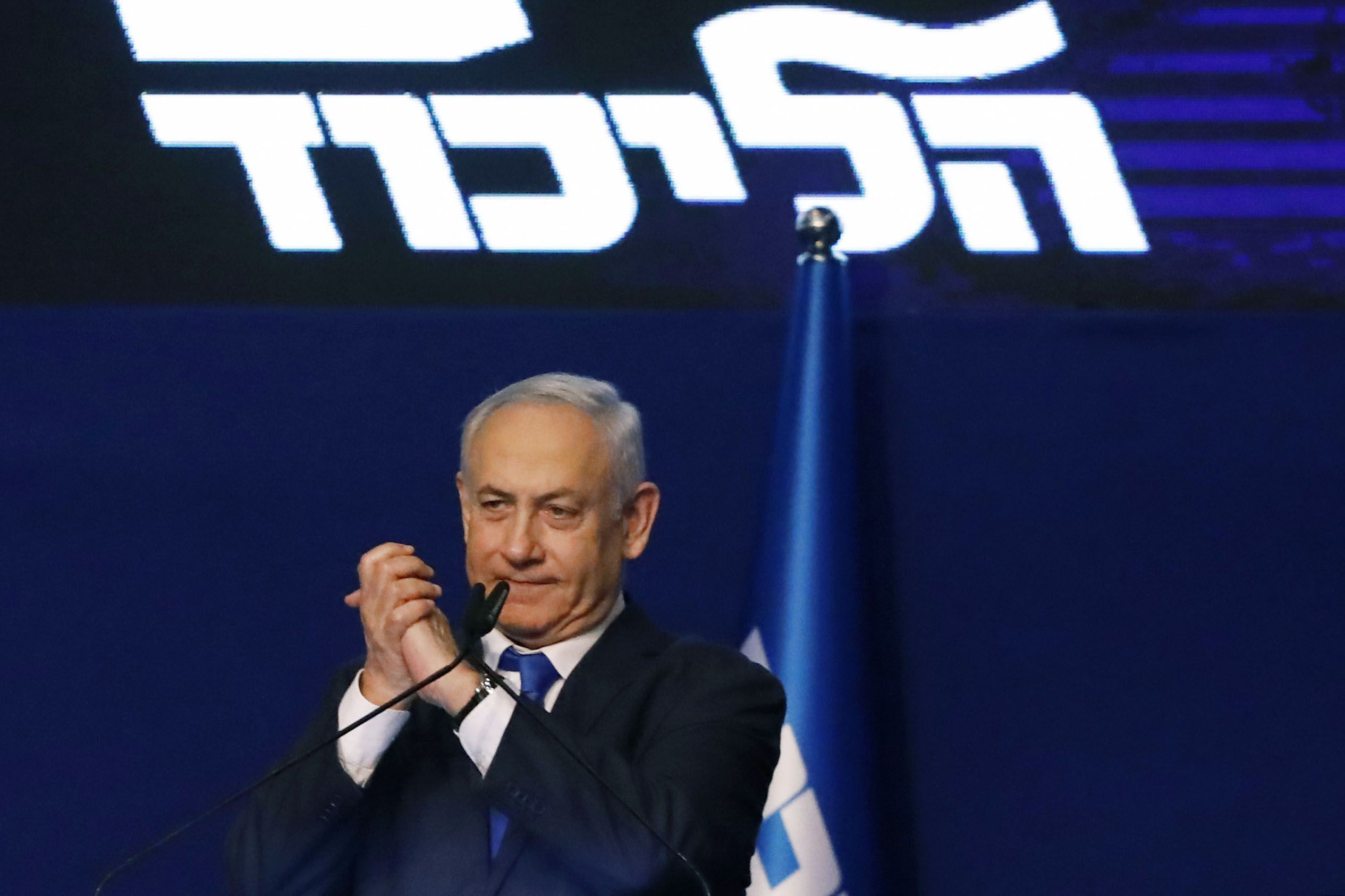
(Bloomberg) — Israeli Prime Minister Benjamin Netanyahu can form a government despite the corruption charges against him, the country’s highest court ruled, paving the way to ending more than a year of political stalemate closely linked to his legal woes.
The decision was criticized by opponents who say Netanyahu’s leadership of the nation while under indictment inflicts grievous harm on public norms.
The unanimous court ruling on Wednesday cleared a major obstacle to installing Israel’s first permanent government since December 2018, and allows the country to focus on the economic havoc created by the coronavirus outbreak.
With the court challenge out of the way and a crucial deadline looming, lawmakers on Thursday approved bills anchoring the power-sharing deal Netanyahu signed with rival Benny Gantz.
The two leaders, who will take turns as prime minister with Netanyahu going first, have set a May 13 date for swearing in their joint administration.
That’s just 11 days before the scheduled start of Netanyahu’s graft trial.
Netanyahu’s Fate Is Now in Hands of Israel’s Highest Court
The High Court of Justice was asked to weigh in on Netanyahu’s fitness to serve because Israeli law doesn’t explicitly address whether a politician indicted on serious crimes can serve as prime minister.
Following two days of deliberations, an expanded panel of 11 judges rejected petitions seeking to break Netanyahu’s grip on power as he faces charges of bribery, fraud and breach of trust.
“The indictment against a lawmaker does not prevent his being named to form a government, and by extension his appointment to lead it,” they said in their decision late Wednesday.
Netanyahu Indicted as Political Crisis Paralyzes Israel (3)
The prime minister says he’s the victim of a political witchhunt by leftists and journalists opposed to his nationalist agenda.
He’s accused of illicitly accepting gifts and scheming to tilt legislation to benefit media moguls in exchange for favorable coverage.
The Movement for Quality Government in Israel, the main petitioner to the court, said it would organize a demonstration in Tel Aviv on Saturday night whose theme will be “Israel is ashamed.” The Netanyahu-Gantz government “may be kosher but it stinks,” the good governance group said in a text message.
The criminal allegations against the prime minister have played a major role in the political crisis that has gripped the country since he set in motion three inconclusive elections almost 17 months ago, gambling that staying in power would improve his legal prospects.
The votes were essentially a referendum on his rule while under a legal cloud, and the repeated stalemates stalled action on issues as consequential as passing a 2020 budget and how to proceed on a vow to annex land the Palestinians claim for a state.
Virus Emergency May Prove a Lifeline for Israel’s Netanyahu
The economic and policy toll of the endless election cycle has been exacerbated by the ravages of the coronavirus, which has sickened more than 16,000 people, killed about 240 and clobbered the economy.
Ultimately, it was the health emergency that cracked open a way out of the political vacuum and extended Netanyahu a political lifeline.
Gantz, a centrist former military chief who had fought the prime minister to a draw three times, reasoned that the country’s leadership needed to close ranks to fight the outbreak and avert a fourth round of balloting. He went back on his key campaign vow never to sit in a government headed by the scandal-tainted Netanyahu, and signed a power-sharing pact with him last month.
Whether the agreement would offer the country more than a semblance of stability is unclear.
There is deep distrust between the two men, and provisions in the accord could be recipe for policy paralysis because they grant them veto power over the other and give their camps equal weight in parliamentary committees. Netanyahu will retain prime ministerial privileges throughout the entire tenure of the two-headed government.
The justices on Wednesday also dismissed petitions seeking to strike down the accord, which the challengers said contained unconstitutional provisions.
While it contains legal problems, “at this point there is no reason to intervene,” the court found, suggesting it was open to possible future petitions.
Hours later, the good governance group saw another opening for intervention, after parliament approved the legislation underpinning the Netanyahu-Gantz rotation agreement. In its petition, the Movement for Quality Government in Israel alleged the pact represents “a shameful trampling of the system of government and the eradication of the Knesset’s independence.”
Netanyahu must now gather signatures from a majority of parliament’s 120 members nominating him as the next prime minister.
He’s got until midnight or parliament automatically disbands.
Inside the Political Deal to Save Netanyahu and Push Annexation
The joint administration’s major focus in its first six months is to be on remedying the damage caused by the virus outbreak. Isolation measures caused unemployment to soar as high as 27% from under 4%, and the Bank of Israel expects the economy to contract 5.3% this year as the government moves ahead on implementing an 80 billion shekel ($22.8 billion) economic bailout program.
The power-sharing pact also allows movement as early as July 1 on annexing some of the West Bank land the Palestinians claim for a state, a measure approved by the Trump administration but deplored by the Palestinians as thwarting their statehood dreams.
(Updates with new court challenge to laws underpinning rotation agreement in 14th paragraph.)
For more articles like this, please visit us at bloomberg.com
©2020 Bloomberg L.
P.