
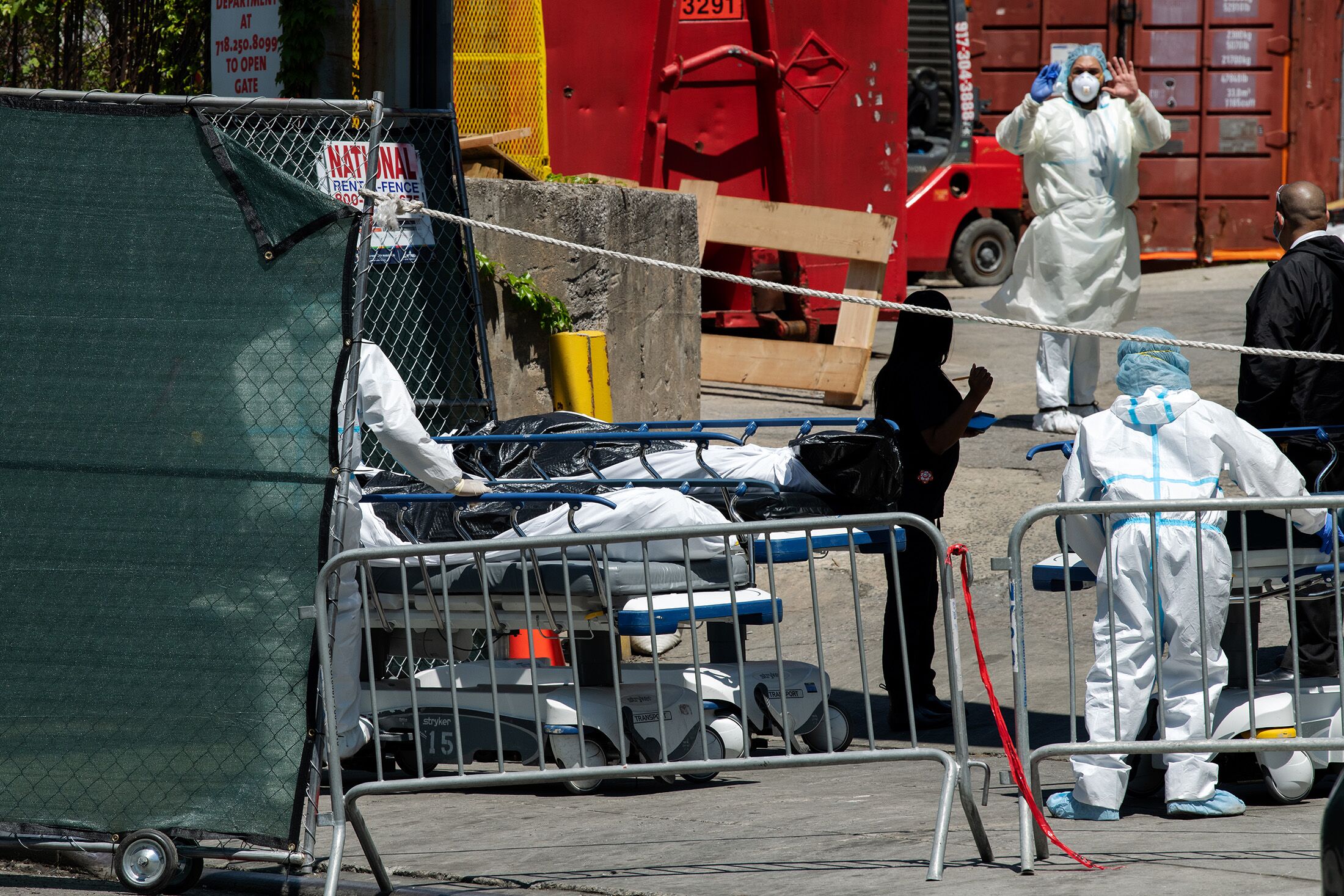
(Bloomberg) — Germany’s coronavirus cases rose the most in a week, days after the government declared the first phase of the pandemic to be over, while U. S. fatalities topped 75,000.
Boris Johnson’s government tried to damp expectations that the U. K.’s lockdown will be significantly rolled back as scientists warned the infection rate has crept upward in recent days. Australia announced a three-phase plan to reopen the economy by July after flattening the curve of new infections.
Japan granted an “exceptional approval” for Gilead Sciences Inc.’s remdesivir to treat the virus, and Moderna Inc. said its experimental vaccine would be in late-stage studies by early summer.
Key Developments
- Virus Tracker: cases pass 3.8 million; deaths top 269,000
- Next coronavirus health crisis could be a wave of suicides
- Children suspected of spreading disease as societies reopen
- Pandemic sparks new calls in U.
S. to abolish the WTO
- U. S. bankruptcy wave builds to the worst run in years
Subscribe to a daily update on the virus from Bloomberg’s Prognosis team here. Click VRUS on the terminal for news and data on the coronavirus. See this QuickTake on unanswered questions about the virus.
ING Hit by Virus Provisions, Siemens Scraps Outlook (1:56 p.m. HK)
The coronavirus pandemic continued to take a toll on European corporate earnings.
ING Groep NV saw profit drop to the lowest since 2014 in the first quarter as the Dutch bank set aside more money to cover for potential coronavirus-related losses. Siemens AG abandoned its full-year forecasts after Europe’s largest engineering company saw profit sink at all divisions amid an industrial slump.
China Drugmaker in Talks to Test Vaccine Globally (1:49 p.m. HK)
The drugmaker behind one of China’s most promising coronavirus vaccine candidates is in talks to conduct late-stage trials globally as the race for immunization against Covid-19 intensifies.
Beijing-based Sinovac Biotech Ltd. is in discussion with regulators in other countries, and the World Health Organization, to launch phase III clinical trials in regions where the novel coronavirus is still spreading rapidly, CEO Yin Weidong said in an interview.
Germany’s New Cases Rise the Most in a Week (1:43 p.m. HK)
The number of new cases in Germany rose the most in a week, just days after the government declared the first phase of the pandemic to be over.
There were 1,268 additional infections in the 24 hours through Friday morning, according to data from Johns Hopkins University.
That is the third day of rising cases and brings the total number to 169,430.
Germany is preparing to open restaurants, hotels and all shops as well as to restart professional soccer games as Chancellor Angela Merkel on Wednesday declared some progress in fighting the virus, which so far has caused 7,392 deaths in the country.
Australia to Reopen Crippled Economy by July (11:06 a.m. HK)
Australia announced a three-phase plan to reopen the economy as its success in flattening the curve of new coronavirus infections allows it to relax lockdown restrictions.
By July, the plan should see some 850,000 jobs that been lost during the crisis restored, Prime Minister Scott Morrison told reporters in Canberra.
Under step one, gatherings of up to 10 people will be permittted, retail and small cafe and restaurants will reopen and interstate travel will be allowed.
In the next phase, larger gatherings of up to 20 people will be allowed and cinemas and galleries will gradually reopen. In the final step, gatherings of up to 100 people will be allowed and most people will be back in the workplace rather than working from home.
Indonesia Weighs Easing Lockdown From Early June (11:02 a.m. HK)
Indonesian officials have begun discussions about reopening Southeast Asia’s largest economy in phases starting from June, as job losses accelerate and businesses struggle to survive amid strict social-distancing rules against the coronavirus.
The Coordinating Ministry of Economic Affairs earlier this week discussed an “exit strategy” from the partial lockdown imposed in large cities, including the greater Jakarta area.
The strategy calls for social-distancing rules to be removed in five phases, with the economy completely reopened by late July or early August.
New Cases Emerge From South Korean Clubs (10:40 a.m. HK)
South Korea’s Health Ministry said 13 new coronavirus cases are linked to a patient who visited three nightclubs in Seoul on May 2. About 1,500 people visited the three clubs that day, and a ministry official said there is high chance more virus cases would be confirmed.
People that visited the Trunk Club, Club Queen and King Club on May 2 are being asked to refrain from leaving their homes.
The government has no plans to change its social distancing guidelines.
Shanghai Disneyland Tickets Sold Out in Minutes (10:36 a.m. HK)
Shanghai Disneyland sold out of tickets for its May 11 reopening after a four-month shutdown, a sign that consumers in China are prepared to spend as the nation recovers from the coronavirus pandemic.
Shanghai Disneyland was the first of Walt Disney Co.’s parks to close on Jan. 25 as the coronavirus began to spread.
While Disney is keeping its U. S., Hong Kong and Paris parks closed, it said Thursday it will open a limited number of shops and restaurants in its Disney Springs mall outside its resorts in Orlando, Florida, on May 20.
Kim Jong Un Lauds China’s Virus Actions (9:33 a.m. HK)
North Korean leader Kim Jong Un sent his first formal message to China since reemerging from an almost three-week public absence, praising President Xi Jinping for his “success” in managing the coronavirus.
Meatpacking Giants Face U.
S. Antitrust Inquiry (8:47 a.m. HK)
The U. S. Justice Department is investigating meatpacking companies for possible antitrust violations, according to a person familiar with the matter, as the industry comes under scrutiny over plant shutdowns that have disrupted the supply of meat.
The antitrust probe is in the early stages and began before the coronavirus outbreak spread across the U.
S., said the person. The U. S. is grappling with a meat crisis after the coronavirus pandemic sickened thousands of workers at slaughterhouses and forced plants to close.
U. S. Airport Screeners Now Must Wear Masks (7:43 a.m. HK)
All U. S. airport security screeners must start wearing masks and passengers should as well, the Transportation Security Administration said.
The move comes as a government and industry working group begins considering a possible requirement that face coverings be worn by everyone entering an airport, two people familiar with the discussions said.
Frontier Airlines will check passengers for fevers starting June 1, introducing a new health requirement.
Flyers with a body temperature of 100.4 degrees Fahrenheit (38 degrees Celsius) or higher will be denied boarding, Frontier said.
Arthritis Drug Seen Helping Patients in Small Study (7:26 a.m. HK)
A drug for rheumatoid arthritis appeared to help improve lung function in hospitalized Covid-19 patients, a positive sign for treating those with severe inflammation in their organs.
Treatment with anakinra, sold by Swedish Orphan Biovitrum AB as Kineret, was associated with a 90% survival rate and reduced respiratory symptoms, according to an observational study of 29 patients published Thursday in the Lancet Rheumatology journal.
One of Covid-19’s most harmful effects is inflammation, a protective response to infections and injury that can turn on the body itself in a phenomenon called “cytokine storm.” Drugmakers are testing products that counter inflammation, rather than the coronavirus.
California Outlines Partial Reopening Guidance (5:08 p.m.
NY)
California issued guidelines for how shops, construction sites and factories can begin to reopen this weekend, although the steps outlined fall well short of business as usual in the most populous U. S. state.
Retail establishments will be encouraged to do curb-side delivery in an effort to keep shoppers from coming into close contact. Dine-in restaurants, shopping malls and offices will remain shut, although Governor Gavin Newsom has said some areas that can meet state criteria can work with health officials to further relax rules.
U.
S. Cases Rise 2.4%; Deaths Top 75,000 (4 p.m. NY)
U. S. cases rose 2.4% from the day before to 1.25 million, according to data compiled by Johns Hopkins University and Bloomberg News. That was above Wednesday’s growth rate of 1.9% and matched the average daily increase of 2.4% over the past week. Deaths rose 3.9% to 75,054. New York reported 3,491 new cases, bringing the total to 327,469, according to the state’s website.
FDA Pulls Approval of Chinese Masks (2:53 p.m.
NY)
The U. S. Food and Drug Administration reversed a decision to allow the emergency use of dozens of N-95 face masks made in China, after government testing found many didn’t work properly.
The agency had authorized use of the masks to help address shortages of personal protective equipment, on the condition that their effectiveness was verified by independent testing labs. That policy, put in place April 3, is being reversed based on testing by the National Institute for Occupational Safety and Health that found many of the masks failed to meet filtration standards.
Trump-Touted Treatment Fails in Study (2 p.m.
NY)
A malaria drug that was touted by Trump and widely used as a potential treatment for patients with Covid-19 failed to help those with infections stay off ventilators or live longer, according to a study published in the New England Journal of Medicine.
Researchers at New York-Presbyterian Hospital and Columbia University Irving Medical Center in New York City evaluated 1,376 consecutive patients who showed up at the emergency room with symptoms of coronavirus, comparing the fate of those who received the medication, hydroxychloroquine, to those who didn’t.
Nearly 60% of the patients were given the drug, typically within 48 hours, and they were more sick on average.
There were no significant differences between the groups in the number of patients who needed to be put on a ventilator or who died, even after taking into account the differences between them, the researchers said. Additional study, including more scientifically rigorous trials that randomly assign patients to treatment groups, is needed to confirm the findings, they said.
Japan Approves Gilead Drug (11:45 a.m.
NY)
Japan approved Gilead Sciences Inc.’s antiviral drug remdesivir, the company said. The “exceptional approval” by Japan’s usually conservative authorities comes days after the U. S. authorized the drug for emergency use on virus patients, the company said. Remdesivir is only being used in the U. S. for treatment of hospitalized patients, Gilead said.
For more articles like this, please visit us at bloomberg.com
©2020 Bloomberg L.
P.