
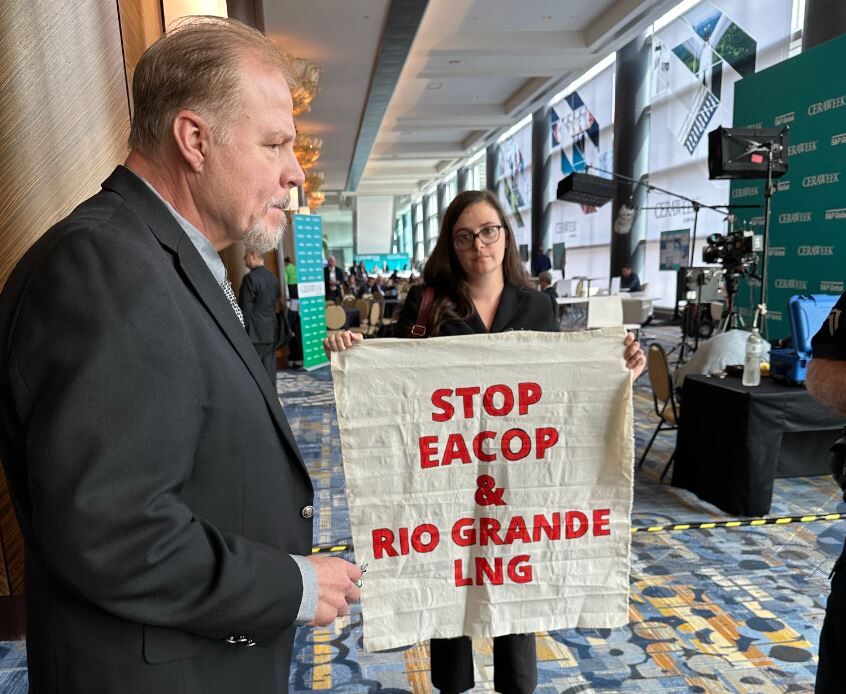
(Bloomberg) — It’s day three of CERAWeek by S&P Global in Houston. Today’s sessions are heavy on electricity and natural gas. Pablo Vegas, the head of the company that operates the Texas electric grid, said the state needs more fossil-fuel generating capacity. Patrick Pouyanne, the chief executive officer of TotalEnerges SE, was interrupted by a climate protester. Petroleo Brasileiro SA CEO Jean Paul Prates warned the state-controlled company may need to trim exports.
The keynote address at lunch will come from US Energy Secretary Jennifer Granholm.
Later, the chiefs of Williams Cos. and EQT Corp. will give their views on supply and demand dynamics in the North American gas market. Another panel will feature energy or mining ministers from Brazil, Egypt and Norway.
For more CERAWeek coverage, sign up now for our Elements newsletter, a daily guide to the energy and commodities markets.
All time stamps are Houston.
Kuwait Sees US, Europe Fuels Demand Remaining Strong This Year (11:06 a.m.)
Kuwait Petroleum Corp. expects fuel demand from US and Europe to remain “quite strong” through the end of this year, Chief Executive Officer Nawaf Al-Sabah told Bloomberg TV.
The state-owned oil company announced earlier this week it opened the second phase of its mega refinery, which “is designed to have a wall of middle distillates, essentially diesel, jet fuel, going into Europe,” Al-Sabah said Wednesday in an interview at CERAWeek. “We’re seeing that the natural flow for that product is going into Europe right now.”
Sunnova Plans to Fight California’s Microgrid Ruling (11:01 a.m.)
Rooftop solar company Sunnova Energy International Inc. will push forward with its bid to build self-contained microgrids in California and challenge an initial ruling against its plan, which threatened to erode the monopolies of investor-owned utilities operating in the region.
PG&E, Southern California Edison and Sempra Energy’s San Diego Gas & Electric had opposed Sunnova’s proposal, alongside the state’s powerful utility union.
“We’re not going to stop until people have the right to choose,” Chief Executive Officer John Berger said in an interview on the sidelines of the CERAWeek by S&P Global conference in Houston. “It’s a colossal political mistake” that reveals the “true colors” of the public utility commission and the political influence of utilities, Berger said.
NextEra Says Energy Transition Can’t Happen Without Natural Gas (10:53 a.m.)
The effort to decarbonize the power grid will require the use of natural gas for years to come as renewable sources ramp up, according to John Ketchum, the chief executive officer of NextEra Energy Inc.
“I run the world’s largest renewable company and there’s definitely a role for natural gas,” he said at a presentation at CERAWeek “Hydrogen is a terrific way to secure power” and represents a significant opportunity for NextEra, he added.
BP Bets on Old Refinery to Deliver on Cutting-Edge Technology (10:35 a.m.)
BP Plc is betting that hydrogen production could come to one of the oldest refineries in the US.
As part of the Midwest Alliance for Clean Hydrogen, the company is aiming to make its 133-year-old Whiting, Indiana, refinery an anchor for a new hydrogen hub spanning as many as six states and serving multiple sectors, from manufacturing to agriculture.
The MACHH2 coalition is vying for a slice of some $8 billion in federal funding for at least six hydrogen hubs around the country — with an application bolstered by its opportunity to produce blue, green and pink hydrogen and help decarbonize multiple sectors, Tomeka McLeod, BP’s vice president for US carbon capture and hydrogen, said in an interview on the sidelines of CERAWeek.
BP has kicked off seismic studies to assess the viability of storing carbon dioxide underground in the nearby Mount Simon formation, said Felipe Arbelaez, BP’s senior vice president of zero-carbon energy.
The company expects to potentially drill an appraisal well there before the end of the year.
Petrobras May Export Less Crude Amid Oil-Export Tax (10:23 a.m.)
Petrobras may export less crude after the Brazilian government announced a 9.2% tax on oil exports last week, Chief Executive Officer Jean Paul Prates said on the sidelines of CERAWeek.
“It really depends on the mix of oils we will run at the refineries, and that’s not up to me, but up to our refinery guys,” he said. “We must adapt to the new reality.”
The company has no plans to file an injunction to stop the temporary tax, which is in effect from Feb. 28 through June 30, he said.
Prates doesn’t believe the tax will be extended beyond the 4-month period. “I don’t see it as a straight, intelligent tool to solve the fiscal problem” of the country, he said.
Petrobras Looks to Take Leading Role in Energy Transition (9:29 a.m.)
Petrobras is looking at initiatives to help Brazil transition faster to clean energy, Chief Executive Officer Jean Paul Prates said.
The state-controlled oil company is studying the use of natural gas to fuel trucks in road transportation, and the use of bio oil to make diesel. The company also aims to take a bigger role in renewable power generation after Brazil privatized power company Eletrobras last year.
TotalEnergies CEO Distrupted by Climate Protester (9:16 a.m.)
Patrick Pouyanne’s remarks were interrupted by a lone protester, who began shouting about 10 minutes into his discussion with Pulitzer Prize-winning historian Daniel Yergin.
She urged executives “end the era of fossil fuels” and “stop all your greenwashing and lies.”
The protester was escorted out of the banquet hall by Houston police. She identified herself to a reporter as a member of GreenFaith, a group that says it’s dedicated to climate justice.
‘Don’t Complain, Do The Same,’ TotalEnergies CEO Says (9:06 a.m.)
European lawmakers should follow the US in passing comparable legislation to the Inflation Reduction Act, TotalEnergies Chief Executive Officer Patrick Pouyanne said Wednesday.
“Don’t complain, do the same,” Pouyanne said during a panel.
Texas Power Regulator Says Clean-Air Requirements ‘Unachievable’ (8:20 a.m.)
The top Texas power regulator blasted federal clean-air requirements, saying they threaten to shut thousands of megawatts of coal-fired generation on a state grid that is becoming heavily reliant on wind and solar.
“We are getting force fed these unachievable intense clean air requirements from the federal government” without any push to unlock the ability to build nuclear to back up intermittent renewable sources, Peter Lake, chairman of the Public Utility Commission of Texas, said on a panel.
Texas Grid Chief Says State Needs More Fossil-Fuel power (8:16 a.m.)
Peter Lake, chairman of the Public Utility Commission of Texas and Pablo Vegas, chief executive officer the Electric Reliability Council of Texas, both said the Lone Star State’s grid needs new fossil-fuel generating capacity to meet growing demand.
The PUC approved a measure called the Performance Credit Mechanism, which would pay generators for being online. This would be a remarkable pivot for a state that has fiercely defended running a power grid that drives investments through electricity price swings only. The reform is being debated at the Texas legislature during the current session.
The plan got pushback from the largest Texas power trader and generation owner, energy giant Shell Plc. “We don’t see a capacity problem,” said David Black, CEO of Shell’s energy solutions unit.
The PCM would mostly go to existing generators and the state should consider alternative ways to directly create incentives to build new power plants, he said. He suggested officials could incentivize the construction of new plants via tax abatements or low-interest loans.
More stories like this are available on bloomberg.com
©2023 Bloomberg L.
P.