
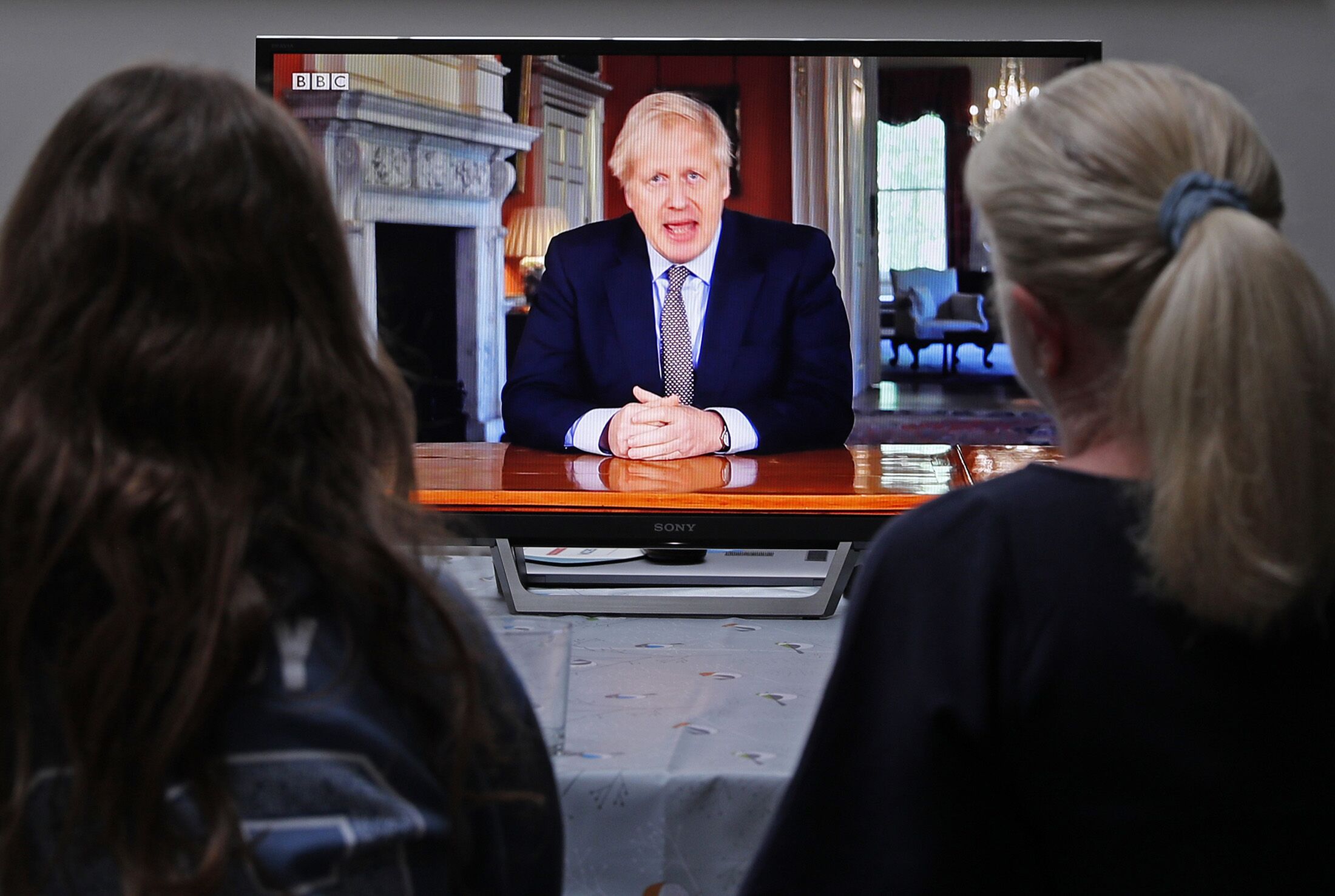
(Bloomberg) — Boris Johnson will flesh out his plan for lifting the U. K. lockdown in Parliament as he seeks to get more people back to work, even as resistance from politicians and labor unions laid bare the hurdles facing the government as it tries to kickstart the economy.
In a televised address to the nation on Sunday evening, Johnson announced the “first careful steps” to easing lockdown rules in a three-point plan, starting this week with unlimited outdoor leisure time for sports such as golf and tennis, and allowing people to drive to parks and beaches in England.
He told people who cannot work at home — such as those in the manufacturing and construction sectors — to return to their occupations.
Here’s How Boris Johnson’s New U. K. Lockdown Rules Will Work
“Work from home if you can, but you should go to work if you can’t,” the prime minister said. The government also dropped its “stay home” message in favor of a call to “stay alert,” and is expected to publish details of its lockdown plan in a 50-page document on Monday.
The second phase of the plan would see primary schools and shops start to reopen from June 1, while step three may allow open-air cafes to resume trading in July.
The shift in tone follows weeks of pressure from members of Johnson’s Conservative Party pushing for a swift end to the lockdown.
But while Johnson stressed his “careful” approach, it’s clear the government faces a battle to persuade businesses and workers it’s safe to resume operations.
Labour Party leader Keir Starmer said Johnson’s statement “raises more questions than answers” and said the country still lacks the “clarity and consensus” it needs.
“The prime minister appears to be effectively telling millions of people to go back to work without a clear plan for safety of clear guidance as to how to get there without using public transport,” Starmer said in a statement.
Before the statement, four of the biggest U.
K. labor unions called on the government to ensure adequate coronavirus-safety measures are in place before allowing people to return to work. The National Union of Rail, Maritime and Transport Workers urged members to “refuse to work” where safety is compromised over the government’s “confused and contradictory messaging over the COVID-19 lockdown.”
Jonathan Geldart, director general of the Institute of Directors, said government guidance must be clear on how businesses can return to work safely. “As people with ultimate legal responsibility, directors need to have confidence that it’s safe, and that if they act responsibly they won’t be at undue risk,” he said in an emailed statement.
Not in Scotland
Meanwhile in Scotland, First Minister Nicola Sturgeon told STV the majority of Johnson’s statement applied only to England, and reiterated that her administration would be keeping its “stay at home” advice and ignoring the new “stay alert” message.
The government of Wales said earlier it will likewise not follow Johnson’s lead.
U. K.’s ‘Stay Alert’ Slogan Criticized Before Johnson Speech
Johnson is caught between demands to get more people back to work and off the state’s furlough program, and the fear of triggering a new wave of infections that could require ministers to shut down the economy again.
The Treasury is considering allowing furloughed workers to return to work part-time as part of a gradual withdrawing of the government’s job retention program, the Sunday Times reported.
The program will be continued to September but at a reduced rate of 60% of wages, down from 80%, and will also top up workers returning on a part-time basis, the Telegraph newspaper reported, citing industry sources it didn’t identify.
In his address, the prime minister said the government would not do anything that risked a new wave of Covid-19 infections, and that the U.
K. had avoided the “catastrophe” of the “reasonable worst case scenario” of 500,000 deaths from coronavirus because widespread adherence to lockdown rules had prevented hospitals from being overwhelmed.
Fines
He also revealed plans to tighten the rules in key areas. Anyone flouting social-distancing rules will face fines starting at 100 pounds ($124), an increase from 60 pounds.
Fines will rise to a maximum of 3,200 pounds for repeat offenders.
“This is not the time simply to end the lockdown this week,” Johnson said. “Instead we are taking the first careful steps to modify our measures.”
Johnson said the government plan includes:
- Primary schools will begin to reopen for some children from June 1
- Secondary schools students facing exams next year will get at least some time with teachers before summer holidays but most high school students will not go back before September
- Commuters should walk, drive or cycle to work rather than use public transport, where social distancing rules will apply
- Businesses will be given guidance on how to make themselves “Covid secure”
- The aim is to reopen some of the hospitality industry and other public places from July at the earliest, though pubs are likely to be closed for longer
- Quarantine measures will soon be imposed on all air passengers arriving in the U.
K. — though the measure will not apply to travelers from France, according to a joint statement issued after a call between Johnson and French President Emmanuel Macron on Sunday
Johnson also unveiled a virus alert system, similar to how the government currently communicates terrorism threat levels. The five-level alerts range from one (green), which would enable life to return to normal, to five (red).
The country is on the verge of improving from level four to three, he said, indicating that the infection rate isn’t increasing significantly.
“Of course we will be monitoring our progress locally, regionally, and nationally and if there are outbreaks, if there are problems, we will not hesitate to put on the brakes,” Johnson said.
Criticism
The U. K. reported another 269 Covid-19 deaths on Sunday, bringing its total to 31,855, the most in Europe.
That leaves Johnson with little room to maneuver as he charts a course out of the lockdown, especially after this government faced intense criticism over its response in the early days of the pandemic.
Researchers from Imperial College London, who are advising the government’s response, warned ministers last week deaths could top 100,000 if restrictions are eased too quickly, the Sunday Times newspaper reported.
On Sunday, Cambridge University statistician David Spiegelhalter criticized the government’s use of data in its daily press conference, calling it “number theater” that under reports cases and deaths.
He estimated a minimum of 3.5 million people have contracted Covid-19, and said it’s “extraordinary” not enough testing has been done to provide an accurate picture.
Johnson said the government “must reverse rapidly the awful epidemics in care homes and in the NHS,” among conditions for easing the lockdown.
“Throughout this period of the next two months we will be driven not by mere hope or economic necessity.
We are going to be driven by the science, the data and public health,” he said. “We have been through the initial peak — but it is coming down the mountain that is often more dangerous.”
For more articles like this, please visit us at bloomberg.com
©2020 Bloomberg L. P.