
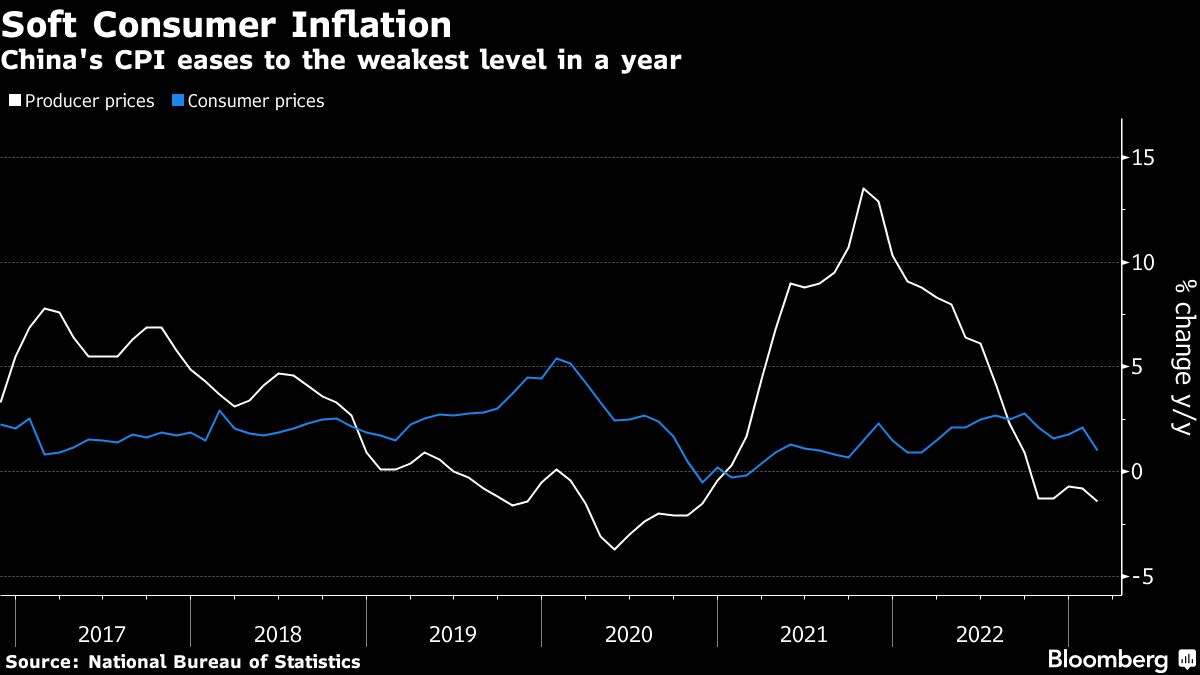
(Bloomberg) — China’s consumer inflation slowed sharply in February as economic activity let up following the end of Lunar New Year, while factory prices continued to decline.
The consumer price index rose 1% last month from a year earlier, the National Bureau of Statistics said Thursday, down from 2.1% in January and well below the median estimate of 1.9% in a Bloomberg survey of economists.
Core inflation, which doesn’t include volatile food and energy prices, ease to 0.6% from 1%.
Producer prices dropped 1.4% last month, following a 0.8% fall in January.
Economists surveyed by Bloomberg had expected a 1.3% decline.
Chinese authorities expect consumer inflation to remain mild this year compared to other economies that reopened after the pandemic and saw skyrocketing prices. The National Development and Reform Commission has said they’re confident CPI will stay within the target of “around 3%” this year.
“Inflationary pressures are generally controllable,” Liu Guoqiang, vice governor of the central bank, said at a press conference last week.
He added, though, that it’s still necessary to “remain vigilant against inflation” given the unpredictability of external factors.
Muted inflation would also leave the People’s Bank of China some room to ease monetary policy to support the economy’s recovery — though the governor has so far suggested interest rates are appropriate.
The rebound has progressed rapidly, with demand for services jumping and home sales showing some signs of stabilization.
China’s central bank Governor Yi Gang on Friday said that inflation would remain under control.
Factory prices, meanwhile, are expected to remain muted, given last year’s high base of comparison. A push by the central government to boost investment, along with the housing market recovery, may led to rising demand for industrial products, though.
More stories like this are available on bloomberg.com
©2023 Bloomberg L.
P.