
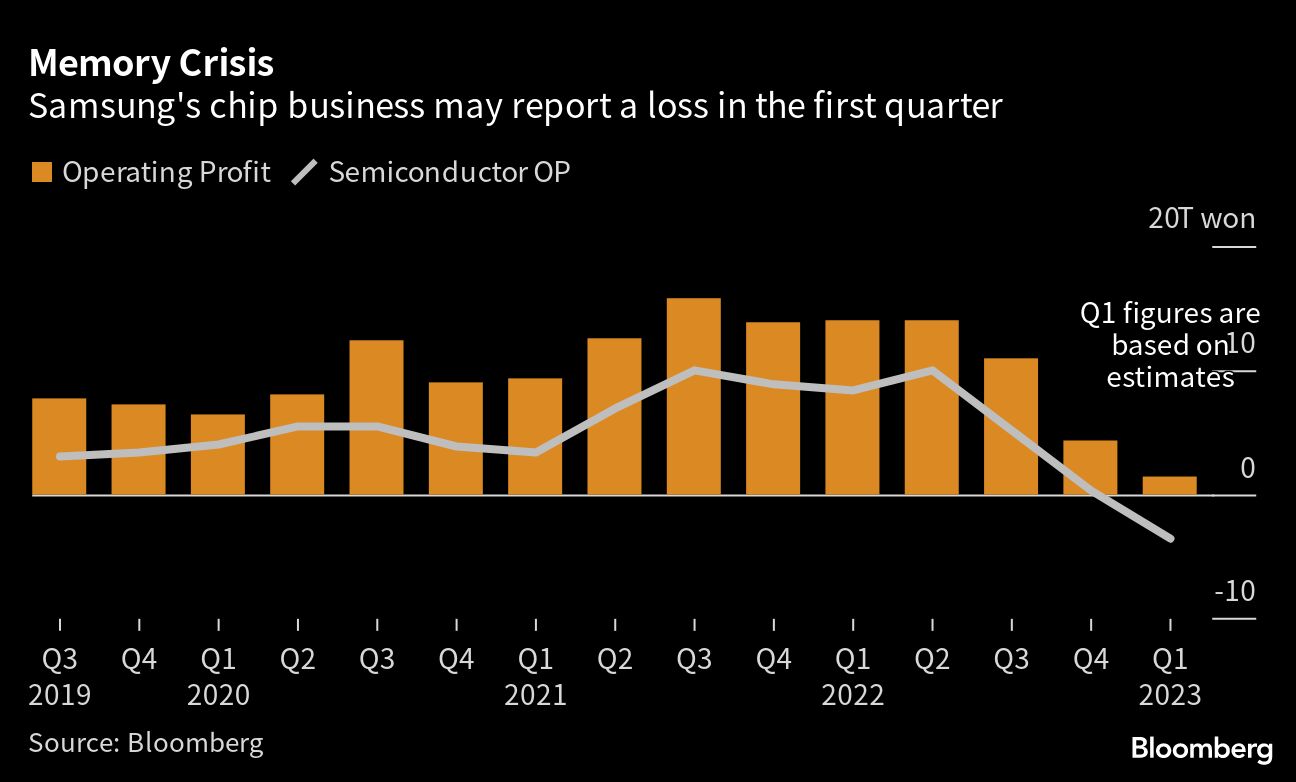
(Bloomberg) — Samsung Electronics Co. reported its slimmest profit since the 2009 global financial crisis and said it would cut memory chip production, a significant step for the industry after oversupply caused prices to crater.
Operating profit plunged more than 90% to 600 billion won ($450 million) for the three months ended March, missing the average analyst estimate of 1.45 trillion won.
Sales fell to 63 trillion won. Samsung plans to provide a full financial statement with net income and information on divisional performance later this month.
South Korea’s largest company warned that earnings would fall in the first quarter on slowing sales. But memory prices tumbled more than anticipated because of sluggish demand for everything from smartphones to PCs, as consumers and companies navigated recession risks.
Despite its post-Covid re-opening, China’s market has also not bounced back as quickly as some anticipated.
Inventory at Samsung swelled to 52.2 trillion won at the end of last year after the company maintained production despite a collapse in demand. In contrast, rivals SK Hynix Inc. and Micron Technology Inc. cut output to deal with historic stores of chips.
“Despite the slowdown in the industry, Samsung has been relatively conservative in investment reduction and production cuts,” said Doh Hyun-woo, an analyst at NH Investment & Securities. “This has resulted in a bigger profit slowdown than its peers, despite its industry-leading manufacturing capabilities.
We estimate the foundry business was also in the red.”
Samsung, the largest player in the $160 billion memory chip market, is estimated to have lost about $3 billion in its semiconductor division.
The Covid pandemic whipsawed the semiconductor industry, leaving many of the biggest players struggling to keep up with market changes. Demand soared as consumers locked down at home bought new computers and smartphones.
The trend quickly reversed as restrictions lifted and the global economy suffered economic shocks from rising inflation, surging interest rates and the war in Ukraine.
Prices of DRAM – a type of memory used to process data – are expected to fall in the current quarter by around 10%, according to Baik Gilhyun, an analyst at Yuanta Securities Co. That follows a roughly 20% slide in the previous three months and a more than 30% drop in the fourth quarter of last year.
Micron, the largest US maker of memory chips, has said customer inventories are getting better, and predicted gradual improvements to the supply-demand balance.
Hynix executives have said production cuts by memory suppliers should take effect in the second half and help prop up prices. But the two Samsung rivals underscored the pace of the recovery will hinge on peers’ efforts to cut supply.
The South Korean giant had resisted pulling back on capital spending and production until now. The company historically has opted not to slow down during difficult times so that it can take share from rivals.
It’s spending hundreds of billions of dollars to build the world’s largest chip complex in its home country, and is building a new facility in the US too. The South Korean and US governments are both offering financial incentives to bolster their domestic industries.
What Bloomberg Intelligence Says
Memory-chip prices could have dropped significantly in 1Q, which might have caused an inventory valuation loss.
The firm’s TV and home-appliance profit could have been sluggish due to weak end-demand caused by inflation. OLED display sales and profit in 1Q might have dropped due to lower output for the iPhone 14. Mobile-segment sales could have been solid due to the new Galaxy S23.
– Masahiro Wakasugi, BI analyst
Click here for the full research
It’s unclear how the US-China conflict over semiconductors might affect the industry in coming years.
Last week, Beijing launched a security review of chips from Micron, spurring concerns the Chinese government is taking a more aggressive line toward American companies.
More stories like this are available on bloomberg.com
©2023 Bloomberg L. P.