
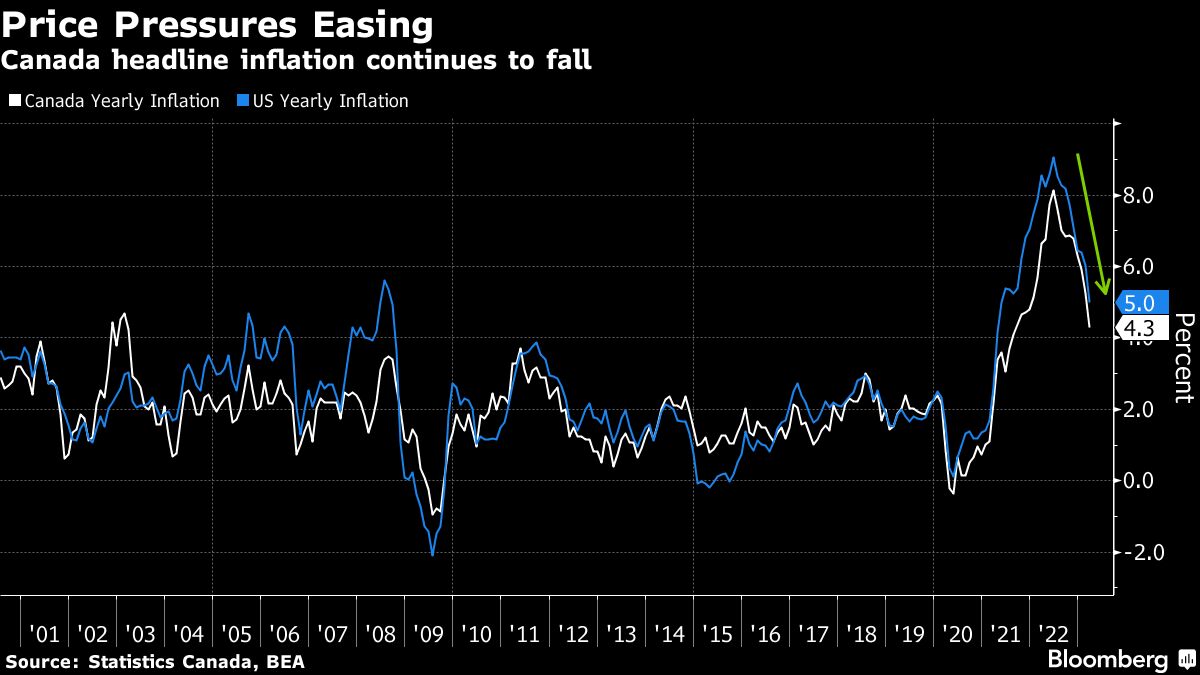
(Bloomberg) — Inflation drifted lower to the slowest pace in nearly two years, a reprieve for the Bank of Canada amid a jobs market and economy that continue to defy expectations for a stall.
The consumer price index rose 4.3% in March from a year ago, the lowest headline number since August 2021, Statistics Canada reported Tuesday in Ottawa. That matched expectations in a Bloomberg survey of economists and was down from 5.2% in February.
On a monthly basis, the index rose 0.5% in March, also matching economist expectations.
Bonds and the loonie were little changed after the release.
Two key yearly measures tracked closely by the central bank — the so-called trim and median core rates — also dropped, averaging 4.5%, in line with forecasts.
A three-month moving average of the measures that policymakers have flagged as key to their thinking fell to an annualized pace of 3.43%, from 3.54% previously, according to Bloomberg calculations.
The figures reaffirm inflation in Canada is slowing sharply this year, supporting the Bank of Canada’s decision to pause its tightening campaign even as the economy proves largely resilient after rapid increases to borrowing costs.
Last week, Governor Tiff Macklem and his officials left interest rates unchanged at 4.5% for the second straight meeting, saying recent data is reinforcing its confidence that inflation will continue to slow.
Policymakers expect consumer price gains will slow to 3% around midyear and return to near their 2% target by the end of 2024. But they said getting the prices all the way back to 2% could prove more difficult because inflation expectations are coming down slowly, and service prices and wage growth remain elevated.
Service inflation slowed to 5.1% in March.
But in a sign wage pressures could be picking up, more than 155,000 federal workers are set to go on strike starting Wednesday if no deal is reached on their talks with Prime Minister Justin Trudeau’s government by Tuesday night.
To be sure, the Bank of Canada’s core measures ticked up on the month, a potential sign of stickiness.
While much of the headline decline in March is coming from lower energy prices and favorable base-year effects, both grocery prices and homeowners’ replacement cost increased at a slower pace.
In March, gasoline prices dropped for the second straight month, down 13.8% in the largest yearly decline since July 2020.
Price growth for durable goods also slowed, with furniture prices leading the deceleration largely on base-year effects.
Homeowners’ replacement cost continued to slow, rising 1.7% from a year ago. In contrast, mortgage interest costs rose at a faster rate, jumping 26.4% — the largest yearly increase on record as Canadians continued to renew and initiate loans at higher interest rates.
Prices for food purchased from stores rose 9.7%, down from 10.6% in February, due to lower prices for fresh fruits and vegetables.
In every province, prices rose at a slower pace in March compared with February.
Price growth slowed the most in Atlantic Canada as a result of lower prices for energy sources used to heat homes in the region.
–With assistance from Erik Hertzberg.
(Updates with market reaction and chart.)
More stories like this are available on bloomberg.com
©2023 Bloomberg L. P.