
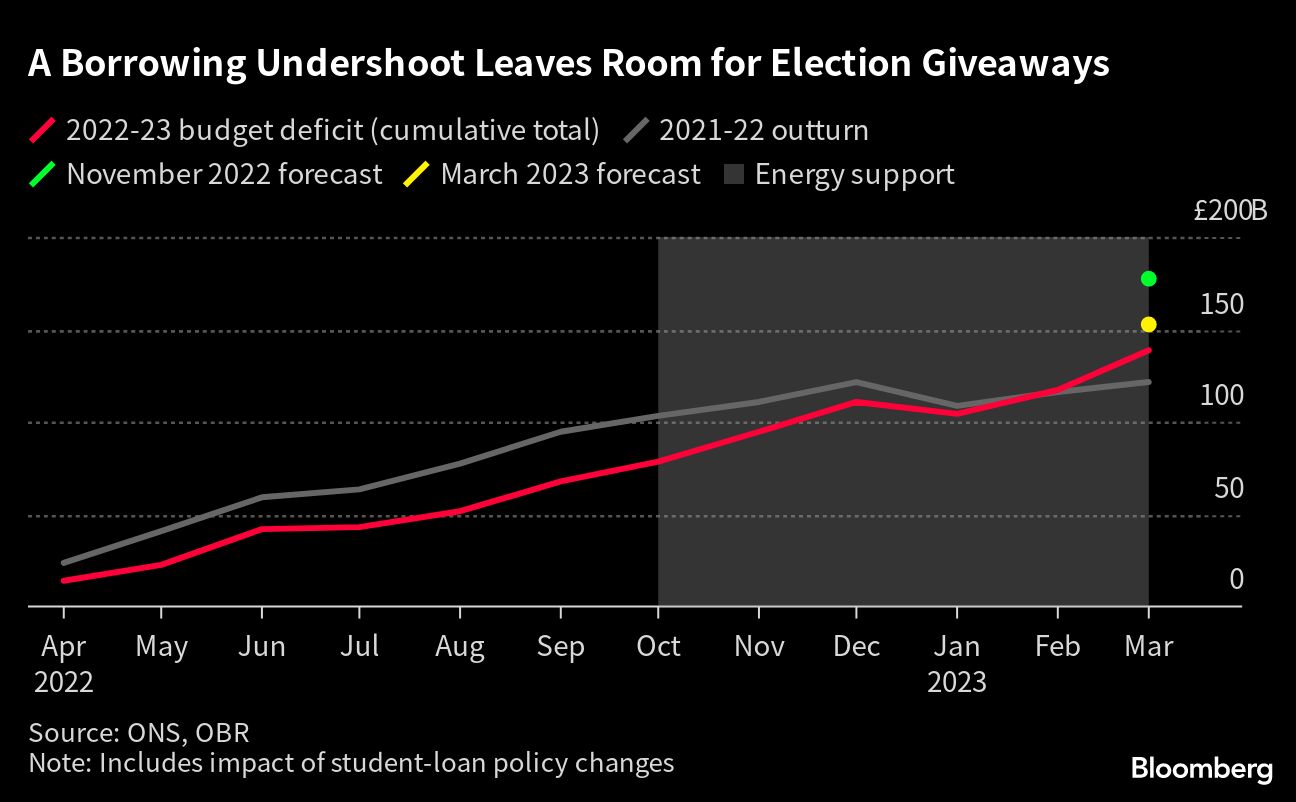
(Bloomberg) — UK government borrowing came in £13.2 billion ($16.5 billion) below official forecasts last fiscal year, leaving Chancellor of the Exchequer Jeremy Hunt modest room for giveaways ahead of the next general election.
Despite another month of huge subsides for energy bills in March, buoyant tax revenue left the budget deficit for 2022-23 as a whole at £139.2 billion, the Office for National Statistics said Tuesday.
That’s higher than in 2021-22 but less than the £152.4 billion forecast by the Office for Budget Responsibility last month.
For March alone, borrowing was £21.5 billion, the second highest for the month on record but in step with economists’ expectations.
The undershoot provides the second fiscal boost for Hunt in recent days after credit-rating agency Standard & Poor’s on Friday upgraded its outlook for the UK. It raises the prospect of further tax cuts or spending increases as Prime Minister Rishi Sunak tries to revive the Conservatives’ fortunes before a national vote due by January 2025 but likely earlier.
Britain’s ruling Conservative Party is more than 10 percentage points behind the Labour opposition in opinion polls.
The public finances were hit hard by a large spike in debt interest costs and the cost of helping households with their energy bills and other one-off cost of living measures.
Debt interest hit a record £106.6 billion, and the cost of energy support measures reached £41.2 billion.
This included a final £1.9 billion in direct payments to households in March and £6.1 billion under the energy-price cap.
Other cost-of-living payments contributed to an 8.1% increase in welfare benefits over the year, which the government boosted in response to Russian President Vladimir Putin’s decision to choke off natural gas supplies to Europe.
“These numbers reflect the inevitable consequences of borrowing eye-watering sums to help families and businesses through a pandemic and Putin’s energy crisis,” Hunt said in a statement. “We cannot borrow forever.
We now have a clear plan to get debt falling which will reduce the financial pressure we pass onto our children and grandchildren.”
Inflation has also driven up the cost of the servicing the national debt as payments on around a quarter of outstanding government bonds are linked to the Retail Prices Index.
The chancellor was helped by strong tax receipts, which rose 10.5% in the year to £929 billion, helped by strong income, VAT and corporation taxes.
Hunt, who last month handed out £20 billion a year more in business tax cuts and spending to bring people back to work, will find there is no shortage of claims on his additional fiscal headroom.
Public-sector workers are waging the worst strikes in decades to press their demands for inflation-matching pay rises.
Meanwhile, rank-and-file Tories fear a backlash at the election unless Sunak and Hunt cut taxes, which are now at their highest share of the economy since World War II.
But while the outlook for the economy has brightened, risks abound, including the drag from higher interest rates and tighter financial conditions in the wake of recent strains in the global banking sector.
(Updates with details from the report from the fifth paragraph.)
More stories like this are available on bloomberg.com
©2023 Bloomberg L.
P.