
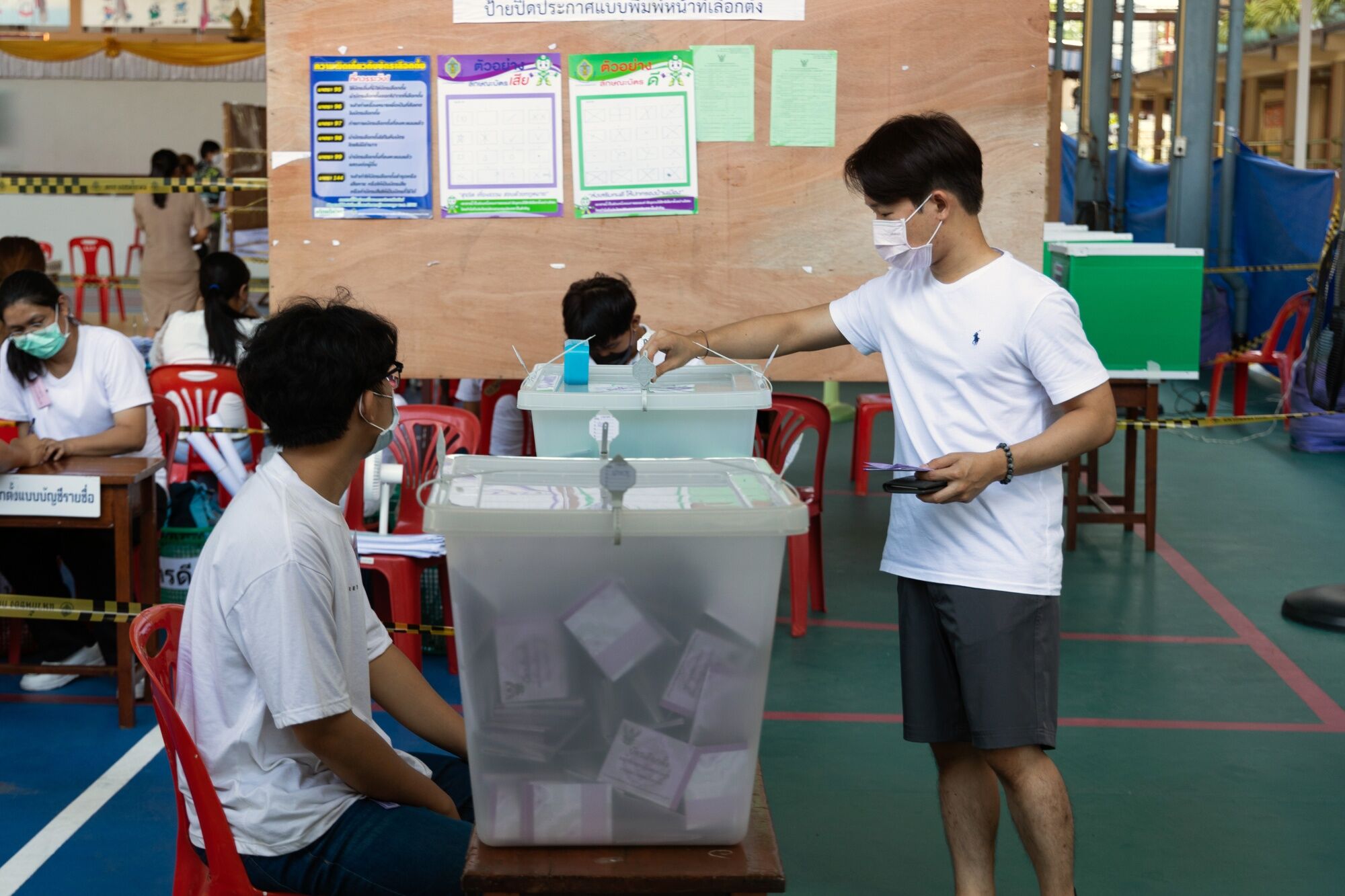
(Bloomberg) — Thailand’s pro-democracy parties scored a resounding victory in Sunday’s election, which augurs well for the country’s equities and currency.
The opposition bloc led by Move Forward and Pheu Thai parties were on course to win more than 280 seats in the 500—member House of Representatives, according to the Election Commission. If they eventually form a coalition government, the parties are expected to follow through with their promises of cash handouts, increase in minimum wages and allowances for pensioners and elderly.
READ: Thai Pro-Democracy Groups Dominate Vote in Rebuke of Military
While uncertainty remains over the formation of a new government, advances by the opposition should give assets in the Southeast Asian nation a short-term boost, analysts said.
Shares related to tourism, retailers and consumption may rally as cash handouts will likely bolster demand amid the economy’s fragile recovery. The baht is up 0.7% against the dollar to 33.75, as the Thai currency extends gains during the Asian session, with investors digesting the results of the election.
READ: Thai Election Outcome Expected to Boost Retail, Tourism Sectors
Here is what analysts and money managers have to say:
Varorith Chirachon, executive director at SCB Asset Management Co.
“Thai stocks will have a short-term rally on optimism about the opposition parties’ formation of a new government.
This block has pledged much more fiscal stimulus than the existing coalition. High wages and cash payouts would spur more domestic consumption and economic growth.
There is some political risk in case Move Forward party fails to lead the new coalition government. The party received most votes and seats. If it is forced out of the new government, there would be a concern about some protests.
That may create some political instability. So investors are closely watching the political development over the next few weeks.
Sectors that would benefit from this will be related to domestic consumption. Consumers will have more money to spend with new payouts.”
Sunthorn Thongthip, strategist at Kasikorn Securities
“I do believe the SET Index will rise after election. Domestic plays would outperform and the foreign flows will return to Thailand on a clear growth outlook vs developed markets.
The SET Index on average increases by 6% a month after the election date on ‘strong government’ scenario and is mixed on a ‘coalition government.’
Finance, property, banking, ICT, commerce, media, and F&B were the key outperformers after Pheu Thai’s wins in 2001 and 2011.
Downside risk for the market is a delay in the formation of a new government as it could delay 2024 budget disbursement and derail investors’ confidence because of the political vacuum that would be created.”
Win Udomrachtavanich, chairman at Daol Securities (Thailand) Pcl
“The fluid part is we need to see if Pheu Thai party is getting along with Move Forward party.
Foreign investors are likely to pause until they see a potential government forming first.”
Nuttachart Mekmasin, strategist at Trinity Securities
“The SET is likely to react in positive tone to some expectations that the two pro-democracy parties will form a coalition government. However, after one week, which is normally the very last period of historical ‘election rally,’ I expect Thai market to enter an overhang mode.
The same would apply to the domestic political situation. The key reason is that the current seats of the two parties are not enough to secure a PM vote due in the next two months. Therefore, during this waiting time, I expect some profit taking in the market.
Our recommendation is that investors who bought stocks at the beginning of May should look for profit taking opportunity during this week, especially if the index goes up in response to the poll result.
Don’t forget that there will be an event risk waiting at the end of May such as domestic rate hike and US debt ceiling crisis.”
Khoon Goh, head of Asia research at Australia & New Zealand Banking Group Ltd.
“There is greater clarity now that the election is out of the way. This should favor Thai assets, which had been under some pressure last week in the lead-up to the election.
There is a tendency for the Thai baht to strengthen in the weeks following an election. Should history repeat, we can expect USD/THB to head lower and potentially test support at the 33.5 level.”
Alvin Tan, head of Asia FX strategy at RBC Capital Markets
“Any THB gains on the election results are premature. A coalition government is still required. As such, the full outcome is unlikely to be known for weeks.”
Alan Lau, strategist at Malayan Banking Bhd
“The election would have a limited overall impact on the THB as tourism is unlikely to be heavily disrupted no matter the outcome.
Some knee jerk reactions from the market may occur but they shouldn’t hold and the currency should still as a whole be driven by other factors such as the broad USD performance, China’s recovery and the level of tourism inflows.”
Galvin Chia, strategist at Natwest Markets
“The election results are so far looking in favor of the opposition parties. Markets were calm and leaning optimistic in the lead-up to the elections, which suggested to me little risk premia being priced in.
A smooth transition of power would of course be positive, but I’m watchful in the coming days and weeks for any potential hiccups along the way.
Signs of political conflict or greater uncertainty around who gets into office could price more risk premium into THB. I would expect THB to otherwise be another regional macro trade that focuses on the likes of tourism flows, portfolio flows, and the economic recovery.”
More stories like this are available on bloomberg.com
©2023 Bloomberg L.
P.