
(Bloomberg) — Australia’s central bank Governor Philip Lowe is likely to see the faster wage growth he’s spent much of his six years at the helm rooting for in an economy that’s weathering its hottest inflation in three decades.
Economists predict government data Wednesday will show the Wage Price Index advanced 3% in the third quarter from a year earlier, the fastest pace since the first three months of 2013.
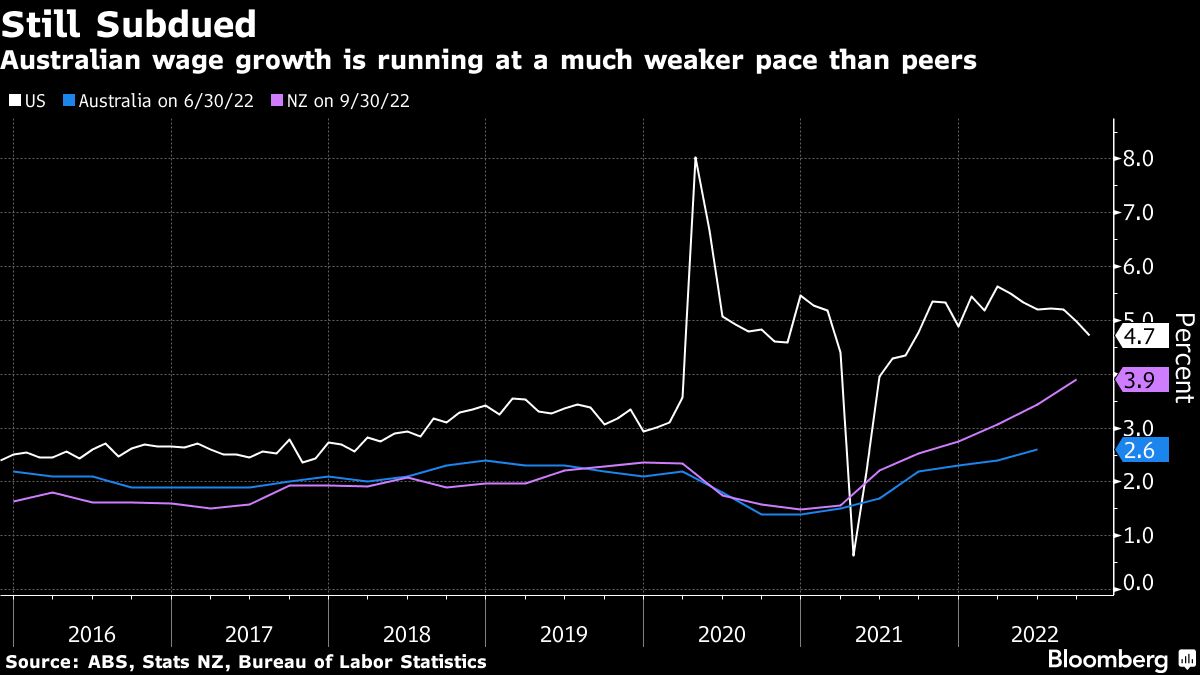
In the current environment of rapid price gains, that level of wage growth is still relatively contained compared with other economies from Washington to Wellington.
The Reserve Bank has also said wage increases remain consistent with a return of inflation to its 2-3% target from a forecast peak of 8% this year.
Still, that situation is at risk of changing as workers trying to cope with the rising cost of living demand compensation via sharp pay increases, giving a further leg up to inflation.
Despite its central case that wages growth will remain moderate, the RBA reiterated the need to avoid “a price-wage spiral” in minutes of its Nov. 1 policy meeting released Tuesday.
The bank said it will pay close attention to the evolution of price-setting at firms and labor costs.
“What the RBA doesn’t want to see is wages running north of 3.5%-3.75% because then you’ve got to engineer an increase in unemployment to drop the rate of wages growth,” said Gareth Aird at Commonwealth Bank of Australia. “That’s the place that the US is in at the moment, where wages growth is just too strong.”
Australia’s jobless rate is hovering near a 50-year low, highlighting the tight labor market underpinning wages.
Jobs data out Thursday is forecast to show employment rose by 15,000 in October and unemployment held at 3.5%, outcomes that would point to ongoing firmness in the market and the possibility of wage gains continuing to strengthen.
Still, some economists say employment has peaked with the economy adding only 500 positions in the past three reports.
For its part, the RBA sees the risk to the economy from large rate hikes hitting the housing market and indebted households as greater than the danger of accelerating wages fueling inflation.
The bank is also welcoming bigger pay rises in the short-term after so many years of scant increases.
That’s why Lowe has opted to downshift to quarter percentage-point interest-rate increases and officials have started highlighting potential for a pause. The cash rate was raised to 2.85% this month from a record-low 0.1% in May when the cycle began.
Moves by the new Labor government are another factor the RBA needs to keep an eye on.
Prime Minister Anthony Albanese has been taking some heat as real wages fall.
Wednesday’s wages data will likely be buttressed by a 5.2% increase in the minimum wage. Salaries may also get structural support from government legislation currently before parliament that would allow the industrial umpire to step in when talks between workers and firms break down, and push for an expansion of multi-employer bargaining.
“The longer the labor market stays incredibly tight and you’ve got really elevated job vacancies then it’s possible wages growth ends up accelerating and you get this circularity where wages expectations have gone up and that keeps inflation elevated,” said Aird, head of Australian economics at CBA. “That’s what we think is a risk to the outlook, but it’s not our base case.”
–With assistance from Tomoko Sato, Swati Pandey and Garfield Reynolds.
More stories like this are available on bloomberg.com
©2022 Bloomberg L.
P.