
(Bloomberg) — Australia’s jobless rate unexpectedly fell in October as a surge in full-time employment underpinned strong hiring, reinforcing the Reserve Bank’s arguments for further interest-rate increases.
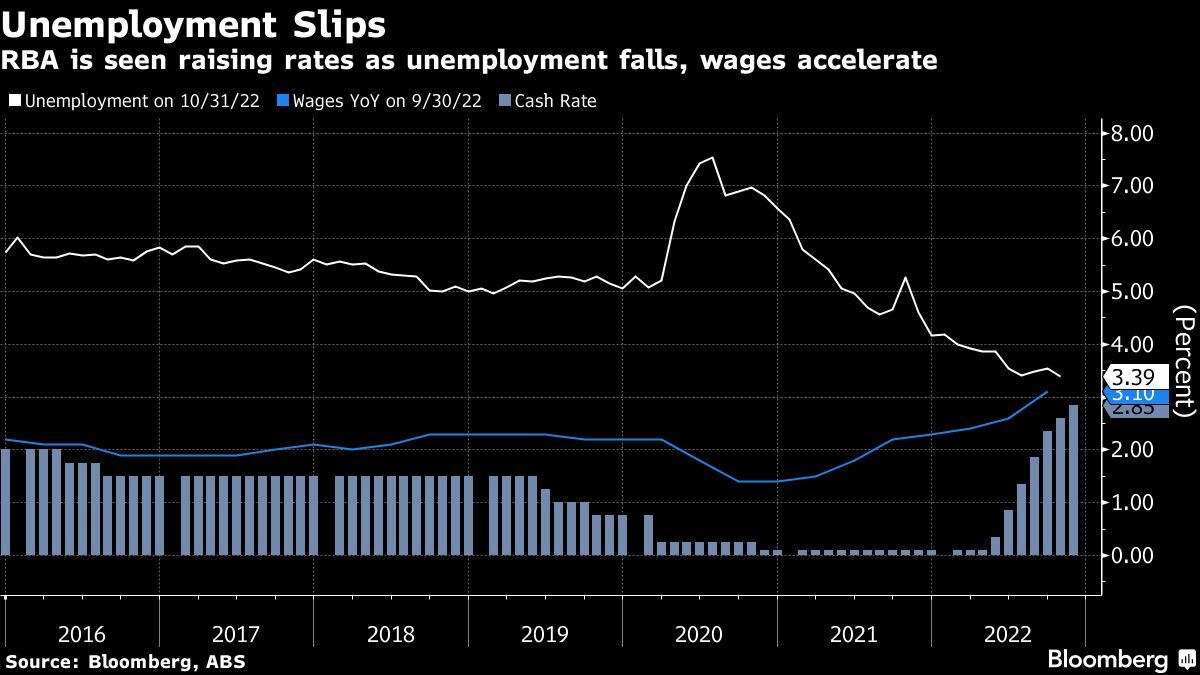
The unemployment rate slid to 3.4% — the lowest level since 1974 — from 3.5% a month earlier, data showed Thursday. Employment advanced by 32,200 people in October, more than double the forecast 15,000 increase.
The figures, together with a solid wage report Wednesday, support the RBA’s rapid policy tightening as it tries to rein in the fastest inflation in more than three decades.
Labor market strength is a key reason the central bank reckons it can engineer a soft landing in the A$2.2 trillion ($1.5 trillion) economy while hiking.
Australian shorter-end government bond yields edged up after the release while the currency was little changed as the data did little to shift expectations for another quarter-percentage point hike in December to take the cash rate to 3.1%.
The report “confirms that the labor market remains incredibly tight, which will add to wages pressures over the coming months,” said Josh Williamson, an economists at Citigroup Inc.
He now sees “hawkish risks where the RBA could continue to hike rates beyond 3.35% in 2023.”
Data Wednesday showed the tight labor market is finally generating wage pressures as pay gains jumped to 3.1%, the fastest pace in almost a decade. The RBA expects the rises to accelerate to 3.9% by December-2023 with unemployment seen holding in a 3.4%-3.5% range until mid-next year.
“The labor market strength also is flowing through to wages,” said Singapore-based Shreya Sodhani, economist at Barclays Bank Plc. “We think a pause in December is less likely especially with the strong labor and wage reports.”
Today’s report also showed:
- Underemployment fell 0.1 percentage point to 5.9% and underutilization fell 0.2 points to 9.3%
- Full-time roles climbed by 47,100, while part-time positions fell by 14,900
- Monthly hours worked increased by 2.3%
- Employment to population ratio rose 0.1 percentage point to 64.3%
- Female unemployment remained steady at 3.6%, while male unemployment fell 0.3 percentage point to 3.2%, the lowest rate since November 1974
–With assistance from Tomoko Sato.
(Adds economists’ comments.)
More stories like this are available on bloomberg.com
©2022 Bloomberg L.
P.