
(Bloomberg) — The peak of Beijing’s new coronavirus outbreak has already passed and further infections should be “sporadic,” the country’s chief epidemiologist said. Israel will pause any further reopening of the economy after a rise in cases, while Japan is set to lift domestic travel curbs on Friday.
German Chancellor Angela Merkel called for a swift deal to pull the European Union out of its worst recession since World War II.
Sweden raised its economic outlook following a softer lockdown, while the Bank of England intensified its response to the virus by expanding its bond-buying program.
The World Health Organization hopes two billion doses of effective vaccines will be available by the end of 2021, Chief Scientist Soumya Swaminathan said on Thursday. The organization halted tests of hydroxychloroquine in a trial of potential Covid-19 treatments.
Key Developments:
- Virus Tracker: Global cases top 8.3 million; deaths exceed 449,000
- U.
S. meat plants are deadly as ever, with no incentive to change
- Russia isolates war veterans to protect Putin from Covid-19
- Pandemic could erase more global wealth than the financial crisis
- Welcome to Covid-era Irish pubs: please drink swiftly and Eat
- Screening apps and 41-day vacations keep miners Covid-free
- Colorful and emotional maps from a world changed by coronavirus
Subscribe to a daily update on the virus from Bloomberg’s Prognosis team here.
Click VRUS on the terminal for news and data on the coronavirus.
Israel Halts Reopening (6:32 a.m. NY)
Israeli Prime Minister Benjamin Netanyahu said he will put any further reopening of the country’s economy on pause after a rise in the number of Covid-19 cases. After imposing a near-total shutdown from mid-March, Israel has reopened segments of its economy since late April. There have been almost 20,000 confirmed cases in Israel, with more than 300 deaths.
Denmark Opens Border to Some EU Countries (6:17 a.m.
NY)
Denmark will allow entry to citizens from European Union countries, including the U. K., which have less than 20 confirmed cases of Covid-19 per 100,000 inhabitants from the end of June. Denmark is already welcoming tourists from Norway, Germany and Iceland while Portugal and neighboring Sweden were left out of the updated government guidelines.
Top Chinese Expert Sees Beijing Outbreak Contained (5:02 p.m.
HK)
A coronavirus outbreak in Beijing that has swelled to more than 150 cases has been contained, said Wu Zunyou, the senior epidemiology expert at Chinese Center for Disease Control and Prevention. More cases will be confirmed in the coming days, but that should reflect only people who are already infected, Wu said.
The government is offering coronavirus vaccines under development to employees at state-owned companies in Beijing, extending an earlier offer of shots for workers traveling overseas.
Sweden Raises Economic Forecast as Recovery Picks Up (4:24 p.m.
HK)
Sweden has raised its forecast for the economy amid signs of a recovery following the country’s softer lockdown approach. Finance Minister Magdalena Andersson now expects GDP to contract by 6% this year compared to a previous forecast of about 7%.
Merkel Calls for Agreement on EU Fund Before Summer Break (3:55 p.m. HK)
German Chancellor Angela Merkel wants a swift deal to pull the European Union out of the worst recession since World War II, urging the bloc’s leaders to show solidarity to fight the coronavirus crisis.
No Rallies for Singapore Elections (2:11 p.m.
HK)
With polls expected to be held soon, campaigning in the country has been altered to curb any virus spread: No physical rallies, refrain from shaking voters’ hands, no gatherings on polling night and no more than five people in a group when candidates canvass support on the ground.
Sanofi Sees Vaccine Ready Next Year (1:41 p.m. HK)
CEO Paul Hudson said in a Les Echos interview that Sanofi’s vaccine could be ready in April-May 2021.
A vaccine should “be affordable and anyone who needs should be able to access it,” he said.
German Infection Rate Lowest in Seven Days (1:19 p.m. HK)
Germany’s coronavirus infection rate fell to 0.86 on Wednesday, the lowest in a week, according to the latest daily report by the Robert Koch Institute. The government is trying to keep the figure below 1.0 to prevent a second wave of infections.
There were 352 new infections in the 24 hours through Thursday morning, bringing the total to 188,604 according to data from Johns Hopkins University.
That compares with 570 the previous day and almost 7,000 at the peak of the pandemic in late March. Fatalities increased by 31 to 8,851.
China Pledges Faster Credit Growth (12:53 p.m. HK)
China’s central bank wants the total flow of credit to rise by almost a fifth this year, as part of efforts to push the economy out of the coronavirus-induced slump.
That’s to be achieved through record special-purpose bond issuance as well as a 19% increase in bank loans, according to People’s Bank of China Governor Yi Gang.
In all, total social financing flow should rise to at least 30 trillion yuan ($4.2 trillion) this year, Yi said during a speech in Shanghai Thursday.
Japan Tourism Numbers to Plunge (12:46 p.m. HK)
Fewer than five million tourists could end up visiting Japan in 2020 as the government’s goal of welcoming 40 million visitors meets the reality of the coronavirus pandemic, according to SMBC Nikko Securities economist Koya Miyamae, who warns of a longer-term economic impact.
The number of visitors to Japan tanked last month to 1,700, according to data from the Japan National Tourism Organization Wednesday.
That was a new low in records that go back to 1964, as the pandemic largely shut down the country’s borders. So far only 3.9 million visitors have arrived in Japan this year.
Wealth Destruction (12:42 p.m. HK)
The rich are still getting richer, but the coronavirus crisis may slow the breakneck pace of wealth accumulation for years to come.
Volatile markets and the economic fallout from the virus could wipe out as much as $16 trillion of global wealth this year and hinder growth for the next five years, according to a study by Boston Consulting Group.
By comparison, the 2008 financial crisis erased $10 trillion.
India’s Outlook Cut (12:23 p.m. HK)
India’s credit rating outlook was cut to negative from stable by Fitch Ratings Ltd., citing the economy’s weakening growth outlook and increased challenges with public debt levels. Fitch cited challenges associated with a high public-debt burden for the move, while affirming the nation’s foreign issuer rating at BBB-, the lowest investment grade score.
Fitch expects India’s economic activity to contract by 5% in the fiscal year ending March 2021 on account of the strict lockdown measures imposed to contain Covid-19.
Beijing Tightens Outbound Travel (12:06 p.m.
HK)
The city tightened outbound travel and this doesn’t mean that Beijing is sealed off, Pan Xuhong, vice head of the city’s public security bureau, said at a briefing. The city, however, barred some people from leaving, especially those who are confirmed of coronavirus infection, people who had close contact with infected ones, asymptomatic patients and those with fever.
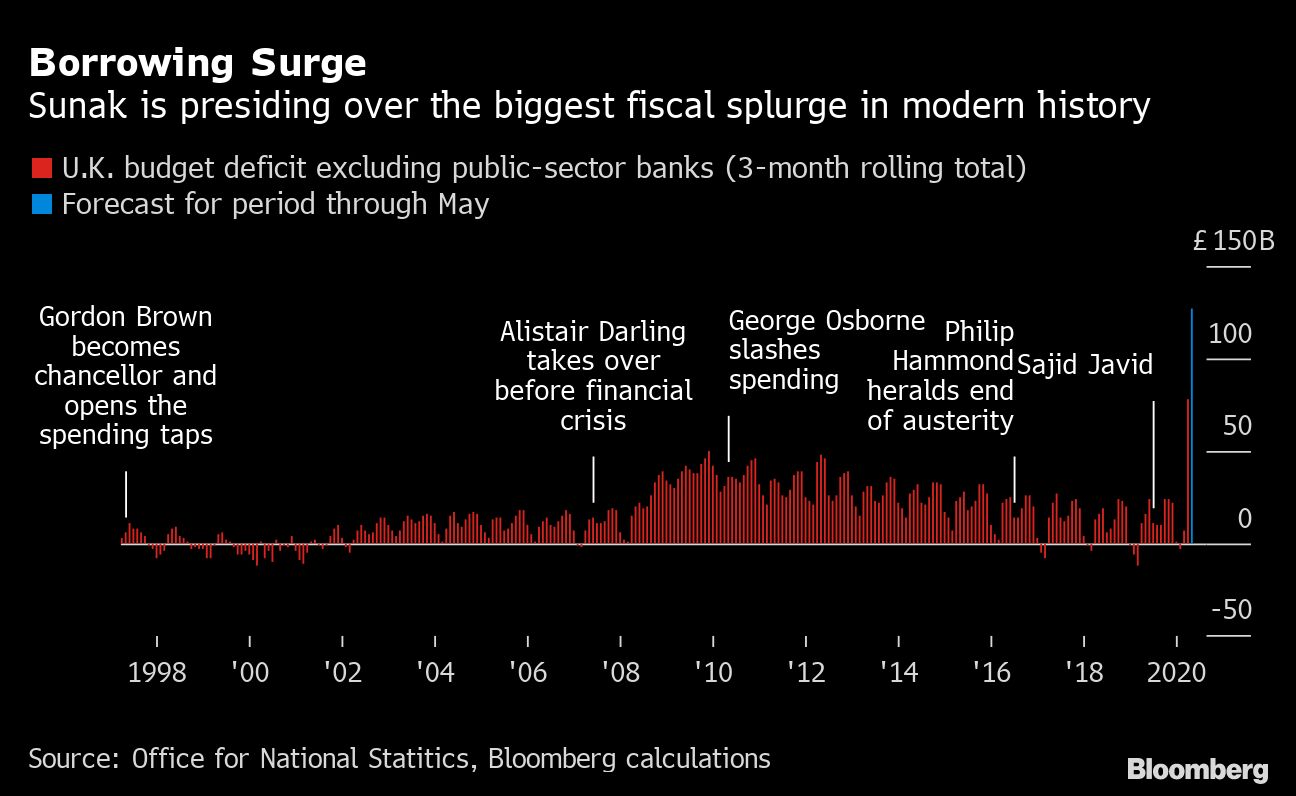
Sunak’s Borrowing Spree (12:01 p.m.
HK)
Rishi Sunak, Britain’s finance minister for just four months, has presided over a borrowing surge that appears set to dwarf the record posted during the financial crisis.
Figures due Friday are forecast to show the budget deficit jumped about 50 billion pounds ($63 billion) in May as the government continued its extraordinary interventions to support the economy through the coronavirus pandemic.
That would take the total for Sunak’s first full three months to well in excess of 125 billion pounds.
Pompeo Pledges Full Transparency (11:05 a.m. HK)
U. S. Secretary of State Michael Pompeo stressed the need for full transparency and information-sharing during the global Covid-19 pandemic and future outbreaks as he met his Chinese counterpart, Yang Jiechi.
Coronavirus Will Fade Away, Trump Says (10:42 a.m.
HK)
The coronavirus pandemic will “fade away” even without a vaccine, but researchers are close to developing one anyhow, Trump said.
“We’re very close to a vaccine and we’re very close to therapeutics, really good therapeutics,” Trump said Wednesday night in a television interview with Fox News. “But even without that, I don’t even like to talk about that, because it’s fading away, it’s going to fade away, but having a vaccine would be really nice and that’s going to happen.”
Trump also told Fox news that “China should have kept it where it was,” referring to Covid-19. “They could have easily stopped it.”
Japan to Lift Domestic Travel Curbs (9:53 a.m.
HK)
The Japanese government will lift all domestic travel restrictions Friday as it looks to move into the next phase of reopening, including a restart of events and nightlife.
The new guidelines, which will no longer discourage the movement of people between prefectures, are expected to be announced by Prime Minister Shinzo Abe Thursday evening. Professional sporting events without spectators, as well as indoor events of as many as 1,000 people at 50% capacity, will also be allowed.
The scale of indoor events is expected to be expanded July 10.
Australian Employment Declines (9:41 a.m. HK)
Australian unemployment surged in May and another swathe of jobs were lost as ongoing restrictions to stem the spread of the coronavirus kept large parts of the economy shuttered.
The jobless rate advanced to 7.1% from a revised 6.4% in April vs economists’ median estimate of 6.9%, data from the statistics bureau showed in Sydney Thursday.
Employment plunged by 227,700 in May after falling an upwardly revised 607,400 in April. The participation rate fell to 62.9%. Economists had penciled in 63.6%.
Beijing Outbreak Tops 150 (9:32 a.m. HK)
A coronavirus outbreak continued to spread in Beijing, with 21 new cases announced Thursday, presenting the biggest challenge yet in China’s efforts to prevent a second wave of infections.
The total number of infections in China’s capital is now more than 150.
While the daily count of new infections is slowing from previous days, health officials have warned that the outbreak stemming from the city’s largest wholesale fruit and vegetable market is expected to continue growing.
Hewlett Packard Enterprise CEO Tests Positive (8:34 a.m. HK)
Hewlett Packard Enterprise Chief Executive Officer Antonio Neri tested positive for Covid-19.
“Yesterday I tested positive for Covid-19,” Neri, 53 years old, said in a tweet. “The good news is, I feel much better already and plan to proceed with business as usual while I quarantine from home.”
Mexico Has 770 More Deaths (8:15 a.m.
HK)
Mexico reported 4,930 new confirmed Covid-19 cases, bringing the total to 159,793, according to data released by the Health Ministry Wednesday night. As many as 770 people died, taking the total number to 19,080.
Brazil Nods to More Easing (7:49 a.m. HK)
Brazil’s central bank left the door open to more monetary easing after cutting its interest rate to a record low, reflecting fresh doubts the economy would quickly recover from the pandemic.
The central bank on Wednesday cut the benchmark Selic by 75 basis points to 2.25% in the eighth straight reduction.
Policy makers wrote in an accompanying statement that uncertainty about an expected second-half recovery is “larger than usual.”
For more articles like this, please visit us at bloomberg.com
©2020 Bloomberg L. P.