
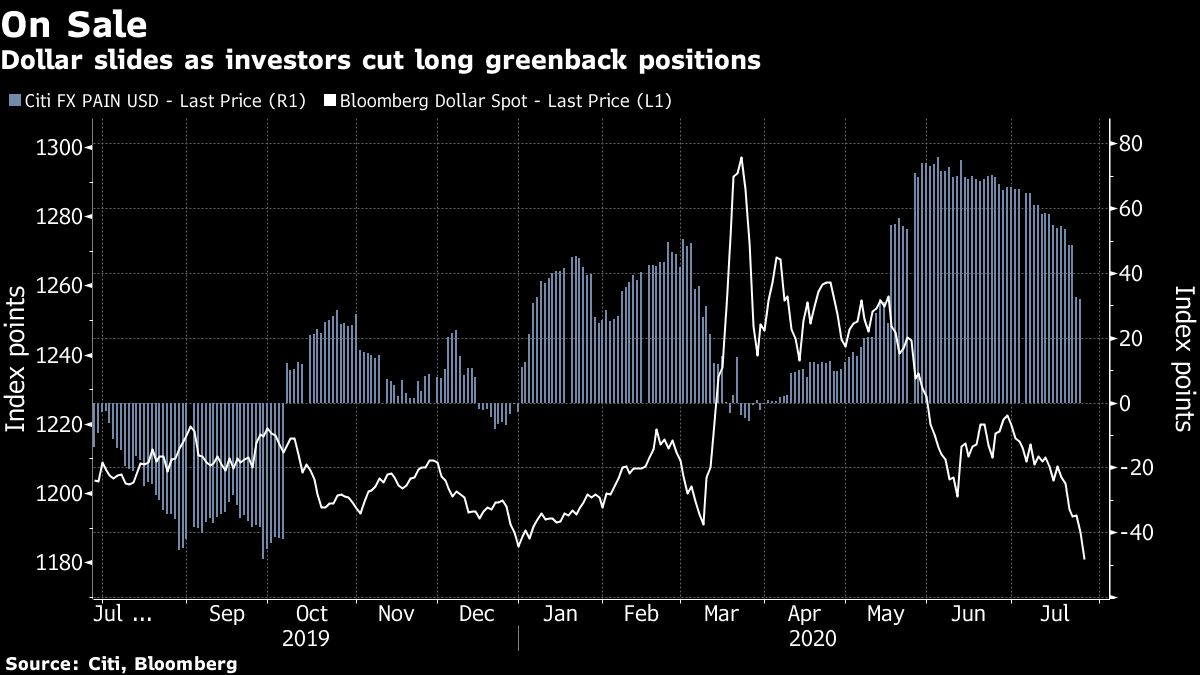
(Bloomberg) — The dollar’s decline is worsening, with money managers positioning for a summer of prolonged weakness.
The Bloomberg Dollar Spot Index slid to near an 18-month low on Monday, extending four weeks of losses. Data from the Commodity Futures Trading Commission show that asset managers are betting on an extended drop as they added to net long positions on the yen, the euro, the Canadian dollar and the Swiss franc.
The reasons for betting against the greenback are many — a worsening row with China, concerns that the U.
S. is struggling to contain the pandemic, the uncertainty of a November presidential election, and growing expectations that the Federal Reserve will have to slash policy rates further.
“The dollar’s strength is well and truly over for now,” said George Boubouras, head of research at hedge fund K2 Asset Management, who is shorting the greenback against the Aussie. “More Fed stimulus is coming as the U.
S. grapples with the virus, and there’s also election uncertainty coming up — all of this will most likely be dollar negative.”
The dollar fell against all its Group-of-10 peers on Monday, with the Japanese yen and Norwegian krone rising 0.6% against the greenback and the Swedish krona gaining 0.7%. The Bloomberg Dollar Spot Index dropped as much as 0.8% to its weakest since February 2019.
A Bloomberg compilation of data on net non-commercial future positions on the dollar against eight peers show the biggest short positions on the greenback since April 2018.
Once the stand-out nation in a world saturated with over $14.7 trillion of negative yielding debt, the U.
S. has seen that edge erode as the coronavirus crisis forced the Fed to slash borrowing costs to near zero and spurred bets of negative interest rates.
Other Havens
The downward pressure on the dollar has pushed investors to look to havens outside of the U. S., sending the spot price of gold rocketing past record heights toward a high of $2,000 an ounce. Silver has also gained from the rally, leaping to its highest in almost seven years.
The euro is another potential candidate for money managers seeking safety.
The currency’s surge past $1.17 to levels not seen since September 2018 could be the beginning stages of a shift toward the euro zone after the union banded together to agree on a historic recovery fund.
Fed Expectations
The benchmark 10-year Treasury yield slipped one basis point to 0.58% on Monday after posting its lowest-ever weekly close the previous session. Traders expect the Fed to signal more accommodation ahead at its July 28-29 meeting, with second-quarter growth expected to show a 35% annual rate decline.
“The dollar should continue making new lows,” said Win Thin, global head of currency strategy at Brown Brothers Harriman, who sees the euro testing September 2018 highs. “The economic underperformance of the U.
S. is likely to feed into continued underperformance of the dollar.”
The weakness has been so pronounced that it’s drawn comments from the likes of billionaire investor Ray Dalio, who says the conflict between the U. S. and China would further harm the dollar.
Yen Strength
As the world’s reserve currency slides, the yen could emerge as a key beneficiary as an alternative haven, market participants say.
A key level to watch will be 105 yen, which has held as a barrier in recent years, according to Rodrigo Catril, currency strategist at National Australia Bank Ltd.
“The USD can’t find any friends at the moment, and within majors EUR and JPY are the ones to watch,” said Catril. “Since 2018, dips below 105 yen have been short lived, but with so much momentum against the USD, it could be different this time with many looking to add to their shorts.”
Some traders may be aiming for a repeat of 2016, when the dollar had dipped below 100 yen, he said.
Fund manager QIC Ltd. sees only one pillar still standing that sets the U.
S. and its currency apart from its peers — demand for big-cap American stocks.
“U. S. exceptionalism has eroded, the Fed is in a mindset of restoring jobs at the moment and it’s going to drive them to provide potentially more policy accommodation,” said portfolio manager Stuart Simmons. “That’s all dollar negative.”
(Updates with other assets from fifth paragraph.)
For more articles like this, please visit us at bloomberg.com
©2020 Bloomberg L.
P.