
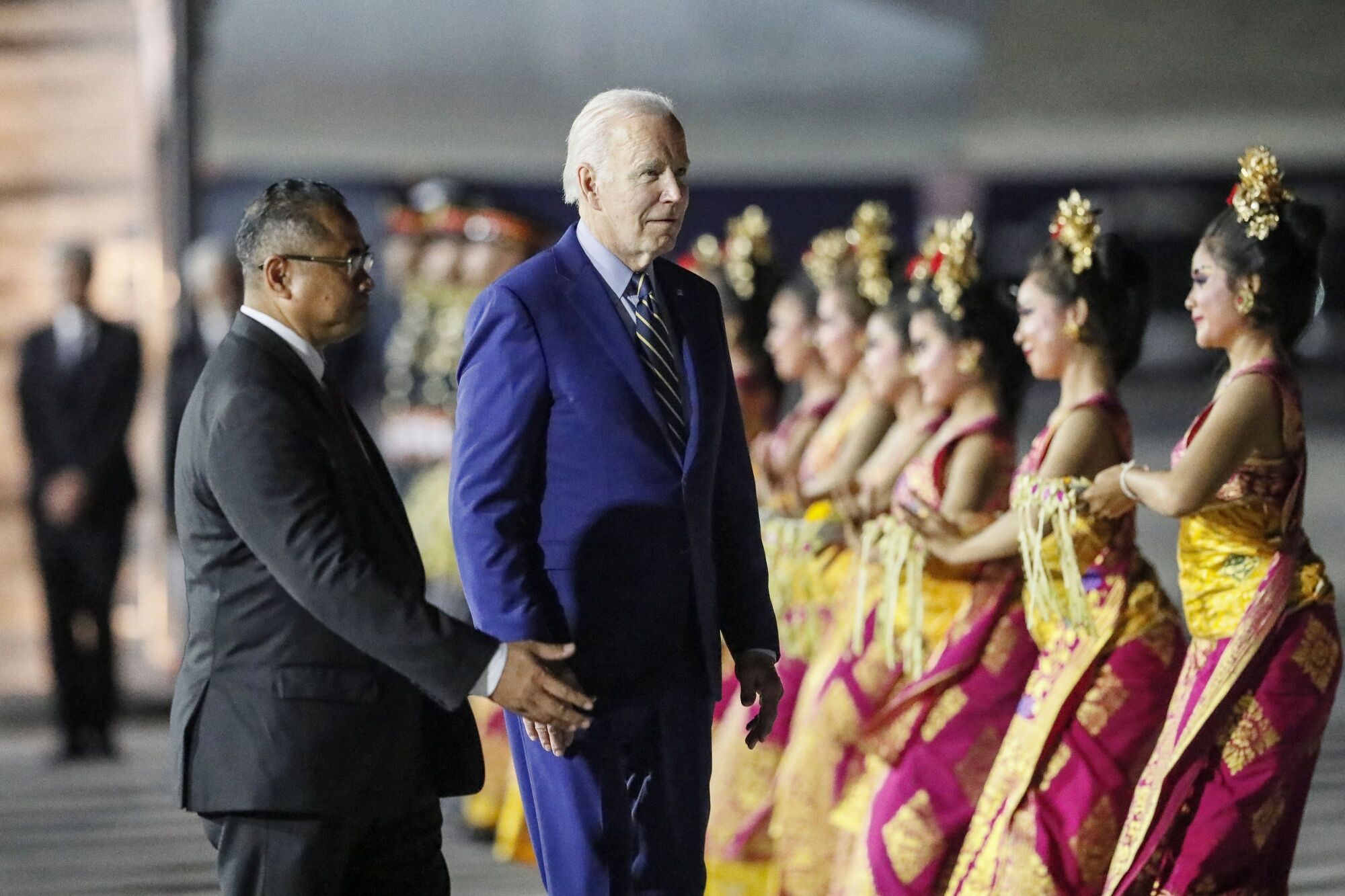
(Bloomberg) — Joe Biden spent the weekend consulting with a series of allies and security partners ahead of his first in-person meeting with Xi Jinping — one of the most closely watched encounters of his presidency.
Meetings with the leaders of Japan, South Korea and Australia on Sunday were preludes for his much-anticipated meeting with the Chinese leader, White House officials said, with the president explaining his approach and seeking out their concerns.
He separately used a summit in Cambodia with the 10-member Association of Southeast Asian Nations to firm up relationships in a region where China is by far the top trading partner.
While US officials declined to spell out any specific outcomes they expect from the Xi meeting, they said he would seek to set guardrails around a relationship that has deteriorated since Biden took office — bringing the two countries perilously close to economic or even military conflict.
American partners wanted to see dialogue as the dominant feature of US efforts to foster stability in the Taiwan Strait, they said.
“We have very little misunderstanding,” Biden told reporters on Sunday in Cambodia. “We’ve just got to figure out where the red lines are and what we — what are the most important things to each of us going into the next two years.”
The meeting is set to begin at 5:30 p.m. local time on Monday in Bali, Indonesia, on the sidelines of the Group of 20 summit.
US officials said negotiations about the meeting’s format went late into the night Sunday, predicting a highly scripted affair. It will take place at Xi’s hotel.
The two presidents are expected to talk for at least a couple hours in a small gathering with some of their senior foreign policy aides. Biden plans to hold a news conference afterward.
Senior Biden administration officials said Monday that relations have warmed somewhat simply by planning for the meeting with their Chinese counterparts, a process that’s taken about a month.
“We feel very good about the coordination and the foundation that we’ve set heading into Bali,” White House National Security Advisor Jake Sullivan told reporters a day before the meeting.
Communications Cutoff
China broke off many routine contacts with the US earlier this year after House Speaker Nancy Pelosi made a visit to Taiwan, and as Biden repeatedly promised the US would defend the self-governed island in the event of a Chinese attack.
Xi himself came under pressure at home to look tough, particularly in the run-up to a twice-a-decade Communist Party meeting in October at which he secured a third time in office — and potentially more.
On top of the sensitivities over Taiwan, the biggest flashpoint between the nations, the US and China have also been divided over Russia’s invasion of Ukraine and US efforts to deny Beijing access to advanced chips that are key to dominanting technologies that will drive growth in the 21st century.
Biden will seek to build a floor under the relationship and increase communication responsibly and practically, US officials said Monday, speaking on condition of anonymity ahead of the meeting.
They framed the meeting as the first serious, in-person US-China diplomacy in years.
Any move to calm tensions would be welcomed in Asia, where many governments saw Pelosi’s visit to Taiwan as an unnecessary provocation. US allies and partners including South Korea, Japan and Taiwan have also failed to fully endorse Biden’s efforts to deny China advanced chip technology — a move Beijing has said was intended to maintain American “hegemony.”
‘Stiff Competition’
In a meeting with Indonesian President Joko Widodo on Monday afternoon ahead of his meeting with Xi, Biden said the two democracies were working together to preserve the “system of international order.”
The president will make clear “that the United States is prepared for stiff competition with China, but does not seek conflict, does not seek confrontation,” Sullivan said.
Xi’s government is in a period of transition and he’s expected to bring along officials who are about to be elevated following the Chinese leader’s move to consolidate his power, the US officials said.
The leaders will be offered simultaneous translation through earpieces, allowing for a quicker-paced conversation, though Biden aides said they expect the tone to be businesslike.
The entire meeting is expected to be conducted with each country’s full team present — the presidents won’t have a more private discussion during the event.
The talks are happening as the US and Europe prepare to impose a cap on the price of Russian oil, in a bid to both limit revenue for the Kremlin’s war machine while keeping the country’s crude on the market. Biden isn’t planning to raise the price cap with Xi, who is Russian President Vladimir Putin’s most important remaining partner, the US officials said.
They said they believe there is some discomfort in Beijing about Russia’s actions and rhetoric, and one official said the US believes China is probably surprised and somewhat embarrassed by the conduct of Russia’s military in Ukraine.
Russian forces have floundered in the invasion while killing or wounding more than 15,000 Ukrainian civilians, including hundreds of children, according to the United Nations — atrocities that much of the rest of the world has declared to be war crimes.
In remarks at one summit in Cambodia that Biden attended, outgoing Chinese Premier Li Keqiang emphasized sovereignty and the irresponsibility of nuclear threats, a US official said.
In a meeting earlier this month with German Chancellor Olaf Scholz, Xi said he opposed the use of nuclear force in Europe, in his most direct remarks yet on the need to keep Russia’s war in Ukraine from escalating.
Biden has teed up the Xi encounter with a series of meetings, statements and speeches plainly aimed at Beijing.
In Cambodia on Sunday, Biden sought input from Japan’s Fumio Kishida and South Korea’s Yoon Suk Yeol on his talks with Xi, US officials said.
The two countries have faced repeated North Korean missile tests in recent weeks, including rockets that flew over Japan.
The US has said that Biden will tell Xi that China has a choice: help reign in North Korea or face an escalated US military presence in the region. One of the US officials said that the three countries are on alert for a North Korean nuclear test and will issue a coordinated response should it happen.
The nature of the response was unspecified.
Biden also met with the prime minister of Australia, Anthony Albanese, another key ally in the region. Earlier, on Saturday, Biden met with Cambodian Prime Minister Hun Sen and expressed US concerns about Chinese activity at a Cambodian naval base.
Meeting with the Association of Southeast Asian Nations at a summit in Cambodia, Biden told them the US seeks to maintain a “rules-based order” and fight “threats to the rule of law,” a nod to China.
The US announced stepped-up efforts to promote maritime security in the region, including combating smuggling and illegal fishing.
“Asean is the heart of my administration’s Indo-Pacific Strategy, and we continue to strengthen our commitment to work in lockstep with an empowered, unified Asean,” Biden said.
Biden enters the Xi meeting bolstered by the Democratic Party’s surprise performance in US midterm elections.
He learned Sunday that Democrats retained control of the Senate while control of the House remains unresolved, both serious setbacks for the opposition Republicans.
–With assistance from Iain Marlow.
More stories like this are available on bloomberg.com
©2022 Bloomberg L. P.