
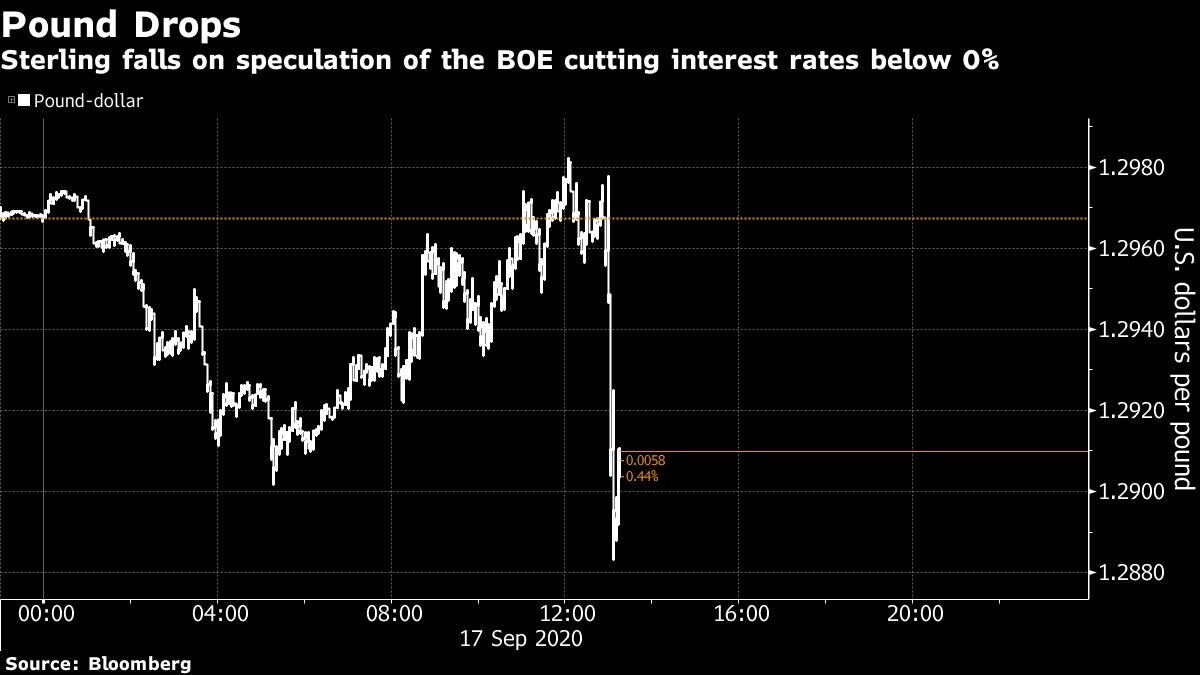
(Bloomberg) — The Bank of England gave the clearest signal yet that it may consider cutting interest rates below zero for the first time in its history as the economy gears up for a period of unusual uncertainty. The pound fell.
With multiple threats to the outlook looming, the BOE will begin “structured engagement” with U. K. bank regulators on how it might implement negative rates.
While officials had previously said they were reviewing the case for such a move, and Governor Andrew Bailey hasn’t ruled it out, the preparation goes beyond anything seen before.
The comments prompted investors to bet that the next 10 basis points of easing will come in May with another cut of the same magnitude to follow in November 2021. The pound weakened, and was trading down 0.5% at $1.2905 at 12:34 p.m. in London.
“The MPC had been briefed on the Bank of England’s plans to explore how a negative bank rate could be implemented effectively, should the outlook for inflation and output warrant it at some point during this period of low equilibrium rates,” minutes of the meeting said.
Just last month, the BOE warned that negative rates could actually be damaging to the U.
K. financial system, which would explain why it wants to figure out a possible route to them with the Prudential Regulation Authority. In its August Monetary Policy Report it said the impact of the virus on the economy will mean loan losses for banks as unemployment rises and businesses collapse.
“As a result, implementing negative policy rates might be less effective in providing stimulus to the economy at the current juncture than at a time when banks’ balance sheets are improving,” it said then.
Still, the prospects for easier policy have increased as the U.
K. faces a resurgence in virus infections and restrictions, as well as fears unemployment could spike when government aid programs are withdrawn next month.
At the same time, Prime Minister Boris Johnson’s threats to redraw his Brexit deal with the European Union could scupper any chance of a trade accord before the Dec. 31 deadline, further boosting economic turmoil.
Officials said that while recent data has been a little stronger than expected, they still think there is “a risk of a more persistent period of elevated unemployment” than their previous forecasts.
Still, the BOE now expects output to be 7% lower in the third quarter than at the end of 2019. Projections given in August showed an 8.6% decline.
“The Committee will continue to monitor the situation closely and stands ready to adjust monetary policy accordingly to meet its remit,” the BOE said. Despite the focus on interest rates on Thursday, economists predict the BOE’s next move will to be expand the bond-buying program, which is expected to be boosted by 50 billion pounds in November.
Hours before the decision, the Federal Reserve and Bank of Japan both kept rates unchanged, with the Fed signaling U.
S. rates will stay near zero for at least three years. The BOE repeated its pledge not to tighten until U. K. inflation, currently at 0.2%, is sustainably moving toward its 2% target.
A dive into sub-zero rates by the BOE would put it on a path already taken by its European peers and the Bank of Japan, giving it some clues on how to best structure such a policy. The European Central Bank, with a policy rate of minus 0.5%, has offered banks partial exemptions to ease the pain of the policy.
Negative rates are effectively a charge on the deposits that banks keep at the central bank.
Exemptions attempt to mitigate concerns that lenders, unable easily to pass that cost onto savers, will pull back on the supply of credit to the real economy. The ECB also offers long-term funding to banks at an ultra-low interest rates if they use that cash for loans.
Read More: TOPLive blog on the Bank of England
(Updates bets on rate cuts from third paragraph)
For more articles like this, please visit us at bloomberg.com
©2020 Bloomberg L.
P.