
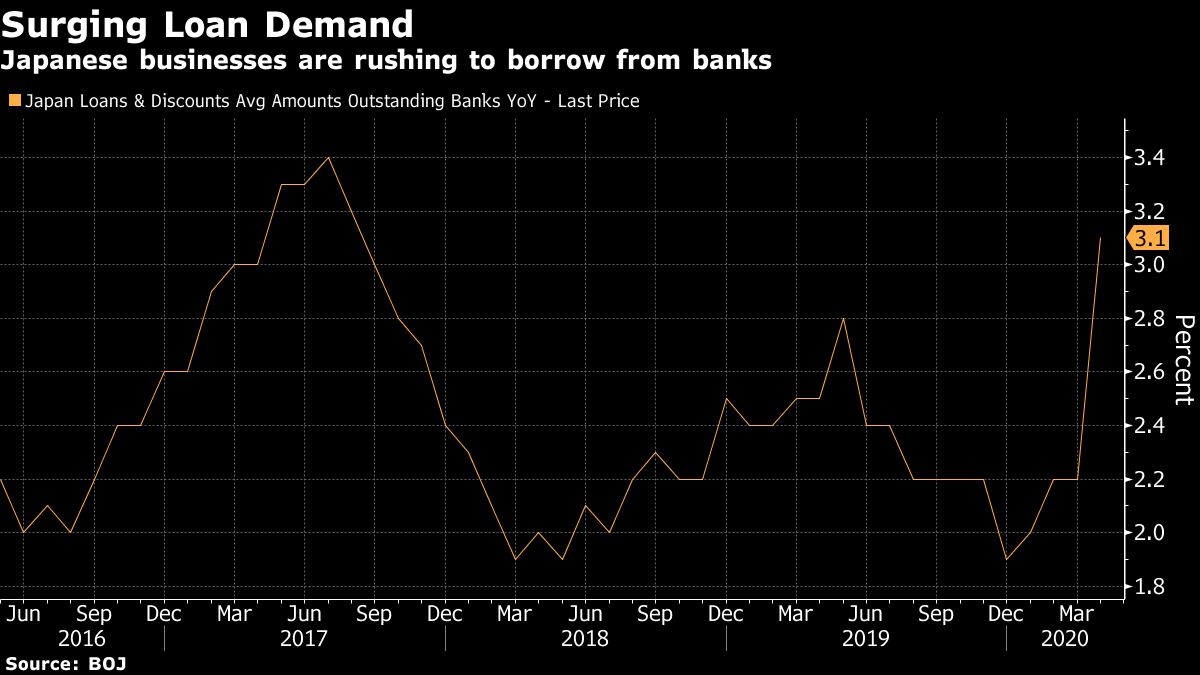
(Bloomberg) — The Bank of Japan launched a new lending program worth 30 trillion yen ($279 billion) to support small businesses struggling amid the coronavirus but held off from adding major stimulus at an emergency meeting Friday.
Following data released earlier in the day showing Japan’s key inflation rate falling below zero for the first time in more than three years, the BOJ kept its policy interest rates and asset purchases unchanged.
Instead, it chose to focus on the more pressing task of preventing bankruptcies, saving jobs and stopping an economic recession from turning into a financial crisis.
The yen strengthened a touch against the dollar after the decision, moving from around 107.71 against the greenback to as much as 107.56.
The Nikkei 225 stock average gave up its early gains following the announcement.
Combined with an earlier lending program and its buying of corporate bonds and commercial paper, the BOJ said its coronavirus response measures now total 75 trillion yen. By comparison, the overall size of the government’s record stimulus package in response to the pandemic is 117 trillion yen.
“This was more a demonstration of the BOJ’s aggressive stance rather than the lending programs themselves,” said Masamichi Adachi, chief Japan economist at UBS Securities and a former BOJ official. “They are certainly trying to avoid the stigma of doing ‘too little, too late’ because that led to the yen strengthening after the global financial crisis.”
Still, for an emergency meeting, there was nothing in the way of surprising action that went beyond what the BOJ itself had already telegraphed.
Even the new program had first been announced in April. The decision not to hold a briefing later in the day also means Governor Haruhiko Kuroda has no immediate opportunity to talk up the details of the new lending arrangements.
The program, due to run through March next year, won’t offer direct assistance to businesses like the Federal Reserve’s Main Street Lending Program. Instead, it will funnel money to companies via commercial banks and other financial institutions.
Like the BOJ’s other virus-lending program, the facility will encourage lending to companies by providing free loans to financial institutions and then paying them 0.1% interest on the amount they in turn lend out.
Adachi said it was difficult to compare the size and scope of the BOJ’s programs against those in the U. S. and Europe because of differences in the respective financial systems.
As for the possible re-emergence of deflation, economists warned that keeping the economy on track was also an important first measure to contain that risk.
While the government has lifted a state of emergency from most parts of the country outside Tokyo and Hokkaido, data earlier this week showed exports plunging more than 20% and the economy falling into a recession that is expected to deepen sharply.
“The BOJ will say that inflation is temporarily weak because of the virus-hit economy and the plunge in oil prices and that as soon as those effects disappear, inflation will be back on a rising trend.
But I don’t think that will be the case,” Adachi added.
What Bloomberg’s Economist Says
“The Bank of Japan is moving swiftly to deliver more financial support for Japan’s hard-hit small companies, with a new 30 trillion yen loan program. If extended by commerical banks as intended, it would be a large dose — equal to 185% of total new loans extended in April.”
Yuki Masujima, economist
Click here to read more
Policy Recap
- Interest rates to remain at the current low level or even lower.
- A rate of -0.1% applied to some reserves kept at the bank by financial institutions.
- Yield target of about 0% for 10-year Japanese government bonds, with a trading range of about 0.2 percentage point on either side of the mark.
- Japanese government bonds to be purchased as needed and without a limit, though the amount of purchases remains secondary to controlling interest rates.
- A guideline to increase holdings of exchange-traded funds with an upper limit of 12 trillion yen a year.
Actual purchases vary widely from month to month, depending on market conditions.
- Active buying of corporate bonds and commercial paper with an expanded upper limit on holdings totaling 20 trillion yen.
(Adds market reaction)
For more articles like this, please visit us at bloomberg.com
©2020 Bloomberg L. P.