
(Bloomberg) — The Bank of Japan stood by its ultra-low interest rates, pushing back against lingering market speculation it will adjust policy as it continues to predict inflation will cool below 2% next year.
Governor Haruhiko Kuroda and his board left their negative rate, 10-year yield cap and asset purchases unchanged at the end of a two-day policy meeting Friday. The result was in line with forecast by all 49 economists surveyed by Bloomberg.
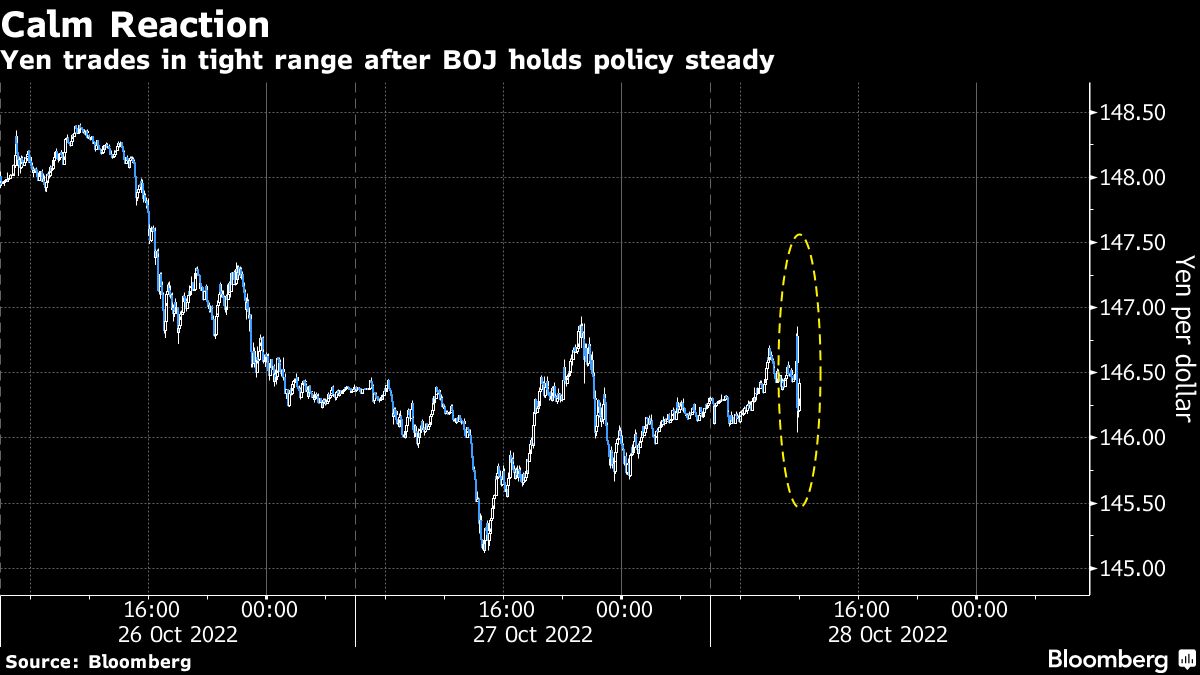
The yen saw a modest fluctuation in both directions after the decision, but was little changed on the day around 146.25 per dollar.
The currency has rallied almost 4% from last week’s three-decade low that triggered more suspected intervention from Japan.
In its quarterly economic projections, the BOJ sharply raised its inflation forecast to 2.9% for the year ending in March while predicting price growth will slow to 1.6%, well below its 2% target in the following 12 months.
Figures out earlier in the day showed inflation in Tokyo hitting the fastest pace since the late 1980s in October with a 3.4% gain.
But the BOJ still sees the acceleration as unsustainable.
Kuroda continues to hold firm as the last anchor of low global rates just a day after the European Central Bank went ahead with another jumbo rate hike. But the governor is walking on a tightrope as his dovish stance risks putting further downward pressure on the yen despite billions of dollars spent by the government to support the currency.
“The BOJ is simply stating the current condition of prices and the economy by boosting its outlook on inflation and remaining cautious about growth,” said Toru Suehiro, chief economist at Daiwa Securities.
The decision maintains Japan’s outlier status on policy and inflation.
The BOJ is defying the overseas tide of interest rate hikes while Prime Minister Fumio Kishida’s government props up the yen and ramps up spending to mitigate the effects of higher food and energy prices partly inflated by the tanking currency.
“The BOJ will keep up its current easing policy until Kuroda’s term ends and the government is going to focus on supporting growth and creating an environment that will make it easy for wages to rise,” Suehiro said.
Kishida is continuing to back Kuroda’s drive to generate lasting growth in prices and the economy through a cycle of rising wages.
The premier announced an economic package with spending of around $200 billion to alleviate the pain of cost-push inflation earlier Friday, with details expected later in the day.
Still, a draft of the plan obtained by Bloomberg earlier this week shows the government also expects the BOJ to watch the impact of volatility in financial markets, a signal that Kuroda can’t entirely ignore how the bank’s actions and his comments can affect the yen.
The focus now moves to Kuroda’s press briefing from 3:30 p.m. with memories still vivid from last month when Kuroda’s dovish comments triggered a sharp weakening of the yen.
Finance Minister Shunichi Suzuki conducted Japan’s first intervention to support the yen in 24 years barely half an hour after the governor finished talking.
Since then Japan is believed to have entered markets again to support the currency without confirming it. The short-term defense of the yen is unlikely to reverse the downward pressure it will face as long as the Federal Reserve keeps hiking rates at pace and widening the policy gap between the US and Japan.
But the suspected interventions at least buy the BOJ time to get closer to the moment when the Fed slows down.
Kuroda and colleagues next meeting is in December. By then the global outlook may be much gloomier and market dynamics may have shifted in favor of the BOJ, taking pressure off its yield curve control and the currency.
“The BOJ’s decision provides no catalyst to drive the yen in either direction,” said Hiroyuki Machida, director of Japan FX and commodities sales at Australia & New Zealand Banking Group Ltd. in Tokyo.
The yen has lost more than one fifth of its value against the dollar this year, the most among major currencies, as traders have focused on the policy gap with the US.
Kuroda has repeatedly said that Japan’s slow recovery from the pandemic makes support from monetary easing necessary while wage gains need to be stronger to make the current cost-push inflation sustainable.
Unlike the US, Japan has suffered long bouts of deflation in recent memory. Under Kuroda it has spent the last decade trying to spark a lasting cycle of inflation and growth.
As a sign of the bank’s concern over the outlook for the economy, it lowered its economic growth projection by citing expected headwinds from a global slowdown. The BOJ now sees the economy growing 2% this fiscal year compared with an earlier forecast of 2.4%, with a further slowing to 1.9% the following year.
–With assistance from Cormac Mullen, Yoshiaki Nohara, Yuko Takeo, Go Onomitsu and Daisuke Sakai.
(Adds economist comment)
More stories like this are available on bloomberg.com
©2022 Bloomberg L.
P.