
(Bloomberg) — California is bracing for another round of rolling blackouts Tuesday as unrelenting heat drives electricity demand to an all-time high, straining a power grid that’s already been pushed to the brink of failure.
Some parts of the state could reach 112 degrees Fahrenheit (44 degrees Celsius) Tuesday and weather forecasters expect 27 high temperature records to be broken across the West.
As the heat intensifies and Californians again blast their air conditioners, electricity demand will likely reach a record peak, setting the stage for more blackouts.
Since Friday, millions of Californians have seen their lights abruptly cut with little notice — part of a last-ditch effort by the state’s grid operator to save the system from cascading power failures. The outages have drawn criticism from industry experts who say they weren’t necessary, prompted California Governor Gavin Newsom to open an investigation and raised questions about the reliability of the state’s grid, which has become increasingly dependent on intermittent solar and wind generation in recent years.
“Let me just make this crystal clear: We failed to predict and plan these shortages — and that’s simply unacceptable,” Newsom said in announcing the probe.
Record-Breaking Demand
California power demand is expected to peak Tuesday at an unprecedented 50.4 gigawatts, which would break a record sent in 2006, when a deadly 10-day heatwave gripped the state.
As of 9 a.m. local time, the California Independent System Operator said it had enough available capacity to meet peak demand. The test will come this afternoon, when energy use ramps up just as solar production begins to wane.
This month is the first time California has resorted to rotating outages since the 2001 energy crisis. And it couldn’t be hitting the region at a more vulnerable time, with the pandemic forcing people into lockdown, leaving them with little choice but to endure the heat indoors.
The cutoffs have been reminiscent of the mass blackouts that utilities carried out less than a year ago to keep their electrical lines from sparking fires during unusually strong windstorms — all extreme weather events made more frequent by climate change.
After rolling blackouts Friday and Saturday, the state on Monday braced for what would have been one of the largest outages in California’s history — potentially affecting as many 10 million people.
But that crisis was averted as consumers throttled back their energy use.
“We are grateful to families and businesses across the state that answered the call to reduce electricity use,” Steve Berberich, the president and chief executive officer of California ISO, said in a statement. “The heat storm is not over, and we still expect exceedingly hot temperatures” on Tuesday and Wednesday, he said.
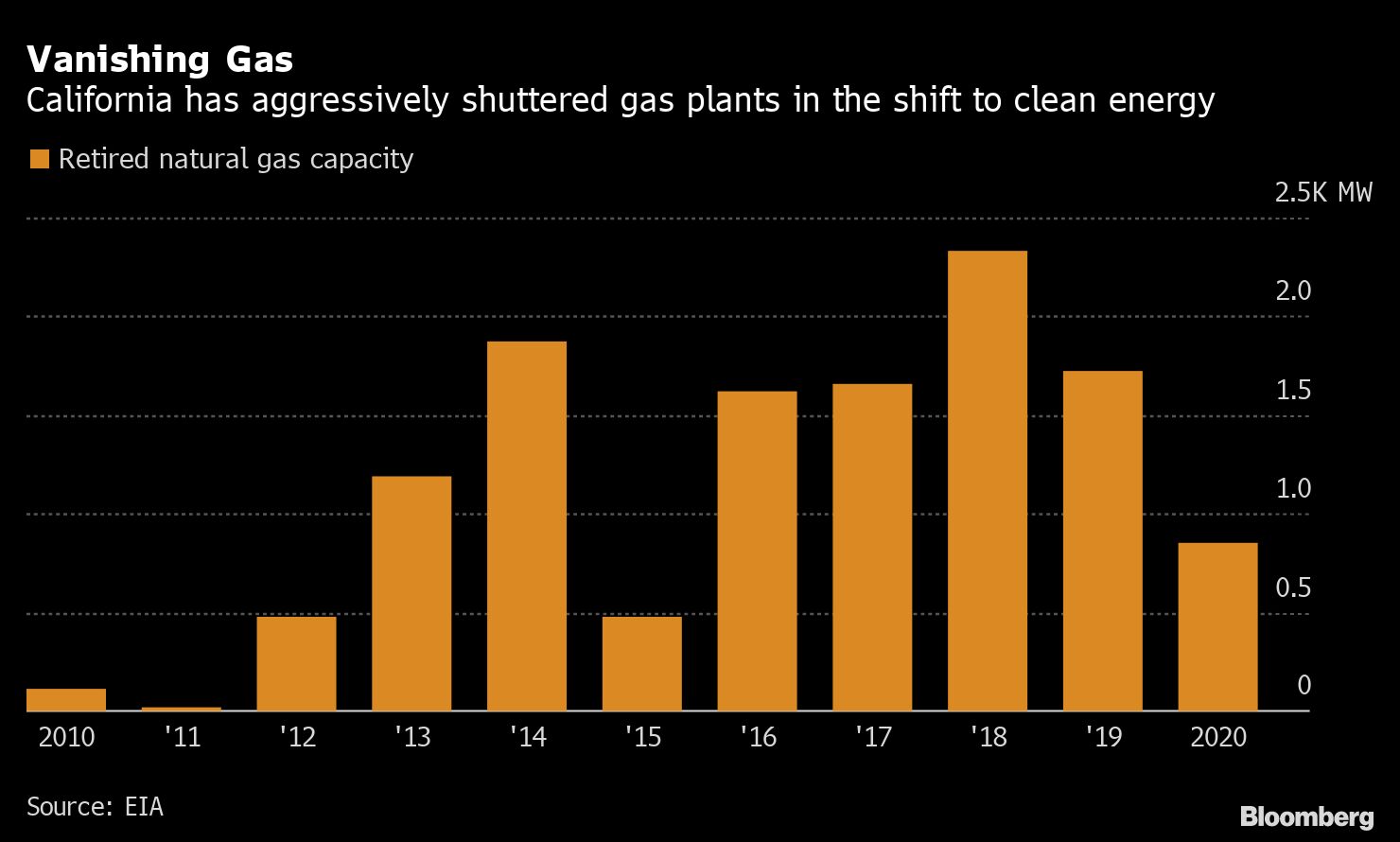
One thing that has made California’s grid so vulnerable to soaring demand is the state’s rapid shift away from natural gas.
About 9 gigawatts of gas generation, enough to power 6.8 million homes, have been retired over the past five years as the state turns increasingly to renewables, according to BloombergNEF. That leaves fewer options when the sun sets and solar production wanes.
Normally, California can import enough power from neighboring states when supplies are tight. But the sprawling heat wave blanketing the U.
S. West is pushing power plants to the hilt across the region.
“California is in a tight spot,” BNEF analyst Brian Bartholomew said. “It’s retired a lot of gas. And the storage that’s supposed to help hasn’t yet come online.”
Read More: Blame Climate Change for Heatwave Misery: Green Insight
The relentless heat is also starting to take a physical toll on California’s power system.
Transformers — the metal cylinders sitting atop power poles — can malfunction and catch fire if they don’t cool off at night. And temperatures in some parts of Southern California are expected to remain in the low 80’s overnight. During the 2006 heatwave, the state’s utilities lost more than 1,500 of these devices, with each knocking out service to one neighborhood in the process.
The heat wave gripping the West Coast stems from a stubborn, high-pressure system that has parked itself across the Great Basin spanning Nevada and other western states.
It essentially acts as a lid trapping hot air, and there aren’t any indications it’s going to budge soon.
Such phenomenons, sometimes called heat domes, are getting worse because the Earth’s climate is changing. As the planet warms, the contrast between the heat at the equator and the cold at the pole decreases. That saps the strength of the jet stream, which otherwise would be able to shove the ridges out of the way.
It explains in part why extreme heat has blanketed regions around the world in recent weeks.
Read More: Japan’s Heat Wave Matches Record as Tokyo Death Toll Rises to 53
Extreme weather has taken a profound toll on electrical grids in recent weeks. Earlier this month, millions of people lost power across the U. S. Midwest after a wall of lightning, hail and deadly winds tore a path of ruin from central Iowa to Chicago.
Days earlier, Tropical Storm Isaias darkened millions of homes from the Carolinas to Connecticut.
For more articles like this, please visit us at bloomberg.com
©2020 Bloomberg L. P.