
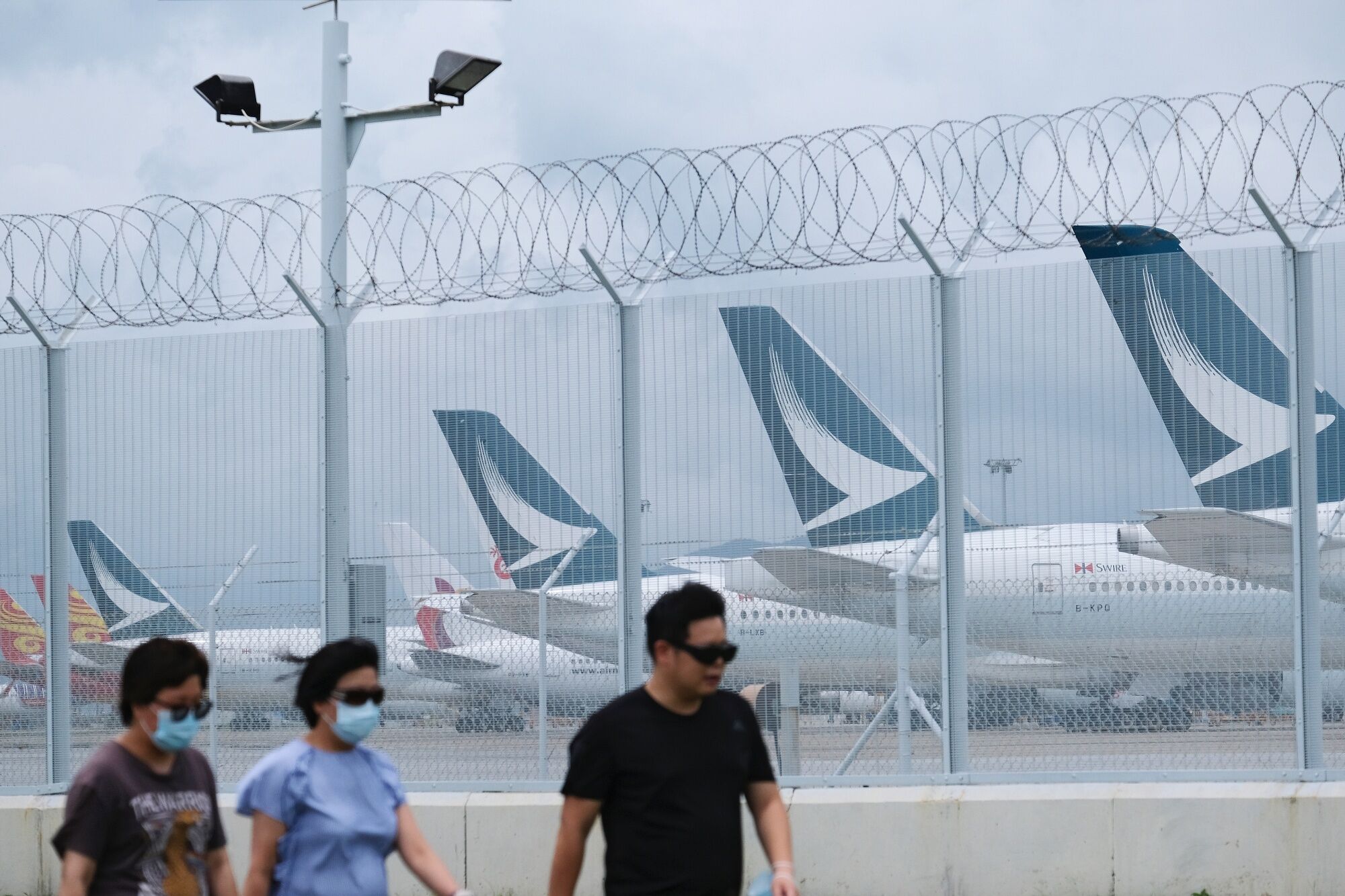
(Bloomberg) — Cathay Pacific Airways Ltd. rose on relief over its HK$39 billion ($5 billion) government-backed rescue plan, after a short squeeze briefly triggered the stock’s biggest rally since 2008.
The shares added 2.2% to HK$9.01 at 11:51 a.m. in Hong Kong. Traders said a rush to cover short positions was behind the 19% pre-market move, which faltered almost as soon as the regular session began.
Trading in Cathay was suspended Tuesday ahead of an announcement on the recapitalization, which includes the issuance of preference shares, warrants, rights and the extension of a bridge loan.
While the plan eases concerns over Cathay’s liquidity, the recovery outlook is “dim” and its monthly cash burn is likely to remain high, Credit Suisse Group AG said as it downgraded the stock to the equivalent of sell.
Daiwa Securities Group Inc. also lowered its rating to sell, saying minority shareholders will be diluted by Cathay’s issuance plans.
Cathay has dropped 22% this year, just outperforming a Bloomberg gauge of Asia Pacific airlines, which is down 25% after the coronavirus pandemic destroyed travel demand. Short interest in Cathay shares was about 13% of free float as of Monday, according to IHS Markit Ltd. data.
The International Air Transport Association said Tuesday airlines are expected to lose $84.3 billion this year, with a 50% slump in revenue to $419 billion.
“Financially, 2020 will go down as the worst year in the history of aviation,” the industry group’s Director General Alexandre de Juniac said. “On average, every day of this year will add $230 million to industry losses.”
Cathay said its plan is designed to provide sufficient funds to survive the industry downturn and set a platform from which to review and transform its business, which Chairman Patrick Healy warned would collapse without the $5 billion recapitalization.
Prior to the pandemic, Cathay was already under enormous financial strain due to Hong Kong’s anti-government protests, which affected traffic numbers and led to the exit of the company’s former chief executive officer.
Passenger revenue is only about 1% of prior year levels.
The airline posted an unaudited loss of more than HK$2 billion in February alone, and since then it has been losing HK$2.5 billion to HK$3 billion a month. Its main shareholders Swire Pacific Ltd., Air China Ltd. and Qatar Airways have undertaken to vote in favor of all resolutions for the recapitalization plan.
“Financially this gives them probably enough for a year to two years,” Sobie Aviation’s Brendan Sobie told Bloomberg Television on Wednesday. “This is just one step to survive the crisis.”
He said the plan was the best scenario for those involved and maintains the shareholding balance for Swire Pacific, Air China and Qatar Airways.
It also helps preserve Hong Kong’s position as an aviation hub. Next, Cathay will have to make strategic decisions on fleet size, capacity and other areas to align with an international market that will take time to recover.
Cathay’s Healy said “tough decisions” would need to be made in fourth quarter to get the airline to the right size and shape to compete effectively, and that “nothing is off the table” in terms of what needed to be done.
The company may access equity and debt capital markets again to strengthen its balance sheet if conditions are right, Healy said.
“The fund-raising gives Cathay about 13 to 16 months of liquidity,” said Paul Yong, an analyst at DBS Group Holdings Ltd. in Singapore. “But short-term profitability remains highly challenged because the rate of the international travel market opening is happening slowly and cautiously.
Also there is social unrest in Hong Kong.”
Coronavirus-related travel restrictions have put enormous pressure on airlines globally, and none are certain about how the future will pan out as new travel requirements come into force and travelers’ attitudes change.
Cathay and its Cathay Dragon unit have been operating a “bare skeleton” passenger service since April after slashing capacity by 96% and cutting their route networks.
Hong Kong Express, the budget carrier Cathay acquired last year, said Wednesday it will gradually resume flight operations from July 12.
IATA said air traffic is likely beyond the worst of its collapse, provided there isn’t a second, more damaging wave of the virus. At its lowest point in April, global air travel was about 95% below 2019 levels, and passenger numbers this year will likely slide to 2.25 billion, which is roughly the same as 2006 levels, it said.
Costs, meanwhile, aren’t falling as fast as demand.
“That’s why government financial relief was and remains crucial as airlines burn through cash,” IATA’s de Juniac said. “The challenge for 2022 will be turning reduced losses of 2021 into the profits that airlines will need to pay off their debts from this terrible crisis.”
(Updates market prices throughout, adds comments from IATA from 5th paragraph.)
For more articles like this, please visit us at bloomberg.com
©2020 Bloomberg L.
P.