
(Bloomberg) — In June, New Hampshire’s Catholic Diocese of Manchester launched a marketing campaign called See You in Class, dangling in-person education this fall and a tuition discount of almost 17% for public-school families.
One 450-student school reaped 241 applications from parents confronting the prospect of more virtual learning. It now has a waiting list, reversing years of sluggish enrollment.
Fears of Covid-19 have forced many of the nation’s largest public-school systems to start the academic year remotely.
But where some see a threat, besieged Catholic schools see a financial lifeline.
Catholic school administrators say they can reopen safely because they have enough building space to allow social distancing while taking other safety measures. But some states and municipalities are pushing back. Public-health authorities barred the Los Angeles Diocese from reopening because the county’s Covid-19 case numbers were too high.
They’ve also blocked some reopenings in the Diocese of Sacramento.
In Manchester, though, administrators say they are optimistic they can boost enrollment and protect the health of students and teachers.
“It’s no secret that enrollment nationwide has declined year after year, decade after decade,” said Alison Mueller, Manchester’s diocesan marketing director. “This is really a wonderful opportunity for us.”
QuickTake: As School Looms, What We Know About Kids and Covid-19
The potential to take in public-school refugees might salvage what has so far been yet another bad year for Catholic education in the U.
S. Of 117 private schools that closed for good due to the coronavirus, 98 were Catholic, according to the Cato Institute’s Center for Educational Freedom. The Diocese of New York alone lost 20, Archbishop Timothy Cardinal Dolan announced last month.
For surviving Catholic schools, though, the pandemic is a chance to reintroduce themselves after decades of decline. Across the country, they’re advertising smaller class sizes, safety protocols, discipline and even their draft-ventilated buildings as keys to running in-person classes safely as they make bold bids for transfers from still-virtual public schools.
Little is known about how children contract and spread Covid-19, but public schools are taking few chances.
Nationally, 61% of their students in kindergarten through high school will attend virtually in the fall, with another 20% mixing in-class and remote learning, according to Burbio, a New York-based data service.
Meanwhile, infections among U. S. children grew 40% in the second half of July, according to the American Academy of Pediatrics and the Children’s Hospital Association. Scientists have warned that in-person classes could become Petri dishes for Covid-19.
Many Catholic schools are forging ahead and taking precautions.
In Boston, a high school is touting its ability to open its old building’s many windows. In Sacramento, the pitch includes temperature checks, masks and grouping kids into isolated cohorts to limit the impact of quarantines if needed.
“There’s a lot of marketing going on right now in our Catholic schools to let people know we’re here and open for business,” said Kathy Mears, chief executive officer of the National Catholic Educational Association.
Some 85% of its 6,000 members are opening for in-person lessons this fall. “They’re being more aggressive because they’re able to because in many cases our class sizes are smaller.”
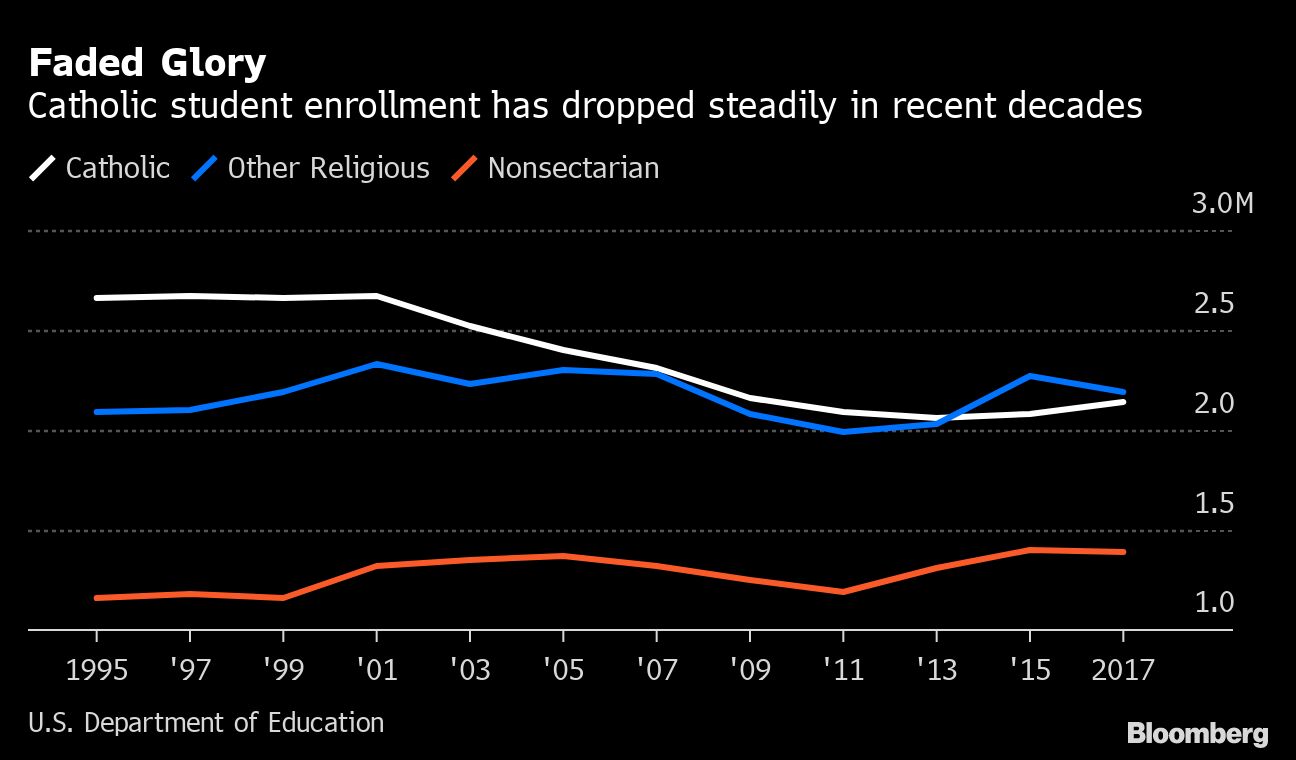
While Catholic education once was the largest private school system in the country, options have dwindled in recent years with enrollment on the decline. Other religious schools, meanwhile, have been growing.
Roughly 21% of the U.
S. population identified as Catholic in 2014, compared with 24% in 2007, Pew Research Center data show. And while Catholicism is still the largest single religious denomination in the country, it’s seen a greater decline in its population than others.
Generally, Catholic schools are cheaper than other private schools because the church subsidizes them. About 21% of students are racial minorities, according to the National Catholic Education Association.
But there are ever fewer Catholic primary and secondary schools and the pandemic accelerated the slide, as parents lost jobs and churches couldn’t hold in-person services — and pass collection plates.
The damage disproportionately affected poorer populations that Catholic schools make it their mission to serve, said Mary Pat Donoghue, executive director of the Secretariat of Catholic Education for the U.
S. Conference of Catholic Bishops: “One of the hardest things about this pandemic is that many of the schools that serve African-American students and urban populations were the most badly hit.”
Such schools include Cristo Rey High School in Boston, which exclusively serves families below the poverty line and had its funding disappear almost overnight. “We couldn’t even pay people,” said president Rosemary Powers.
Donors stepped up and saved the school: “We had a miracle,” Powers said.
In Brookline, Massachusetts, there’s a 23-student waiting list to get into Saint Mary of the Assumption Elementary School, which has pupils from pre-kindergarten through eighth grade.
It’s leasing white event tents to set up outdoor classes in September. Applications and enrollment are booming, with the school’s 250 spots filled.
“It’s a good problem to have,” said Principal Theresa Kirk. “We’re hoping that the people that came to us because their school was doing something different will stay with us and love us.”
Saint Mary upped its advertising — using Twitter, Facebook and Vimeo videos to appeal to parents whose schools have gone all remote.
The school, which received Paycheck Protection funds earlier this year, also invested in air filtration. Classes are limited to 15, and parents are asked to stay in New England.
In California, where schools can open based on county infection rates or with county waivers, most public institutions aren’t. That’s largely because of teacher-union resistance, said Lincoln Snyder, schools superintendent for the Diocese of Sacramento.
The diocese opened schools where infections are few, and it’s seeking waivers elsewhere. New enrollment is up, though the newcomers don’t make up for what was lost, Snyder said. The diocese had a 6% increase in new elementary school enrollments, but an 11% drop in returning elementary students, about five times normal. ”People lost jobs, people moved,” he said. “It was mostly pandemic related.”
The reopenings make some teachers nervous.
In St.
Louis, where Bishop DuBourg High School is bringing students back as neighboring public schools open remotely, Spanish instructor Kathryn Williams-Heese initially was both joyful and “terrified to come back into a group of people when we’ve been staying alone and trying to avoid groups for so many months.”
She has been impressed by the school’s social distancing, mask compliance, temperature checks and promised free testing for staff.
But “I’m still in the back of my mind concerned about myself and my students,” she said. “I feel like an essential worker right now. We’ve asked the question: Why are we here when nobody else is?”
For more articles like this, please visit us at bloomberg.com
©2020 Bloomberg L. P.