
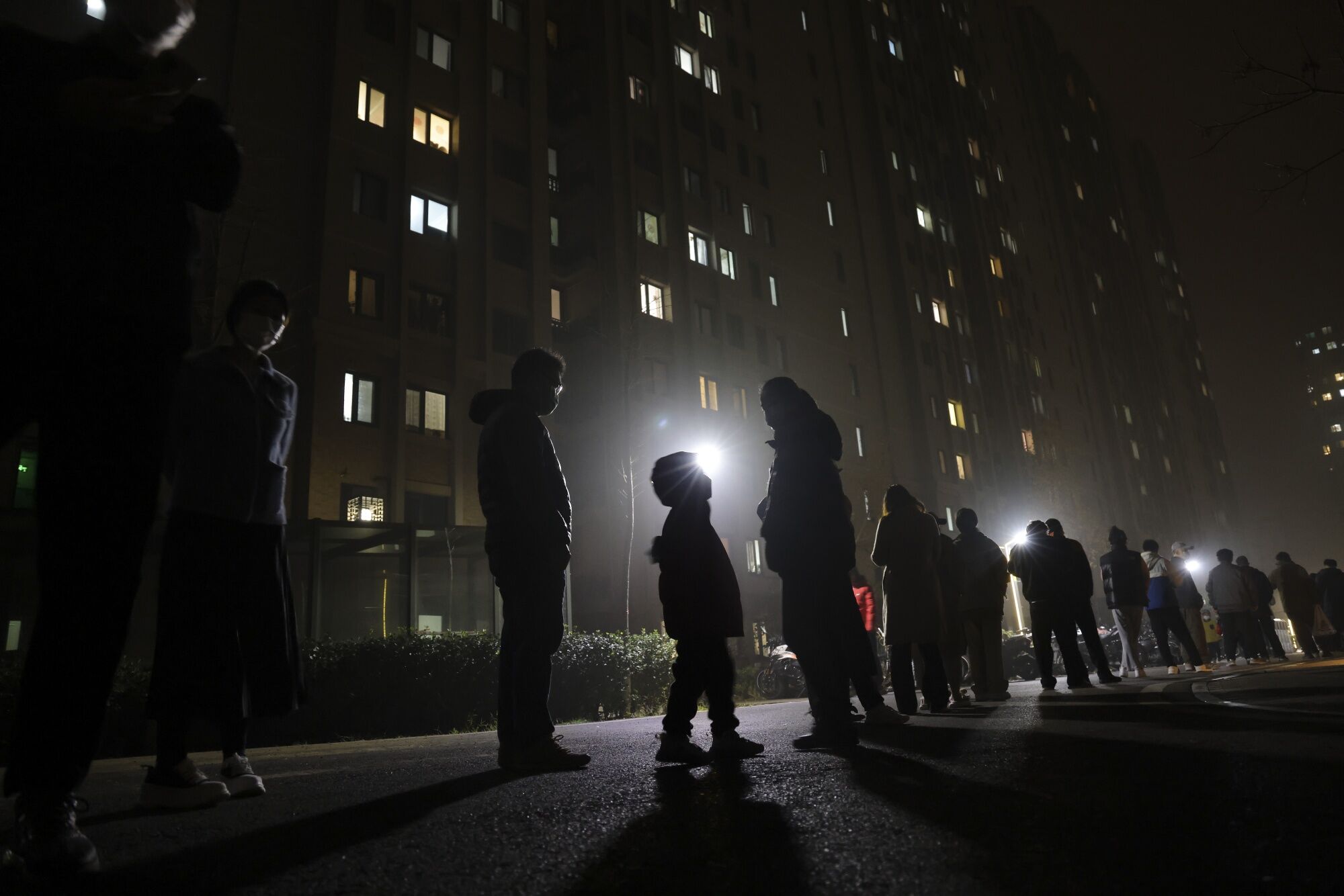
(Bloomberg) — Barely a week in, China’s lighter-touch Covid Zero policy is already running into trouble.
Surging infections are threatening to overwhelm some of the country’s biggest and most important cities, with local officials stymied over how to control the contagion without the usual tools of mass citywide testing and snap lockdowns. Three Covid deaths in the capital Beijing, the first in more than six months, provided a reality check for a population that’s been shielded from the pathogen by the stringent approach.
It’s creating a make-or-break moment for China’s leaders, who must decide whether to accept the rising case count that ultimately inundated every other major country, or revert to the tried-and-true control measures that have put a stranglehold on their economy.
There are early indications of a relapse into the strict zero-tolerance approach in hard-hit areas, as local officials panic over surging case counts, particularly as cold weather nears.
The problem is that officials are being asked to achieve two contradictory goals, with little guidance on how.
The People’s Daily, the flagship newspaper of China’s state media, laid out the task in its latest commentary on Monday, saying the country must end its excessive, one-size fits all approach, while also avoiding an irresponsible exit.
That’s mission impossible, said Huang Yanzhong, a senior fellow for global health at the New York-based Council on Foreign Relations. Local authorities are becoming more confused, he said.
“They knew very clearly in the past that they need to get cases to zero,” Huang said. “Now, they don’t know what to do and find themselves in a dilemma.”
20 Measures
Financial markets, China watchers and parts of the population were heartened when Chinese President Xi Jinping and his new leadership team issued a new playbook on Nov. 11.
The revised direction, laid out in 20 measures intended to guide the Covid response, asked local governments to refrain from sweeping curbs and instead take a more targeted approach to control the virus while boosting vaccination and preparing hospitals to care for severe patients.
Since then, however, infections have more than doubled to 26,000 cases a day.
The scale of the outbreak is likely even bigger since some cities pulled back on testing as part of the easing, a move that allows the virus’s spread to go undercover.
The surge has left many Chinese — steeped in the official narrative that Covid Zero shielded them from the deadly virus for the past three years — fearful of leaving their homes.
The whiplash could be seen in the city of Shijiazhuang, not far from Beijing.
Its approach after the top leaders’ Covid pivot was avidly watched in the country as potentially leading the transition away from Covid Zero. Daily infections plunged after the city dropped several bedrock policies, including mass testing, and allowed students to go to school despite an ongoing outbreak.
Cold Feet
A spike in cases over the weekend, though, resulted in cold feet, and officials asked residents to stay at home on Monday — in essence reverting to a de-facto lockdown.
Shijiazhuang’s experience shows the difficulties China faces in trying to carry out any meaningful shift away from the Covid Zero regime.
Being able to juggle both priorities “requires an infinite level of sophistication, which a lot of local governments don’t have,” said Jin Dong-yan, a virologist from the University of Hong Kong.
In major economic hubs, from the capital to manufacturing centers and China’s ‘iPhone City,’ officials are fluctuating between approaches as case counts surge.
In some places, infections have grown to higher numbers than ever before, potentially reaching a level where uncontrollable spread is triggered.
The swelling Covid outbreak was inevitable after the targeted measures spelled out in the new playbook were adopted, said Lu Mengji, an virologist at University of Duisburg-Essen in Germany.
“The worsening outbreak will trigger further controls, and at a wider scale,” Lu said. “Six or seven weeks from now we’ll see how much damage the outbreak will cause to the extremely frail population,” he said. “That will mean either confidence or setback in carrying this new policy forward.”
Vaccination is Key
More deaths are likely given the rising caseloads and relatively low vaccination rates among the country’s most vulnerable groups, with 66% of those aged over 80 fully vaccinated, and just 40% boosted.
Experts note that the new playbook from Beijing also talks about the need to boost vaccination among the elderly, a key step to mitigating severe disease and curtailing deaths.
China’s top health authorities also said last week they’re drafting plans to accelerate vaccination efforts.
But efforts to fine-tune the country’s approach come at an inopportune moment. Winter is coming, and cold weather facilitates spread of the virus. Even Western countries are bracing for a Covid resurgence, and have sought to mitigate the impact on health systems through additional boosters and expansion of hospital facilities.
That means a return to the strictest measures doesn’t guarantee China’s current outbreak will be tamed.
“It’s such a vast country and such a highly infectious virus,” Hong Kong University’s Jin said. “Getting cases back to zero from now will be very costly, but the government is still bent on doing that.”
More stories like this are available on bloomberg.com
©2022 Bloomberg L.
P.