
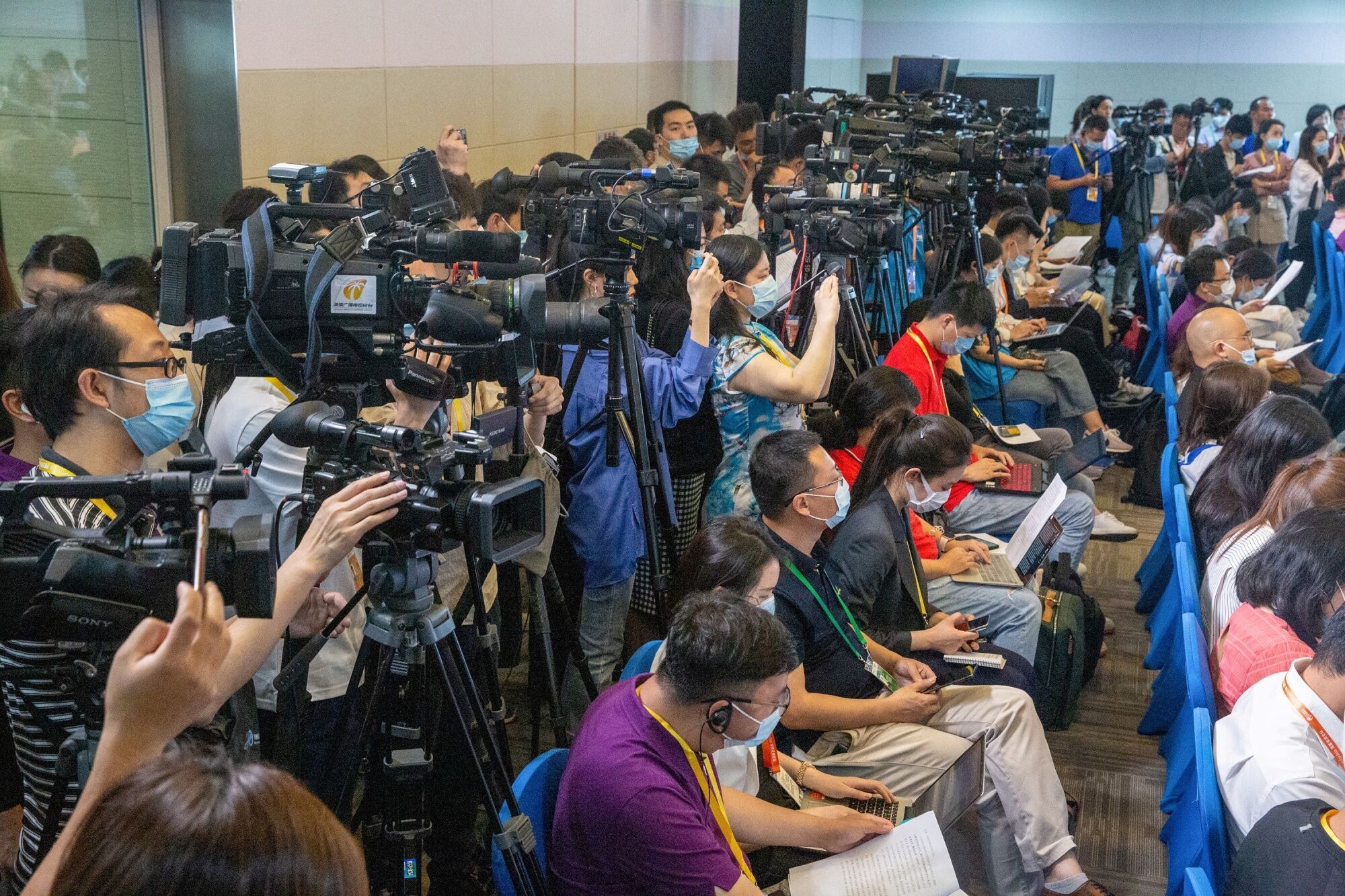
(Bloomberg) — Chinese government officials and business leaders are gathered this week on the tropical island province of Hainan for the Boao forum, with discussions expected to encompass topics from digital currencies to carbon neutrality and the economic outlook for a post-pandemic world.
Billed as an Asian version of the World Economic Forum, the forum kicked off Sunday and is slated to run through Wednesday.
China’s President Xi Jinping will make a keynote speech via video Tuesday, the Foreign Ministry said in a statement.
On the first day of the event, a senior Chinese central bank official said the nation’s goal for internationalizing its currency is not to replace the dollar, and efforts to create a digital yuan are aimed at domestic use.
Bloomberg News captured the pulse of the event throughout the forum.
Updated as of 03:40 p.m. in Beijing.
What to Watch:
- Click here for the agenda, here for latest list of delegates
- Xi to Discuss Global Risks and Challenges in Speech Tuesday
- Chinese central bank governor Yi Gang to speak on a panel about carbon neutrality on Tuesday at 4 p.m. local time
- IMF Managing Director Kristalina Georgieva, Ray Dalio and Stephen Schwarzman among speakers on a panel about the global economic outlook on Monday at 8 p.m. local time
- Chinese deputy securities regulator Fang Xinghai scheduled to speak on a panel about financial opening on Monday at 8 PM local time
- Larry Fink, Deputy PBOC Governor Li Bo, former PBOC Governor Zhou Xiaochuan speaking on a panel about pension reform on Tuesday at 8 p.m. local time
- A look at China’s green goals; first-quarter economic performance
Latest developments:
JD.com Sees Encouraging Signs as Poorer Consumers Spend
China’s low-income households are picking up spending, boding well for overall consumption in the economy and a sign of a more balanced recovery, the chief economist of e-commerce giant JD.com Inc.said.
Higher earners in the nation’s biggest cities expanded their spending during the pandemic last year to splurge on luxury and electronic products such as phones and computers, Shen Jianguang said in an interview at the Boao Forum.
The driver for consumption is now starting to shift to smaller cities, he said.
“Recently we are seeing a lot of people started working and all the shops are open,” he said. Consumption is “more geared toward necessity goods and less discretionary goods” and spending in tier-three and tier-four cities are picking up, he said.
Maersk’s China CEO Calls Politicization of Trade a ‘Great Pity’
The business community was glad to see Europe and China reach the Comprehensive Agreement on Investment, but “then we have seen that political differences have sort of created issues that could make an early ratification difficult to achieve,” according to Jens Eskelund, China CEO of shipping firm AP Moller – Maersk A/S.
Esekelund is also vice president of the EU Chamber of Commerce in China.
“I think it is something that the EU Chamber of Commerce sees as a worrying tendency that trade sometimes becomes politicized and that political difference have spillovers into the commercial arena.
It’s something we think is a great pity,” he said on a panel at the Boao Forum. “Our hope is that, irrespective of the current differences, that it will be possible for the two sides to find some sort of common ground that leads to ratification.”
In a position paper published in September 2020, 43% of the chamber’s members reported that the business environment had become increasingly politicized compared to the previous year.
Read: Europe’s Contested Deal With China Sends Warning to Joe Biden
Boao Forum Returns After Hiatus
China is signaling it’s open for business with the resumption of the high-profile Boao Forum for Asia, an opportunity for the government to make a renewed effort to lure foreign investors in a post-pandemic world.
The event was canceled last year as a result of the coronavirus pandemic.
Digital Yuan Not to Replace Dollar
China’s goal for internationalizing its currency is not to replace the dollar, and the efforts to create a digital yuan are aimed at domestic use, a senior central bank official said Sunday.
“For the internationalization of the renminbi, we have said many times that it’s a natural process, and our goal is not to replace the U.
S. dollar or other international currencies,” People’s Bank of China Deputy Governor Li Bo said Sunday.
Internationalizing Yuan a Top Priority, Says Economist
The top priority for China’s financial sector is promoting the global use of its currency and opening up the financial markets, instead of digitizing the yuan, said Wu Xiaoqiu, director of the Finance and Securities Institute at Renmin University of China.
“Global history tells us a country’s financial opening up always begins with liberalizing the currency,” said Wu at a presser at the Boao Forum. “The key task now is not to put so much focus on the digital currency.”
China should work toward allowing free cross-border flow of capital and greater exchange rate flexibility, Wu said.
The country’s economy is solid enough, and liberalizing the yuan exchange rate is unlikely to lead to a crisis of sudden depreciation of the yuan, he added.
CanSino Checking Vaccine Safety Closely
CanSino Biologics Inc. is monitoring its Covid-19 vaccine more carefully after cases of blood clots forced other suppliers to suspend inoculations. “We’re just monitoring more cautiously,” CanSino Chairman Yu Xuefeng said on the sidelines of the Boao Forum.
The comments come as a vaccine from Johnson & Johnson was halted in Europe after U.
S. officials paused immunizations to investigate blood clots suffered by six women.
For more articles like this, please visit us at bloomberg.com
©2021 Bloomberg L. P.