
(Bloomberg) — UK pensions are offloading collateralized loan obligations as the nation’s bond markets plummet, and at least some investors fear CLO prices could fall further because of a key risk embedded in the securities.
CLO managers take portfolios of leveraged loans and package them into bonds. The risk in the resulting securities stems from a guideline that can constrain these asset managers: less than 7.5% of their portfolio should be rated in the CCC tier, the lowest grades of debt that commonly trade in the market.
If they exceed that level, asset managers often have to cut off payments to holders of the riskiest securities issued by CLOs.
That in turn could pressure CLO prices, according to Scott Johnson, managing director at NexPoint Advisors, which buys these securities. At least some CLO managers would probably respond by shedding CCC loans, hurting loan prices as well.
Recently, the average level of CCC holdings in portfolios backing CLOs was 4.4%, up from this year’s low in August of 4%, according to S&P Global Ratings data.
But in the US, almost 30% of the loans held in these portfolios are rated B-, one step above the CCC tier and a record high percentage. With recession looming, investors wonder how much of that debt will be downgraded to the CCC tier, and when.
“If rating agencies do decide to downgrade a lot of companies, that’s going to greatly impact CLOs and would put heavy pressure on selling,” said Young Choi, portfolio manager at King Street Capital Management, in a phone interview. “It’s on everyone’s minds and you can already see it starting to be reflected in loan prices.”
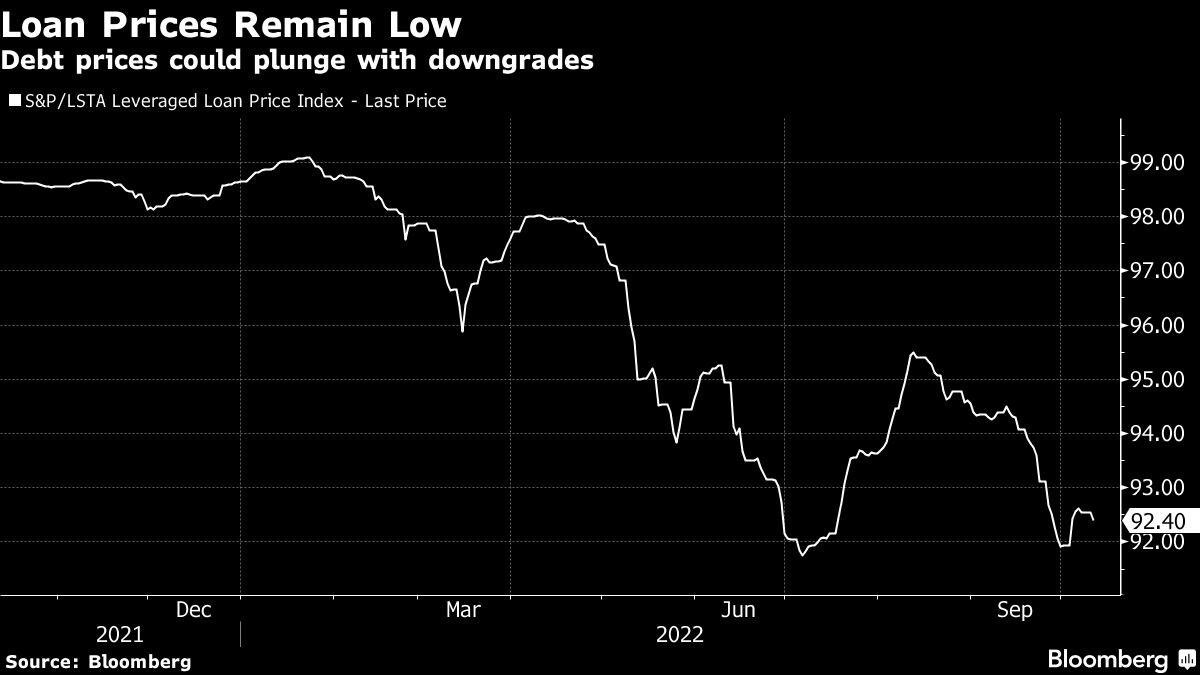
Leveraged loans are now trading at around 92.4 cents on the dollar on average, close to this year’s low of 91.75 cents in early July.
At the start of the year, prices were closer to 99 cents.
But as long as defaults remain low enough, most the securities would probably perform well. That’s what’s motivating some buyers now.
Apollo co-President Jim Zelter said on Tuesday that the safest parts of CLOs are trading at prices that reflect draconian assumptions of defaults topping 10% a year for five years.
“We think in some cases it’s an opportunity to be a buyer,” Zelter said, speaking on Bloomberg TV.
Read more: Apollo Makes Quick Gains on CLOs Dumped by UK Pension Funds (3)
The concentration of CCC loans in CLO portfolios is manageable for now, said Dan Ko, portfolio manager at Eagle Point Credit Management.
The current percentages are similar to where they were before the pandemic, he added.
“CLOs can still withstand a significant amount of CCC downgrades before CLO equity cashflows are cut off,” Ko said.
Still, there is reason to be concerned. In May 2020, during the pandemic, CCC loans were about 12% of CLO portfolios, according to S&P, so large numbers of downgrades are certainly possible.
So far this year, around 9% of loans in CLO portfolios have had their ratings cut, according to a Bank of America report. And the CCC downgrade rate from B- rated issuers stood at 4%, higher than the historical average at 1% to 2%, said the report.
Morgan Stanley analysts forecast that a fifth of existing B- loan borrowers could be vulnerable to downgrades if the economy remains in a “high rates and weak earnings” regime for more than a year, according to a recent note.
For some investors, these numbers are hard to ignore.
“CLOs that have high CCC percentages today will be forced sellers as their single B names get downgraded to CCC. This will result in realized losses for the CLO structures,” said NexPoint’s Johnson. NexPoint believes the CCC universe could double by next year, which would put additional pressure on CLOs.
Elsewhere in credit markets:
US
All three companies that were looking to sell bonds in the US investment-grade primary market on Wednesday stood down as producer inflation data topped estimates.
- With the always pivotal quarterly bank earnings about to unfold later this week, many bond investors this time around are laser-focused on the reports for any signs of stress in lenders’ balance sheets and whether their ability to tap funding is being challenged
- AMC Entertainment Holdings Inc. is dangling a yield of around 14% to potential investors in its new secured bond, the latest example of a company willing to pay up to refinance debt in a choppy market
- Advisers at Perella Weinberg Partners are corralling Bed Bath & Beyond Inc. bondholders in hopes of striking a deal with the company to exchange notes due 2024 for longer-dated securities, according to a person with knowledge of the efforts
- Banks finally wrapped up a $2.25 billion debt deal consisting of a leveraged loan and junk bonds for Latam Airlines Group SA after they struggled to find buyers for the company’s bankruptcy exit financing
- Nielsen Holdings Plc’s roughly $9 billion buyout debt structure was finalized including a revolving facility, term loans and a bridge-to-bond financing
- For deal updates, click here for the New Issue Monitor
- For more, click here for the Credit Daybook Americas
EMEA
Seven issuers sold €5.2 billion ($5.04 billion) of notes in Europe’s primary bond market on Wednesday.
- The week so far has already seen more than €20 billion of sales, largely due to a €11 billion bond for the European Union on Tuesday
- Strategists from Bank of America Securities said that government debt issuance in the euro area is likely to break records next year as nations scale up their spending to shelter their citizens from the energy crisis and their economies from recession
Asia
China’s crop and seed products seller Syngenta Group was the only issuer that braved the market on Wednesday for a dollar bond amid widening credit spreads.
- Yield premiums on Asian investment-grade dollar bonds are on track to rise for second session to the highest since August, with markets jittery after the BOE pledged to end emergency gilt purchases
- International issuance almost came to a halt while domestic note sales are trickling in, with a Malaysia Ringgit deal for United Overseas Bank Malaysia Bhd, a Singapore dollar bond for Koh Brothers Group Ltd., and a New Zealand dollar issue for its Local Government Funding Agency
- Global borrowers including Shinhan Bank Co. and Thermo Fisher Scientific Inc. are adding to the most yen bond sales in three years, taking advantage of the country’s lower borrowing costs amid a global fixed-income rout as central banks elsewhere raise rates to fight inflation
More stories like this are available on bloomberg.com
©2022 Bloomberg L.
P.