
Czechs End Koruna Backstop and Open Door for Possible Easing
(Bloomberg) — The Czech central bank scrapped its implicit backstop against a weakening currency and signaled that a debate about potential monetary easing is nearing. The koruna fell.
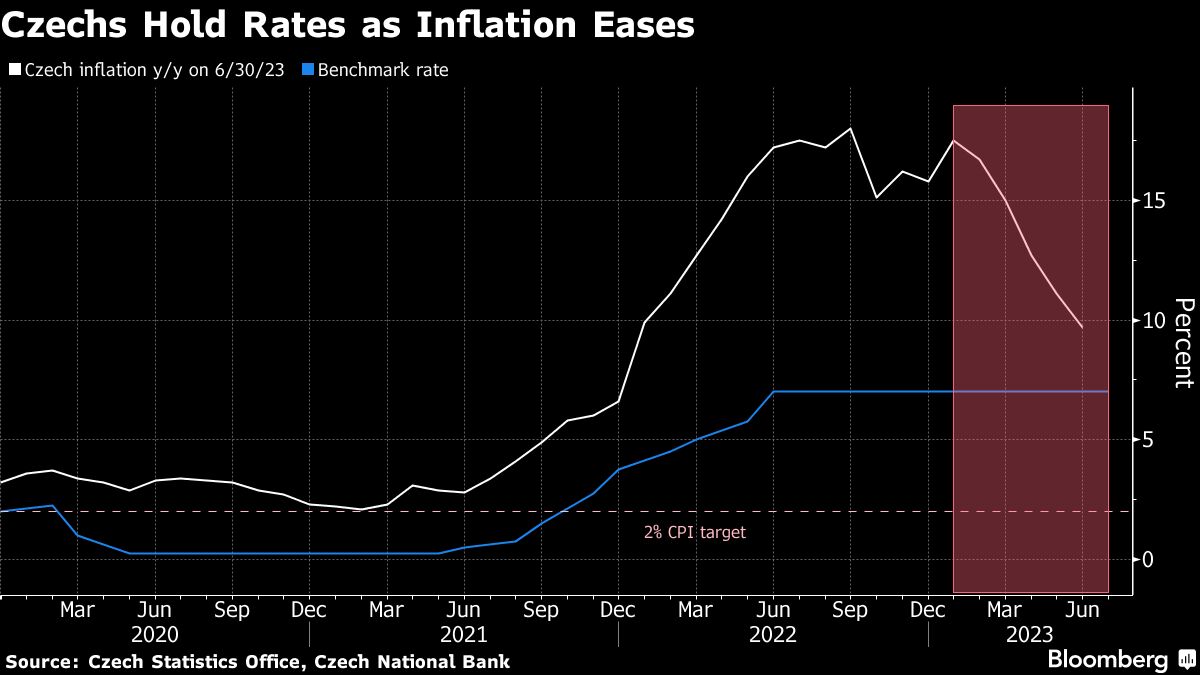
Policy makers held the key rate at 7% on Thursday, as expected, maintaining the highest borrowing costs since 1999. The benchmark has been at that level for more than a year as the country begins to recover from the worst cost-of-living crisis in three decades.
The bank formally ended an intervention regime it had used to prop up the koruna, but said that it will still prevent excessive currency swings that would threaten to jeopardize price or financial stability.
The board also scrapped its previous guidance about stable or higher rates, and Governor Ales Michl for the first time said discussions about when to lower rates may start this fall.
But policymakers agreed that borrowing costs will remain higher than suggested in the fresh forecast, with Michl reiterating his warning that market bets on the pace of cuts “may not materialize.”
“The debate will be on the table in the fall at the earliest, but it will be only a debate and all options are open,” Michl told reporters in Prague when asked about the outlook for policy easing.
The bank is weighing a sluggish recovery from recession, caused largely by depressed household spending, against the threat that a persistently tight labor market will fuel price growth over the longer term.
While recent data show economic growth stuck near zero and inflation easing into single digits for the first time in 17 months, Michl said risks to inflation were still tilted to the upside.
Current interest rates are sufficient to bring inflation to the 2% target, the governor said, adding that price growth is still too fast and the forecast envisaging next year’s core inflation above 3% doesn’t allow the policy panel to consider lowering borrowing costs for now.
Read More: Markets Likely Wrong on Czech Rate Cuts, Central Banker Says
The koruna fell as much as 1.2% after the announcement, the biggest drop this year.
It traded down 1% at 24.19 per euro as of 4:50 p.m.
The bank, which last intervened to prop up the currency in October, also resumed the sale of part of its income on international reserves and ended the intervention regime because “it has lost its purpose,” Michl said.
“A strong koruna is still essential for the entire bank board and it’s very important for achieving low inflation,” he said.
The decision on the currency means central bankers are likely to tolerate a somewhat weaker exchange rate, said Marek Drimal, a strategist at Societe Generale in London.
“The tone of the press conference was overall dovish, as the governor didn’t rule out a potential rate cut in September, as unlikely as it still is,” Drimal said.
–With assistance from Deana Kjuka.
(Recasts with comments from news conference throughout.)
More stories like this are available on bloomberg.com
©2023 Bloomberg L.
P.