
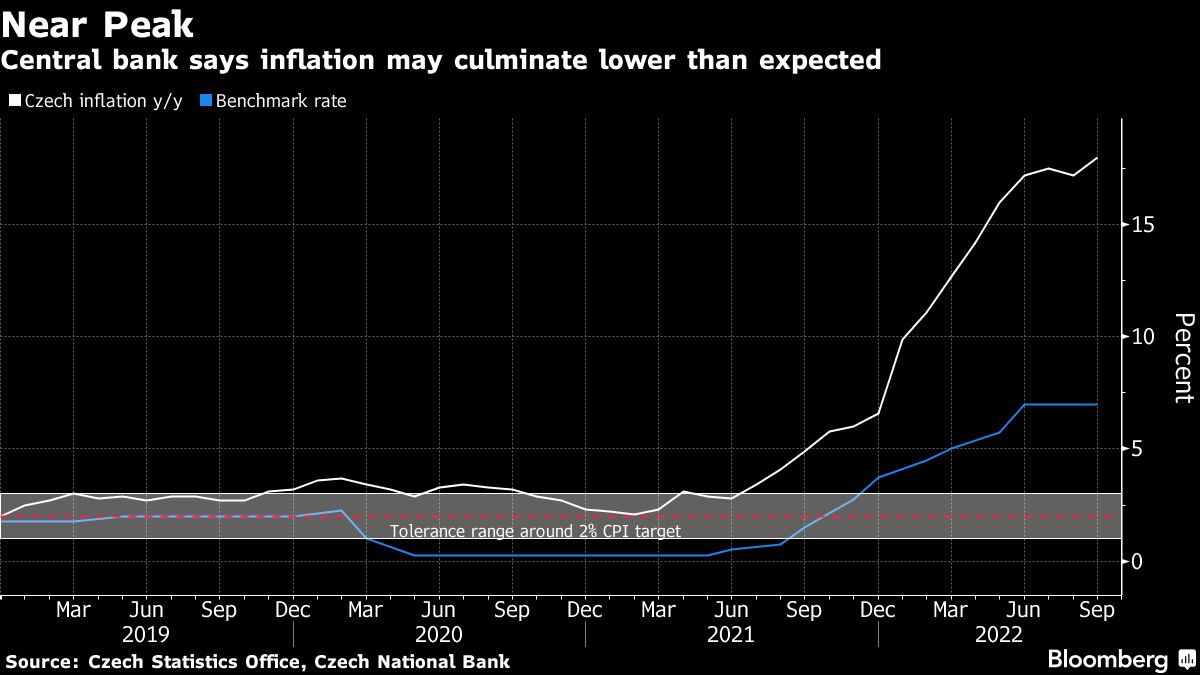
(Bloomberg) — The Czech Republic held borrowing costs at the highest level since 1999 as the central bank expects a looming recession to curb the worst inflation in three decades.
Policy makers left the benchmark rate at 7%, keeping it stable for a third meeting after the bank’s new leadership halted a year of rapid monetary tightening. The bank also said it will maintain its intervention policy of preventing excessive koruna swings, which has helped the currency outperform regional peers this year.
Governor Ales Michl will comment on the decision at a news conference scheduled for 3:45 p.m. in Prague.
He’ll also present highlights of the bank’s new economic forecasts.
While major global central banks are ramping up rate hikes to bring inflation under control, the majority of Czech policy makers consider borrowing costs high enough to tame domestic price pressures. They say more hikes would hurt the export-oriented economy too much, especially as the risks of a recession increase.
Data showed this week that gross domestic product declined in the third quarter as surging energy costs forced households to limit other spending.
The central bank’s latest prognosis outlined another quarterly contraction in the last three months of the year.
Komercni Banka AS predicts rates to stay unchanged at least until the middle of next year, although it sees upside risks stemming from higher inflation expectations and anticipated wage growth.
“The government’s loose fiscal policy and the continued fast interest-rate increases abroad are also factors playing in this direction,” Komercni analyst Jaromir Gec said in a report ahead of the meeting.
Read more:
- Czech Central Banker Sees Signs of Easing Inflation Pressures
- Citi Sees One More Czech Rate Hike to Curb Sticky Inflation
- Record Current-Account Gap Is Fresh Blow to Czech Koruna Outlook
Central bankers who oppose further hikes are watching wage growth and state spending as indicators of future local price pressures.
They say slowing credit growth, combined with declining real household income and weaker economic activity, will eventually help bring inflation to the 2% target.
By contrast, two remaining hawkish policy makers have pointed to rising inflation expectations, saying the bank should do more to cool domestic demand and curb price growth.
–With assistance from Deana Kjuka and Harumi Ichikura.
More stories like this are available on bloomberg.com
©2022 Bloomberg L.
P.