
(Bloomberg) — White House aide Larry Kudlow said a new wave of coronavirus cases hasn’t appeared even as new infections jump 2.8% in Florida and increase in other states. New York subway ridership increased 25% in one week as people returned to work.
Brazil’s outbreak, second only to the U. S., may be far wider than reported, researchers said. Norway and Finland will reopen for regional travel, except with Sweden where infections are high.
The European Union will seek deals with drug makers to secure a protective shot.
The International Monetary Fund said the global economy will recover more slowly than expected.
Key Developments:
- Virus Tracker: Cases pass 7.5 million; deaths exceed 422,000
- Covid-19’s renewed assault on America is underway
- Resurgent virus returns governors to crucible amid reopening
- How a “second wave” sparks renewed pandemic fears
- Universal Studios’ crowds look thin after reopening
- Johnson & Johnson is speeding up its vaccine timetable
- Americans return to car dealers, thwarting expected shift online
Subscribe to a daily update on the virus from Bloomberg’s Prognosis team here.
Click VRUS on the terminal for news and data on the coronavirus. For a look back at this week’s top stories from QuickTake, click here.
N. J. Sales Taxes Drop 29% Amid Lockdown (12:55 p.m. NY)
New Jersey sales-tax collections during the economic lockdown plunged by a record 29% in May from a year earlier, a bigger decline than the worst month of the Great Recession, according to the state treasury department.
The number reflects collections in April, the first full month of the shutdown, as sales taxes report on a one-month lag.
Revenue from the alcohol beverage excise tax increased 8.7% in May. Casino collections fell 34%, the state said.
Brazil Outbreak Wider Than Data Shows: Survey (12:45 p.m. NY)
Novel coronavirus infections in Brazil, which has the second-most cases in the world, may be far more widespread than official data suggest, a new study reveals.
Researchers at the University of Pelotas in southern Brazil estimate six unreported cases for every one confirmed diagnosis across 120 cities studied The conclusion is based on tests and interviews with more than 31,000 people conducted June 4-7.
In Rio de Janeiro, where the government tally lists 40,000 cases, up to half a million people may have been exposed, they said. Brazil has 802,828 cases, according to John Hopkins University data, trailing the 2 million in the U. S.
“The number of people with antibodies is in the millions — not thousands,” the authors said in a statement.
N. Y. Cases in Line With Average (11:45 a.m.
NY)
New York registered 42 new deaths on Thursday, a slight rise from the 36 reported a day earlier, Governor Andrew Cuomo said. New cases rose 0.2%, matching the seven-day daily average.
Cuomo at his daily briefing displayed charts showing New York City”s infection rate down to 1.5%, ranging from 1.1% in Manhattan to 1.9% in Queens. The rate in six of the state’s 10 regions is below 1%, while Long Island is at 1% and Western New York is 1.4%.
HHS Chief Denies Trump Rift With Advisers (11:30 a.m.
NY)
Health and Human Services Secretary Alex Azar denied President Donald Trump is at odds with his advisers as more states reopen their economies without meeting the guidelines of a White House task force of his health experts. Trump has been urging states to open faster.
“The guidelines are guidelines,” Azar said in an NBC News interview to be broadcast Saturday. “They’re simply potential markers for how one would progress to reopening.
But each governor knows the lay of the land in their state better.”
Florida Cases Jump Most in 6 Weeks (11 a.m. NY)
Florida cases rose 2.8% to 70,971, the biggest daily jump since May 1, as the state continued to roll back restrictions five weeks after reopening. The average daily increase was 2% in the previous seven days. Deaths reached 2,877, an increase of 1%.
As recently as Thursday, Governor Ron DeSantis downplayed concerns about the up-tick, saying it reflected increased testing and isolated outbreaks in long-term care facilities, prisons and agriculture communities.
The new positivity rate — people testing positive for the first time — was 5.01% on Thursday, the third straight day above 5%.
Previously, it had topped 5% just twice in the past four weeks. Hospitalizations on a seven-day basis were on a steady decline until this week when they began to rise again, though slightly.
NYC Subway Ridership Up 25% (10:40 a.m. NY)
New York City subway ridership jumped 25% Wednesday from the previous week as businesses began coming back to life after three months of lockdown, Mayor Bill de Blasio said. “Our job is to get working people back to work,” he said.
Monday marked the start of the first phase of reopening for manufacturing, construction, wholesale and curbside retail businesses.
Subways carried 851,000 passengers Wednesday, representing 15% of the pre-pandemic ridership, the Metropolitan Transportation Authority said.
Bus ridership increased 23% from a week earlier, to 914,000 — or 42% of pre-pandemic levels. Staten Island Ferry passengers were up 31%, de Blasio said.
Norway, Finland Ease Regional Travel (10:40 a.m. NY)
Norway will allow unrestricted leisure travel throughout the Nordic region starting next week, but keep restrictions on most areas of Sweden.
After opening for travel to Denmark, Norway is easing restrictions for Finland, Iceland and Greenland from June 15, Prime Minister Erna Solberg said.
Due to high infection levels in Sweden, which adopted a more liberal strategy, only travel to the Baltic Sea island of Gotland will be allowed, Solberg said.
On Thursday, neighboring Finland also removed regional travel restrictions, excluding Sweden. The Swedish government on Friday extended a temporary ban on entries to the European Union via the country until June 30.
England Infection Rate Rose (10:30 a.m.
NY)
The estimated coronavirus transmission rate may have risen in England over the past week, according government scientists, suggesting efforts to ease the U. K. lockdown may need to slow.
The so-called ‘R’ number, representing new people infected by each case, is likely between 0.8 and 1. That compares with an estimate of 0.7 to 1 a week ago. Regional assessments of the R number suggest it may be greater than 1 in southwest England.
The Office for National Statistics on Friday estimated the number of infected people was 33,000 from May 25 to June 7, down from 53,000 the previous week.
Centene Says Covid to Drop Medical Costs (10:20 a.m.
NY)
Health insurer Centene Corp. said it paid $221 million in Covid-19 claims through May, which is less than 1% of its total medical costs.
Coronavirus-related costs for insurers have been more than offset by a drop in other care, as patients defer elective surgeries and skip emergency visits. Centene said the net effect from the pandemic to lower its medical costs for the year.
The average cost of an inpatient Covid claim was $9,500, according to Centene, which focuses on government-sponsored health programs including Medicaid and the Affordable Care Act marketplace, while intensive-care claims were about double that.
Greece to Extend Ban on U.
K. Flights (9:40 a.m. NY)
Greece will maintain a ban on flights from the U. K., which has the second-most Covid-19 deaths, until June 30 and will require mandatory tests for travelers from all airports in Italy, Spain and the Netherlands. Only the land border with Bulgaria will reopen June 15 with Albania and North Macedonia set for July 1. The Greek border with Turkey remains closed, except for trucks, until July 1.
U.
S. Isn’t Seeing Second Wave: Kudlow (9:20 a.m. NY)
The top White House economic adviser, Larry Kudlow, said health experts aren’t seeing a second wave of outbreaks and echoed other officials in saying the U. S. economy will not be locked down again. He said certain spots are seeing a bit of a jump in infections.
Texas, California, Florida and Alabama are among states where infections and hospitalizations are reaching new highs.
Kudlow said 100% or 97% of small businesses will reopen next month.
Lisbon Reports New Cases (9:10 a.m.
NY)
Portugal reported 270 new cases on Friday, taking the total to 36,180. Daily new cases have ranged from 192 to 421 in the past two weeks. The additional cases are mostly in the greater Lisbon region, where authorities have increased testing after new clusters were identified.
EU Approves Virus Buying Plan (8:15 a.m. NY)
European Union regulators won the go-ahead to seek deals with pharmaceutical companies on developing a coronavirus vaccine.
Health ministers cleared a plan to pursue advance purchase agreements with drug companies to supply countries with hundreds of millions of doses.
The European Commission would dip into an emergency pot of more than 2 billion euros ($2.3 billion) to help finance vaccine research. The goal is to strike accords with a handful of businesses that have sufficient production capacity in the 27-nation bloc.
Masks Can Reduce Virus Spread, Study Finds (6:41 a.m.
NY)
Masks could reduce the growth rate of coronavirus infections by 40%, according to a study of German towns and cities that introduced face-covering rules for public transit and shopping in April. After running models designed to remove the effects of other public-health measures, the researchers concluded that masks are a cheap and efficient way to manage the outbreak.
More Students to Return in England (5:55 p.m.
HK)
Almost nine in 10 secondary schools and colleges in England will allow more pupils to attend from Monday, according to a survey by the Association of School and College Leaders. Students who are taking exams, including GCSEs and A-levels, will be among those returning to face-to-face education.
Chinese Vaccine Maker Inks Deal in Brazil (5:27 p.m. HK)
China’s leading coronavirus vaccine developer signed an agreement with a research center in Brazil to conduct further testing of its shot’s efficacy, as the global race intensifies to come up with the first viable candidate to prevent Covid-19.
Beijing Reports Cases for a Second Day (4:26 p.m.
HK)
Beijing declared two positive tests on Friday after Thursday’s confirmation of a case broke a 55-day spell of no detections. Officials temporarily closed a food market visited by one of the newly infected persons while primary schools won’t fully reopen as previously scheduled.
F1 Cancels Three Races (3:00 p.m. HK)
Formula One has canceled races in Singapore, Japan and Azerbaijan for the 2020 season due to the pandemic.
It’s the first time in 12 years that Singapore will not host a Formula One race, while the Azerbaijan Grand Prix was held for the first time in 2017.
Hungary’s Orban Reluctantly Backs EU Fund (2:21 p.m. HK)
Hungarian Prime Minister Viktor Orban said he’s come around to support the European Union’s plan to jointly finance a 750 billion-euro recovery fund, but there’s still work to do to agree on its fair distribution.
U.
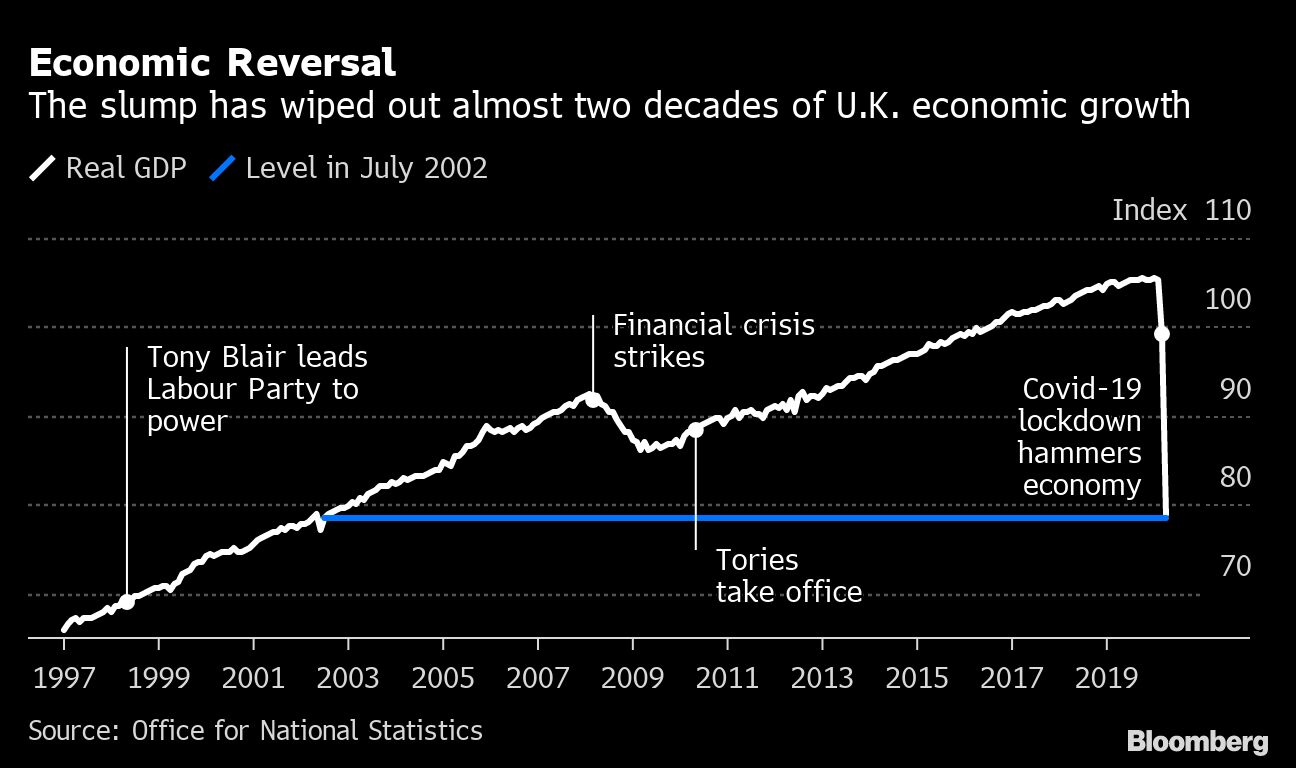
K. Economy Contracts by Record 20% in April (2:06 p.m. HK)
The U. K. economy shrank a record 20.4% in April as businesses and workers reeled under the lockdown designed to control the coronavirus pandemic. The contraction, which followed a 5.8% drop in March, will prompt louder calls for the government to press ahead with plans to ease restrictions.
Thailand Eases Lockdown (1:41 p.m.
HK)
Thailand will end most of its remaining lockdown curbs and allow more businesses in the country to reopen on June 15 after no local coronavirus transmissions were found for over two weeks. The civil aviation authority will allow the beach resort island of Phuket to resume airport operations from June 13.
India Overtakes U. K. in Cases (1:17 p.m. HK)
India’s coronavirus infections rose by 10,930 to overtake the total number of recorded cases in the U.
K., making it the world’s fourth-worst affected nation. The South Asian nation recorded 297,535 infections by Friday, compared to the U. K.’s 292,860, according to data collated by Johns Hopkins University. After burgeoning infections in May and June, India now trails only the U. S., Brazil and Russia.
IMF Sees Slower-Than-Predicted Recovery (10:33 a.m. HK)
The global economy is recovering more slowly than expected from the pandemic and will bear lingering scars from the experience, International Monetary Fund Chief Economist Gita Gopinath said in a video released Friday.
The IMF is set to release economic growth projections June 24 that “will be, very likely, worse than what we had” in April, Gopinath said.
In April the IMF estimated the global economy would shrink by 3% this year — the deepest contraction since the Great Depression.
For more articles like this, please visit us at bloomberg.com
©2020 Bloomberg L. P.