
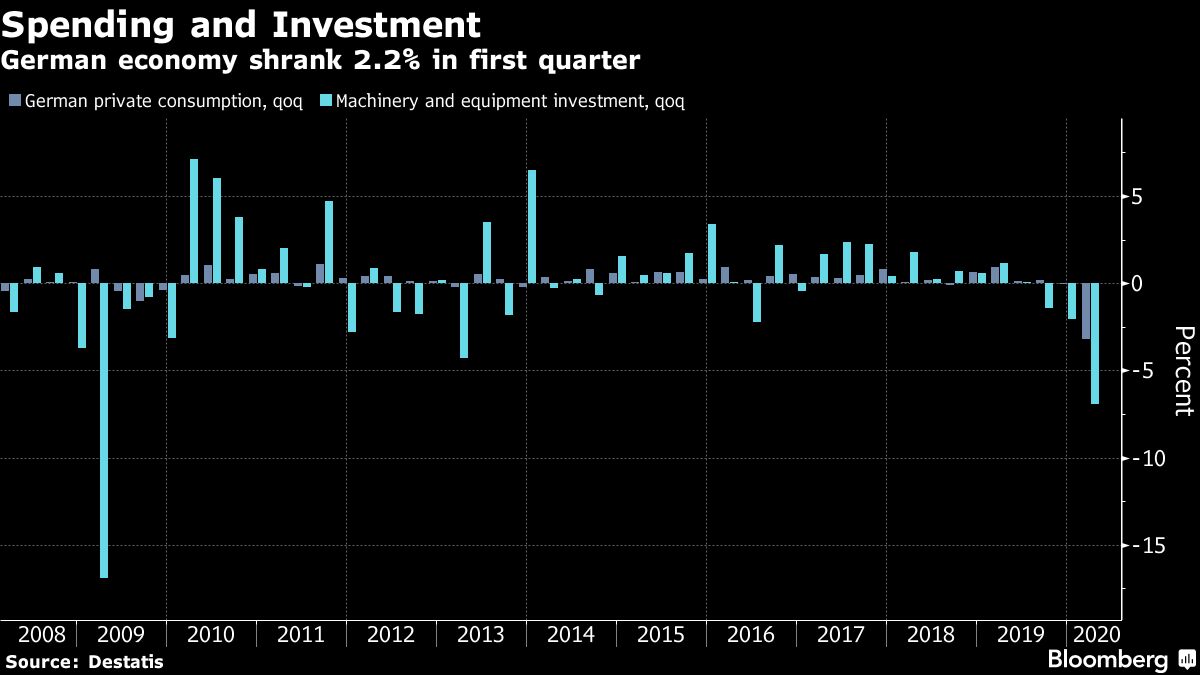
(Bloomberg) — German companies and consumers slashed spending even before the full force of the pandemic restrictions hit, plunging Europe’s largest economy into a recession at the start of the year.
Machinery investment fell 6.9% in the three months through March, and household spending declined. Government spending and construction provided something of a cushion.
The economy shrank the most in more than a decade in the quarter, even though most containment measures only fully kicked in a week before the end of the period.
Surveys have shown a far worse collapse in April before tentative signs of a bottoming out this month.
The German government has already mobilized more than a trillion euros ($1.1 trillion) to support households and companies, and is hammering out a plan for additional tools to aid the recovery. The Bundesbank has said this quarter should mark the trough of the downturn as restrictions are gradually lifted, but warned that uncertainty about the outlook is very high.
Manufacturers and service providers continue to report steep drops in output this month, though at a slower pace than in April.
A gauge of business confidence is due to show only a small improvement when it is released later on Monday.
Still Germany isn’t faring as poorly as much of the rest of the euro area. That’s partly because the nation was more successful in containing the virus and eased its lockdown restrictions sooner.
The economy is also more reliant on manufacturing and trade which, while badly hit, have weathered the crisis slightly better than the services and tourism industries that are dominant in Europe’s south.
The European Commission forecasts that the German economy will shrink by 6.5% this year — the worst recession since Word War II, but still better than an expected contraction of more than 9% in Italy, Spain and Greece.
For more articles like this, please visit us at bloomberg.com
©2020 Bloomberg L.
P.