
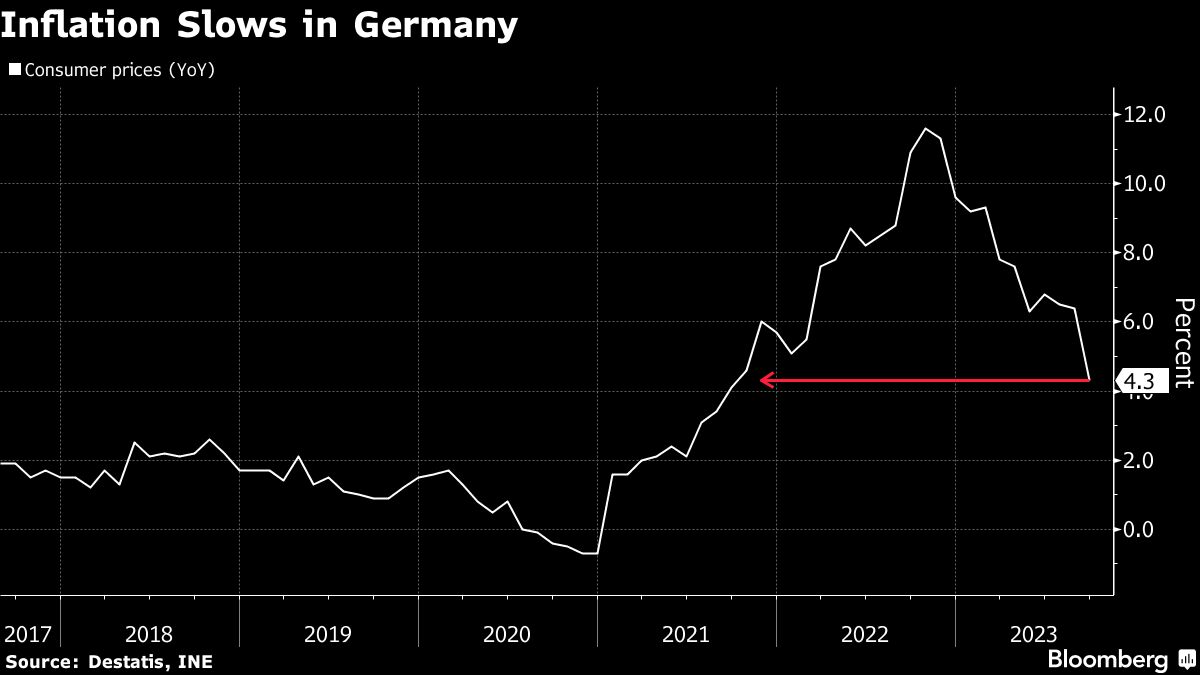
German Inflation Sinks to Lowest Level Since Before Ukraine War
(Bloomberg) — German inflation plunged to its lowest level in two years after the effect of heavily discounted public transport last summer disappeared from the comparison.
Consumer prices advanced 4.3% from a year ago in September, compared with 6.4% in August, the statistics office said Thursday.
While that’s the slowest pace since Russia’s invasion of Ukraine sent energy costs soaring, it remains more than double the European Central Bank’s 2% goal for the 20-nation euro zone.
Prices rose 0.2% on the month.
The data from Europe’s largest economy will cement expectations for the ECB, barring any shocks, to stop raising interest rates following an unprecedented 10 straight hikes. That doesn’t mean a cut is imminent: Officials say they’ll keep borrowing costs at restrictive levels for a prolonged period to get price gains back to the target.
As markets increasingly come around to that higher-for-longer narrative, figures from Spain earlier Thursday showed inflation jumped to 3.2% this month on electricity and fuel costs.
Citing the advance in oil that’s brought prices near $100 a barrel, the central bank there sees a further acceleration to 4.3% in 2024.
That’s among upside risks to the ECB’s prediction that euro-area inflation will return to 2% in the second half of 2025. A separate report from the European Commission showed consumer-inflation expectations at their highest since May.
There are downside risks, too, as the region’s economy sours.
German output will shrink by 0.6% this year, according to new forecasts by five institutes that advise the government — a gloomier take than the International Monetary Fund and the European Commission. The institutes see this year’s 6.1% inflation reading easing to 2.6% in 2024 and 1.9% in 2025.
September’s German data show price pressures are abating, even if the size of the retreat is boosted by the base effect of the government offering unlimited local and regional transport for €9 ($9.48) a month between June and August 2022.
Bundesbank President Joachim Nagel has warned against sounding the all clear on inflation, saying further rate hikes may yet be needed.
September figures for the euro-area, due Friday, are expected to reveal a drop to 4.5% from 5.2% — the lowest since late-2021.
–With assistance from Joel Rinneby.
More stories like this are available on bloomberg.com
©2023 Bloomberg L. P.