
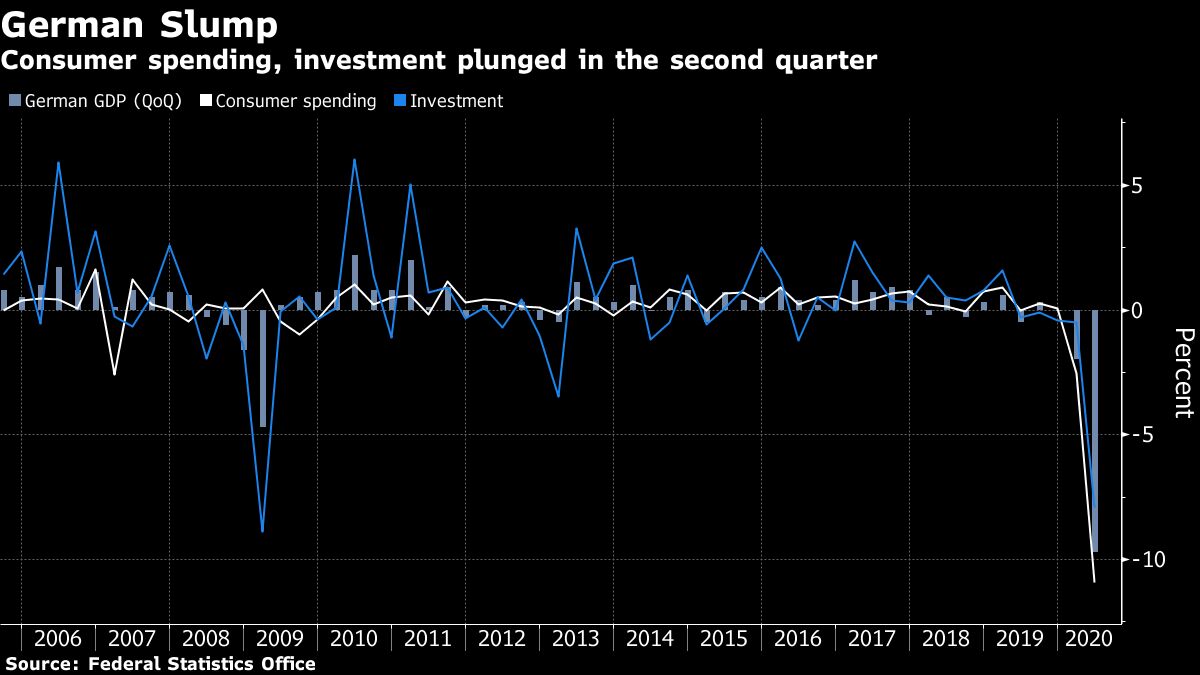
(Bloomberg) — German companies and consumers cut spending sharply during virus-related restrictions, leaving the economy in a deep slump from which it will only slowly recover.
Figures from the statistics office show investment collapsed by 7.9% in the second quarter and household spending slid 10.9%, resulting in a 9.7% drop in total output, revised from an initial 10.1%. Exports registered a decline of more than 20%.
Public consumption rose on the back of massive fiscal support, blowing out the government’s budget.
The country recorded a deficit of 3.2% in the six month through June, the first shortfall since Europe’s debt crisis in 2013.
Since then, industrial production and retail sales have roared back to life, suggesting the economy is making progress in recovering lost ground. But companies remain skeptical about the outlook, and signs are increasing that the brisk rebound following the end of lockdowns has started to flag.
Finance Minister Olaf Scholz predicts gross domestic product won’t reach pre-crisis levels before late 2021 at the earliest.
He’s proposed extending job-preserving subsidies to 24 months to prevent a spike in unemployment ahead of next year’s elections.
The Bundesbank has also urged patience. Exports are hampered by fresh infections in many countries, and high uncertainty about the virus is damping investment, it said.
The Ifo institute’s business climate index due at 10 a.m. Munich time will provide the latest snapshot of the economy.
It’s forecast to show a slight pickup in confidence.
Purchasing managers have already signaled weakening momentum in August, and profit warnings have arrived thick and fast.
Car rental company Sixt scrapped its forecast for this and next year due to conditions in the travel industry. TUI AG, the world’s biggest tour operator, reported a 1.1 billion-euro ($1.3 billion) quarterly loss.
And German airline Lufthansa, already set to cut 22,000 jobs and sell at least 100 planes, doesn’t expect demand to return to normal before 2024.
(Updates with budget deficit in third paragraph.)
For more articles like this, please visit us at bloomberg.com
©2020 Bloomberg L. P.