
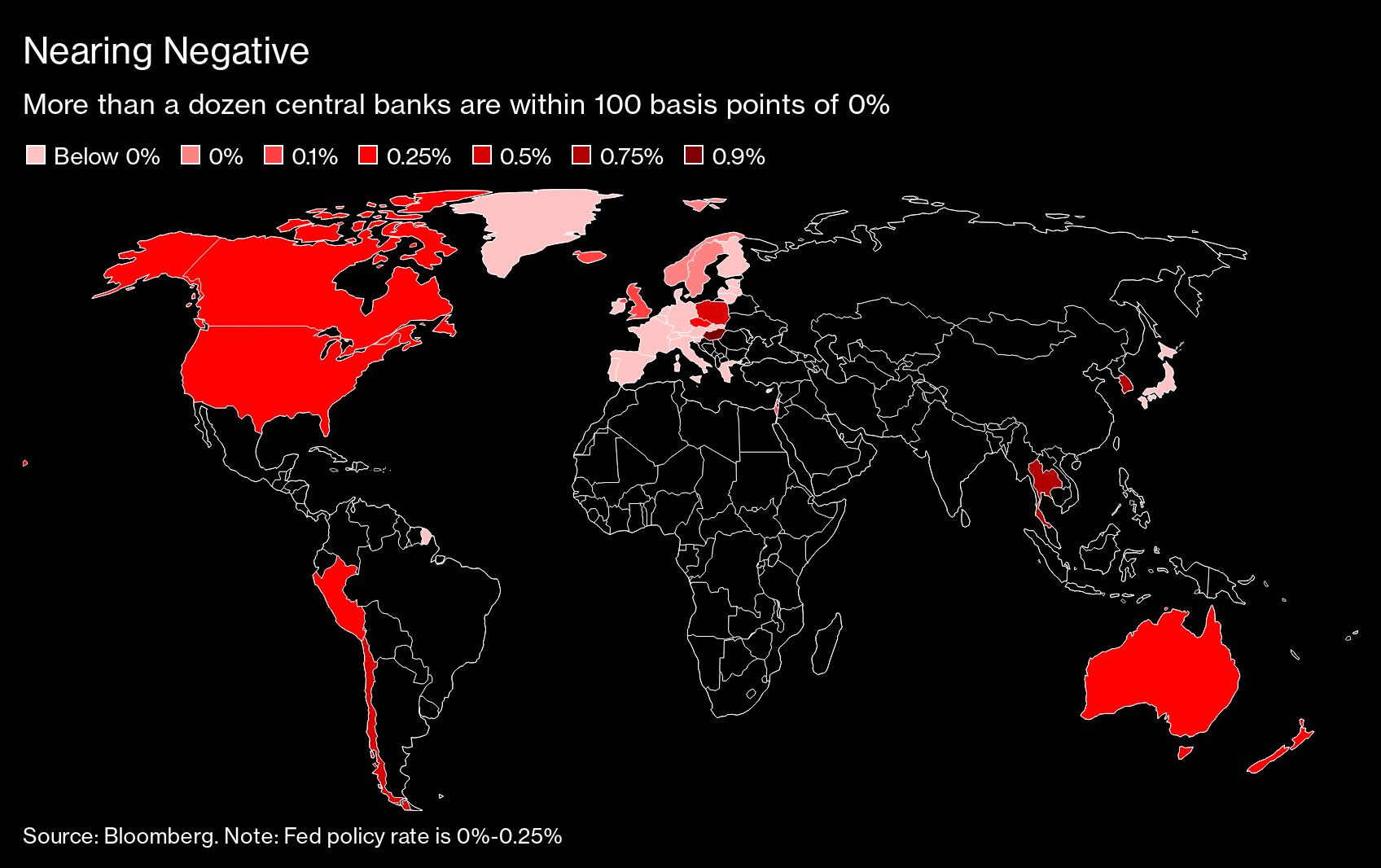
(Bloomberg) — Global central bankers are echoing Federal Reserve Chairman Jerome Powell’s latest dismissal of negative interest rates, just as investors bet more of them will be dragged into the policy amid the coronavirus crisis.
Bank of England Governor Andrew Bailey and Bank of Japan Governor Haruhiko Kuroda both weighed in on Thursday by suggesting their focus is on bond purchases to keep borrowing costs low, and on lending programs to keep credit flowing.
The comments are something of a warning to investors who continue to wager the Fed and BOE will cut below zero by next year.
President Donald Trump has implored Powell to use the policy, tweeting on Tuesday that the U. S. should accept the “gift” used by other countries. Japan and three central banks in Europe still apply negative rates in a bid to spur spending and lending, a smaller club since Sweden exited the measure to ease the pain on bank profitability and investment funds.
“I’m taking central banks at their word on this — certainly the Fed and the BOE,” said Peter Dixon, an economist at Commerzbank AG in London. “When you think about what negative interest rates are doing to the banking system for example, it just makes life an awful lot harder.”
One of the boldest monetary policy experiments of the 21st century, negative rates have been the norm in much of Europe for more than half a decade.
But the measure has encountered increasingly vocal opposition in the euro region from both banks and savers who say the policy robs them of returns.
Against that backdrop, Powell’s protests resisting subzero rates have been categorical, and his comments on Wednesday matched that tone.
“I know that there are fans of the policy, but for now it’s not something that we’re considering,” the Fed chairman said. “We have a good toolkit, and that’s the one we’ll be using.”
Central bankers still like to rule nothing out, and Bailey did just that even as he insisted in a web conference — a week after keeping the benchmark at 0.1% — that subzero rates are “not something we are currently planning for or contemplating.”
Subzero policy has its defenders.
In an article this month, Harvard University Economics Professor Kenneth Rogoff said most objections are “either fuzzy-headed or easily addressed” and only “effective deep negative interest rates can do the job” of raising inflation.
Meanwhile, New Zealand’s central bank said this week that it’s open to cutting below zero, though its immediate action was to almost double its quantitative easing program.
Such views are an opening for investors. “Markets are told not to do it, but yet they keep doing it,” said Andreas Steno Larsen, the chief global strategist for currency and rates at Nordea Bank, calling it a “pure risk/reward” trade.
While the Fed cut rates to nearly zero as the pandemic struck, it has since focused on unlimited bond purchases and programs to bolster lending to companies and households.
The BOE has taken a similar strategy in coordination with the government.
What Bloomberg’s Economists Say
“Powell’s comments show a willingness from the Fed to do more to support the economy, but negative rates will not be in contention.”
-Carl Riccadonna and Andrew Husby. Read their U. S. INSIGHT
Powell and Bailey may have good reason to hold fire on rates. Six years since the European Central Bank took the plunge below zero, the results have been mixed.
Banks complain they’re picking up most of the cost, payable as a charge on deposits at the central bank.
That’s dangerous if the squeeze on profits discourages lending. The policy is also politically unpopular, especially among northern European savers.
The ECB has been an ardent supporter of negative rates, and an article in its Economic Bulletin on Thursday still insisted that “the main component of bank profitability, net interest income, has so far remained rather resilient.”
Yet many of its 25 policy makers reckon the measure has reached its limits.
They’ve avoided further reductions in the deposit rate — now at minus 0.5% — instead ramping up bond purchases and bolstering loan programs for banks. While they have cut rates on long-term loans, resorting to such technical tweaks that the general public won’t necessarily notice shows how politically toxic the issue has become.
List of Priorities
In Japan, Kuroda has started emphasizing that keeping struggling businesses afloat with financing is his main priority.
The BOJ’s key rate has been just below zero since early 2016, and on Thursday he put further reductions last in his list of policy options.
That leaves negative rates as a tool to guide exchange rates one of the strongest arguments. Denmark actually raised its rate to minus 0.6% in March to prop up the krone, while a Swiss National Bank policy maker threatened as recently as this week to cut its rate of minus 0.75% — the world’s lowest — again if needed.
While weakening the dollar could be one motivation for Trump’s pressure on Powell, it shows no sign as yet of bearing fruit with a Fed move below zero anytime soon.
“We can assume that this isn’t going to happen right now,” Jane Foley, a foreign-exchange strategist at Rabobank told Bloomberg Television. “Will it happen in the next downturn or the one after that?
I don’t think anyone would want to stick their neck out and say definitely not.”
For more articles like this, please visit us at bloomberg.com
©2020 Bloomberg L. P.