
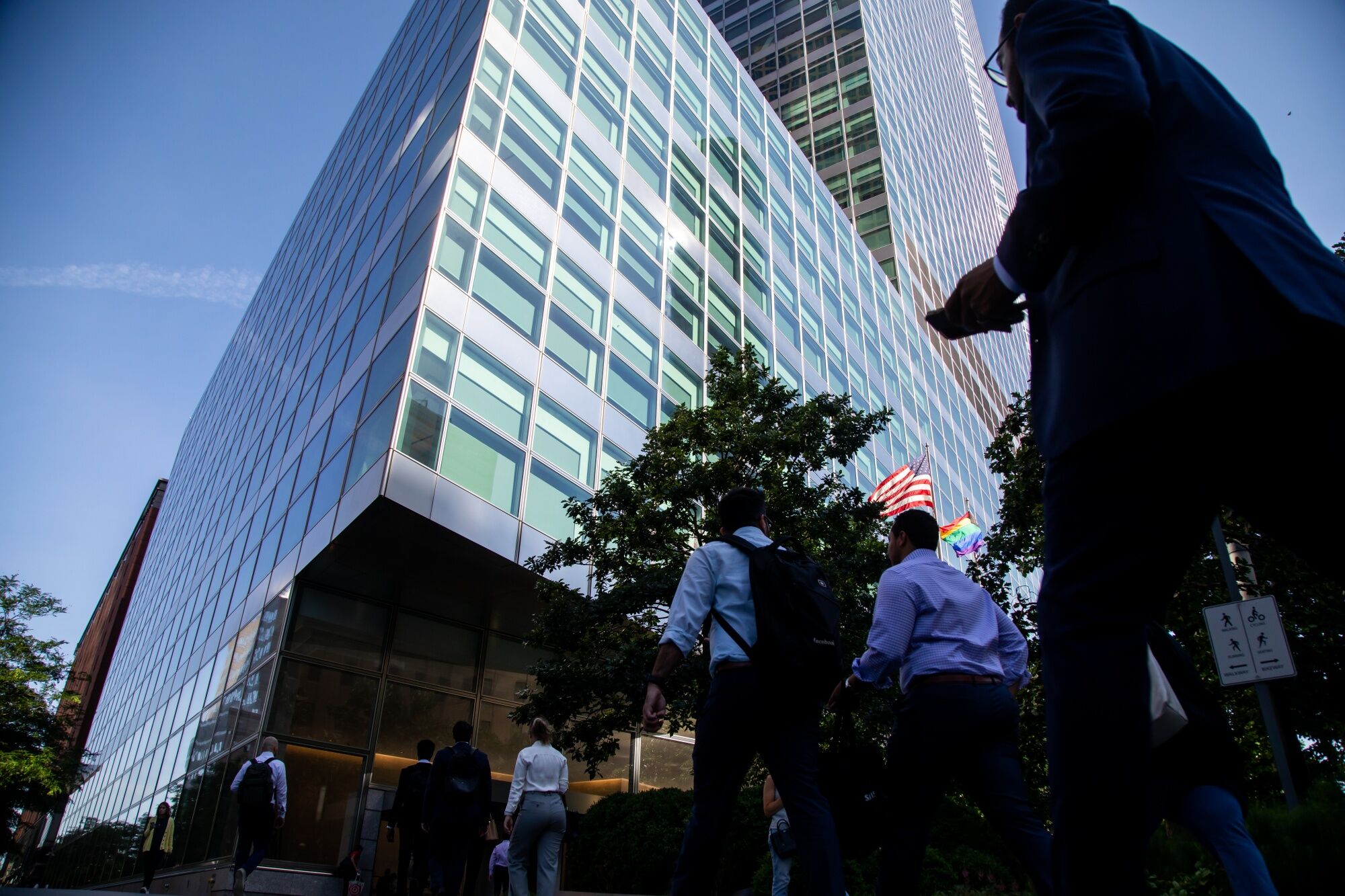
(Bloomberg) — Goldman Sachs Group Inc.’s traders once again helped rescue results from a sharp slowdown in investment banking just as the firm prepares for a reorganization that will combine the two business units.
The trading operation posted $6.2 billion in third-quarter revenue, an 11% increase that was better than analysts had forecast. Fixed income led the gains, according to a statement Tuesday that showed a 43% profit plunge.
Goldman was the last major US bank to post results in a quarter that has highlighted the resilience of the US consumer.
The continued health of the industry’s Main Street operations has helped spur revenue growth, and shelved concern for now about the risks of a sputtering economy.
Chief Executive Officer David Solomon said in an interview that the firm’s market share in most businesses is “growing faster than our competitors.”
In conjunction with Tuesday’s earnings report, Solomon pitched investors on a new vision for the company.
The firm plans to stitch its banking and trading business into one unit, fuse the wealth operation with its expanded asset-management business and have a smaller stand-alone business that focuses on embedded finance — effectively offering up Goldman’s banking services on corporate partners’ platforms.
The revamp includes a pullback from the New York-based company’s strategy of trying to build a consumer-banking operation to diversify revenue.
That effort has suffered setbacks including missed profitability goals.
“As we’ve learned, the concept of really being broad with a consumer footprint is not really playing to our strength,” Solomon said in an interview on CNBC Tuesday.
Goldman shares, which are down 18% this year, advanced 2.3% to $313.75 at 12:04 p.m. in New York.
“I would attribute the outperformance in Goldman Sachs today to a combination of the pullback from the consumer business and the solid results in a challenging environment — with the former more important than the latter,” said Brennan Hawken, a bank analyst at UBS Group AG. “Investors have always been lukewarm, at best, about Goldman’s consumer aspirations.”
Trading revenue exceeded the $5.7 billion average estimate among analysts surveyed by Bloomberg.
The strong performance in fixed income was driven by rates and currencies. Equity-trading revenue of $2.68 billion was in line with expectations, and the best for the quarter on Wall Street.
Banking Slump
Investment-banking revenue fell 57%, bigger than the decline that was predicted as companies steered clear of dealmaking and capital markets. Analysts were expecting the figure to drop by more than half from a year earlier.
Revenue from equity and debt underwriting collapsed, as did merger-advisory fees.
The firm’s asset-management business, which includes the alternatives-investing platform, turned in revenue of $1.82 billion, a 20% drop from a year earlier.
The unit tends to post volatile results because its own balance-sheet investments still drive performance. Goldman has been on a fundraising spree that it hopes will help stop those gyrations. Its wealth-management business posted $1.63 billion in revenue. The two groups will come together as one large unit soon that will be run by Marc Nachmann. As part of the changes, Julian Salisbury will become chief investment officer of that group.
In its planned restructuring, Goldman will disassemble its consumer business, shoving its Marcus-brand direct-to-customers business into the group run by Nachmann.
A separate, smaller unit run by Stephanie Cohen will showcase the operations that house its credit-card tie-ups with Apple Inc. and General Motors, installment-loan provider GreenSky, and the transaction-banking business that takes in corporate deposits.
In the third quarter, consumer-banking revenue was $744 million, mostly driven by higher credit-card balances. The provision for credit losses was $515 million, reflecting consumer portfolio growth and the impact of continued broad concerns on the macroeconomic outlook.
Also in the results:
- Net income dropped to $3.07 billion, or $8.25 a share.
Analysts expected adjusted earnings of $2.8 billion.
- Revenue slid to $12 billion, compared with estimates of $11.4 billion.
- Debt-underwriting revenue fell 55% to $328 million.
(Updates with additional comments from Solomon in fourth paragraph.)
More stories like this are available on bloomberg.com
©2022 Bloomberg L.
P.