
(Bloomberg) — Group of Seven finance ministers and central bank chiefs pledged to enhance policy cooperation and safeguard against downside risks, a draft communique showed on Wednesday.
The G-7 also pledged to preserve financial stability, and said it’s important for regulators to remain vigilant to guard against rising systemic risks as financial conditions tighten, according the draft, a copy of which was obtained by Bloomberg.
In a nod to a surging US dollar, the draft recognized that many currencies have moved significantly with increased volatility.
The draft said the G-7 reaffirmed its April 2021 exchange-rate commitments, a reference to a prior communique.
The IIF is holding its annual meetings alongside those of the International Monetary Fund in Washington this week, bringing global finance and central bank chiefs — along with their development and banking counterparts — to the US capital at a fragile moment for the global economy.
Even after the misery of this year — surging inflation, war in Ukraine, China’s slowdown — Bloomberg Economics is asking whether next year could be worse.
The unfortunate answer is yes, particularly as the Federal Reserve’s rate hikes drive the dollar higher, stressing economies around the world.
The IMF on Tuesday cut its forecast for worldwide growth next year and said that policies to tame high inflation may add risks to the global economy.
(All times Eastern)
Goldman’s Mangone Sees $5 Trillion Need for Climate (11:18 a.m.)
Close to $5 trillion needs to be invested in projects to meet global climate goals, half of which is needed for technologies such as carbon capture and hydrogen, said Kara Mangone, the global head of climate strategy at Goldman Sachs Group Inc.
“It’s easy to feel the climate challenge is daunting but there’s a tremendous amount of innovation happening in capital markets,” she said Wednesday at in a panel discussion hosted by the Institute of International Finance, adding that the passing of a big funding bill in the US will help steer money to newer climate technologies.
Mangone added that $1 trillion is needed to preserve current biodiversity systems but only 10% of that money is being invested.
G-24 Nations Seek Emergency Help, IMF Surcharge Fix (10:41 a.m.)
The Group of 24 developing nations asked international financial institutions for scaled-up support and emergency financing, cautioning that “warning lights are flashing” for many fragile nations.
IFIs such as the International Monetary Fund and the World Bank have already stretched their lending to manage the pandemic and need to expand their resources to support a more difficult recovery now that food and energy insecurity are deepening existing challenges, Bank of Guatemala Governor Alvaro Gonzalez Ricci, who is the current chair of the G-24, said in a statement Wednesday.
The group — which includes Algeria, Argentina, Lebanon and India — called for timely completion of the IMF’s quota review to increase resources.
It also urged correcting the “regressive and procyclical character” of the IMF’s surcharge policy, where it collects commissions on large loans.
The group asked the World Bank and other multilateral development banks to take steps, to “manage risks and leverage their capital more effectively while exploring how to increase lending capacity through capital increases or other options.”
Lagarde Says Monetary, Fiscal Chiefs Must Cooperate (10:07 a.m.)
European Central Bank President Christine Lagarde said policy makers are determined to bring down inflation and argued that cooperation with other monetary authorities and fiscal policy is necessary to succeed.
“We need to have cooperation among ourselves — central bankers — to understand what the spillovers will be, what the spill backs could be, what impact we have on each other and what ramifications it will take because financial markets are extremely integrated and because our respective monetary policies have an impact on other countries around the world beyond,” Lagarde said at an event hosted by the Institute of International Finance.
“We also need to have cooperation between monetary policy and fiscal policy,” she said. “We have to act in a cooperative way because if we don’t, then monetary policy is going to have to be even more determined and and more decisive in its fight against inflation.”
Climate Change Threatens China GDP: World Bank (9:44 a.m.)
Climate change poses a significant threat to the long-term prosperity of China — which emits 27% of global greenhouse gases — but the country is well positioned to meet its climate commitments and transition to a greener economy, the World Bank said.
“Unabated climate change” could lead to estimated GDP losses ranging from 0.5% to 2.3% as early as 2030, the World Bank said in its Country Climate and Development Report for China, released Wednesday.
The impacts threaten the nation’s densely populated and economically critical low-lying coastal cities, which are home to an estimated one-fifth of its population, it said.
ECB’s Knot Sees Significant Hikes to Curb Inflation (8:55 a.m.)
European Central Bank Governing Council member Klaas Knot said a “continued effort” is needed to bring inflation under control, reiterating that at least two more “significant” interest-rate increases should follow last month’s 75 basis-point hike.
Speaking on Bloomberg Television, the Dutch policy maker also said bond markets have become more sensitive to issues of debt sustainability, putting a burden on fiscal authorities to pursue responsible policies.
BOJ to Keep Easing to Lift Inflation, Kuroda Says (8:35 a.m.)
The Bank of Japan will maintain monetary easing in order to support the economy’s recovery from the pandemic and get inflation up to its goal, Governor Haruhiko Kuroda said.
“We have to continue our monetary easing until we achieve the 2% target in a sustainable and stable manner,” Kuroda said at an event at the Institute of International Finance in Washington Wednesday. “The economy is still recovering from the pandemic so we have to continue to support the economy to recover,” he said.
Kuroda stands out among major central bankers as the last holdout on rock-bottom rates and the view that the current wave of inflation is unsustainable.
Japan’s inflation quickened to the fastest pace in over three decades excluding tax-hike distortions in August, creating headaches for the central bank as it seeks to explain why it needs to continue with monetary stimulus when inflation is far above its 2% goal.
“We expect gradually the core inflation rate would rise in coming years,” Kuroda said. “In order to achieve the price-stability target in a stable and sustainable manner it must be accompanied by wage increases.
Wages are certainly rising now but insufficiently to guarantee 2% inflation.”
Governments Must Trim Budgets to Help Inflation Fight, IMF Says (8:30 a.m.)
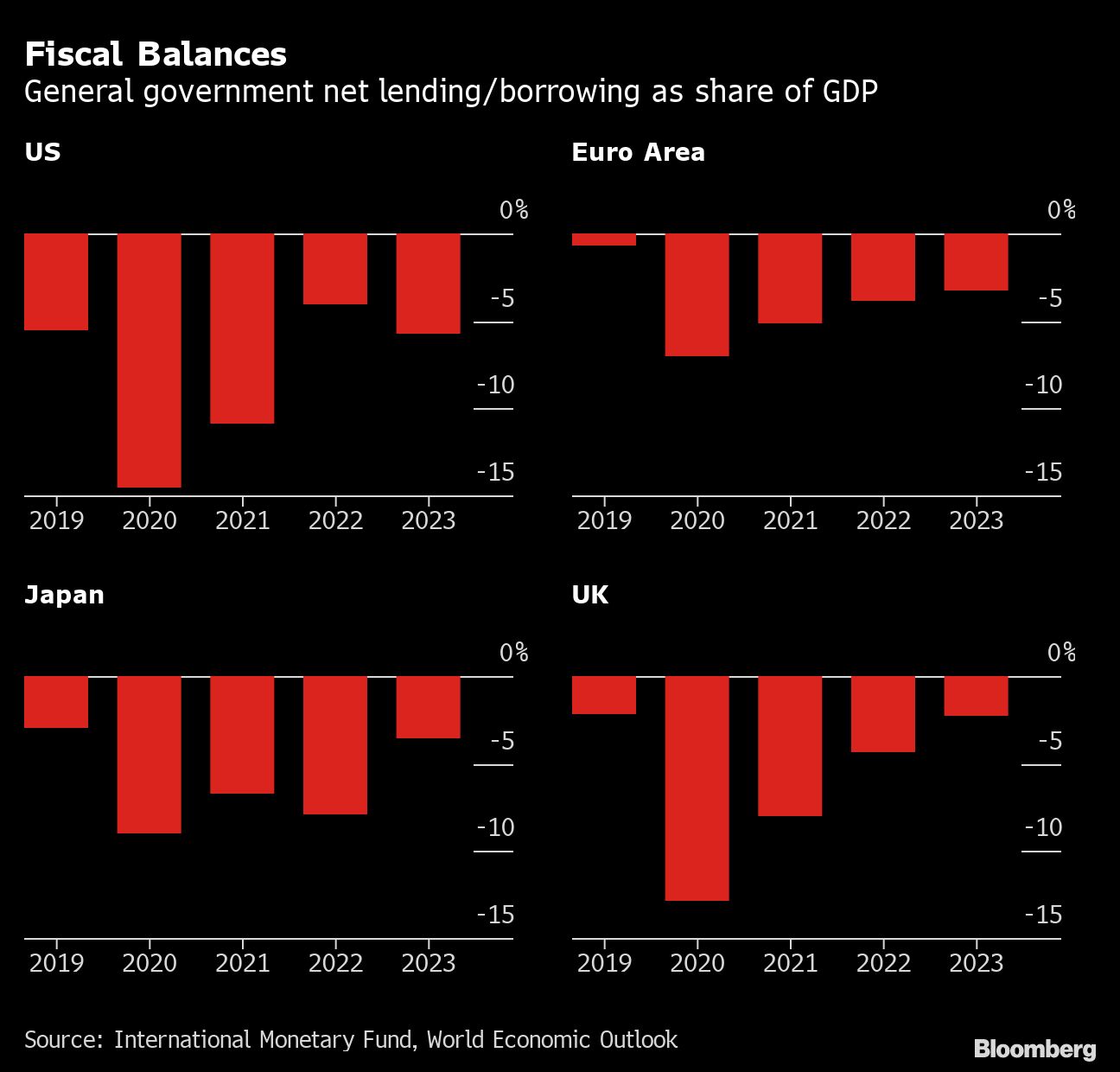
Governments should keep trimming the budget deficits they ran up in the pandemic, even as they seek to help households hit by soaring energy and food prices, the International Monetary Fund said.
Global public debt is set to reach 91% of gross domestic product this year, some 7.5 percentage points above its pre-Covid level, the IMF said in the latest edition of its Fiscal Monitor, published on Wednesday.
While debt ratios have retreated from their 2020 peak, with economies recovering and governments paring back emergency measures, the cost of servicing it is set to rise as central banks drive up interest rates to fight inflation.
And this year’s spike in commodity prices has brought new pressures to spend.
More stories like this are available on bloomberg.com
©2022 Bloomberg L. P.