
(Bloomberg) — One of Indonesia’s major real-estate companies is adding to broader concerns that more Asian property developers will struggle to repay debt.
The firm, which runs an industrial complex east of Jakarta about the size of Manhattan, is seeking approval from investors by Dec. 7 to exchange most of its $300 million 2023 bond for longer-maturity debt. S&P Global Ratings views PT Kawasan Industri Jababeka’s offer as “distressed” and has warned holders won’t be adequately compensated, while Fitch Ratings said the swap is being conducted to avoid default.
The bid by Jababeka, which owns golf and country clubs as well as a power plant, underscores how rising rates are exposing the fragility of some Asia property issuers.
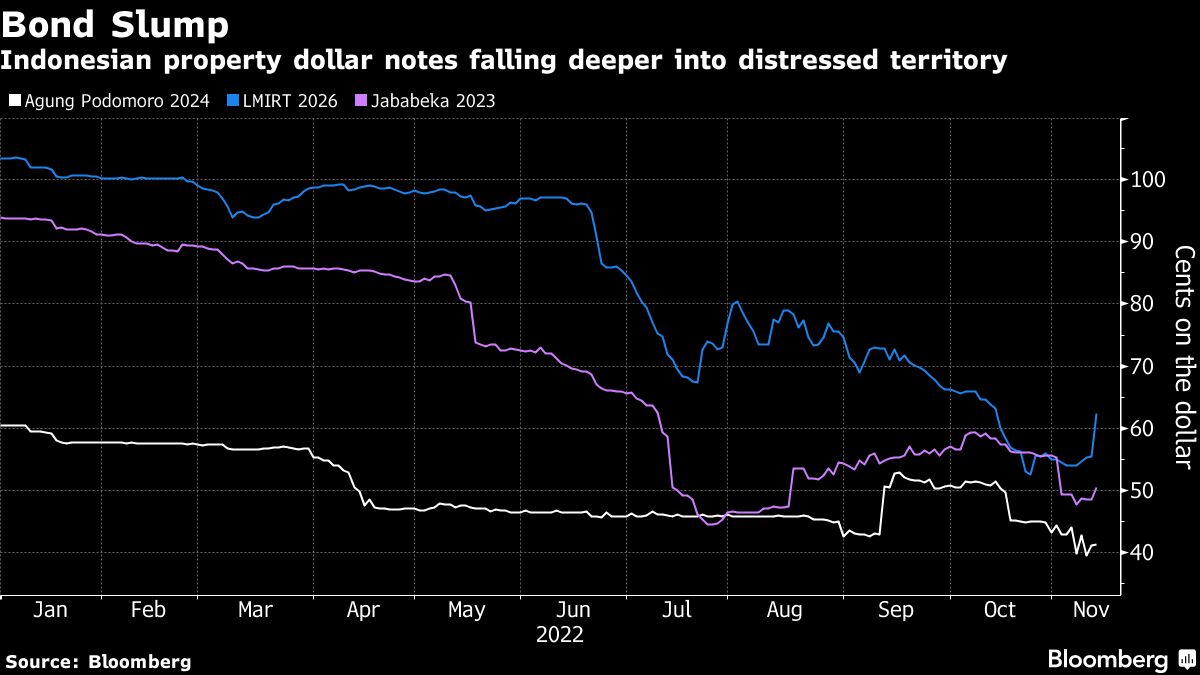
Its dollar bond has extended declines in recent weeks, and along with debt of peers PT Lippo Karawaci and PT Agung Podomoro, is trading at distressed levels.
“Lower-rated Indonesian developers with sizable near-term US dollar debt maturities could face refinancing risks,” Edward Chan, a director at S&P, said in a report this week. “In particular, developers with less recurring income will experience a liquidity squeeze.”
The cracks in Indonesia follow record defaults in China, measures in Korea to prop up the market and stricter corporate bond regulations in Vietnam.
What’s happening?
Jababeka provides real estate for companies like Toyota Motor Corp. and Mattel Inc. to set up and operate factories in Indonesia, tapping the country’s population of over 270 million to gain access to affordable and skilled labor.
It sold the 6.5% junk-rated bonds in 2016 to raise money for general corporate purposes.
Jababeka had ambitious plans to build industrial cities and tourist resorts across the country, but some of those projects were derailed by the pandemic and a 2018 tsunami.
The company is now seeking to extend the tenor of that debt, which matures in October, to 2027. The price of the bonds have almost halved since the start of this year, according to data compiled by Bloomberg. Fitch last week cut Jababeka’s rating further into speculative-grade territory, to C from CC.
The proposed exchange comes amid increasing signs of funding concerns among Indonesian builders.
Like nearly everywhere, rising interest rates in the world’s fourth-most populous nation are hurting demand for property and pushing up debt servicing costs, and those difficulties are being compounded by a strong dollar.
Who’s the company?
Jababeka, which was founded in 1989 and listed on the Jakarta stock exchange in 1994, counts Unilever Plc and Samsung Electronics Co. among its customers.
It’s based in the Kota Jababeka complex, a 22-square-mile development located on a stretch of Indonesia’s main national highway about 35 kilometers (22 miles) east of the capital Jakarta.
The company sought to buy back the 2023 notes in mid-2019, but ultimately said it didn’t have sufficient funds, which led to a change of management and a lawsuit from shareholders. Jababeka said in July last year that it had a plan to repurchase, or redeem the notes early.
The swap offer comes as the company’s cash balance over the past eight quarters has averaged less than $80 million, Bloomberg-compiled data show.
Last month, the developer said it had obtained a $100 million five-year loan with 5.5% interest from PT Bank Mandiri to refinance some bonds and would use land and buildings in a golf course development as collateral.
Muljadi Suganda, an investor relations official at Jababeka, declined to comment on the exchange offer when reached by text message on Thursday.
Why does it matter?
Contagion is the big risk for any financial crisis, and real estate is often where the first signs of trouble emerge, and for some investors the debt exchange offer brought back memories of a near-default episode by Jababeka just before the start of the pandemic.
The current debt exchange plan may set a precedent for other builders in the country whose notes have tumbled to below 70 cents on the dollar, a level typically considered distressed.
Several of them have bonds maturing in coming years:
Emerging-market borrowers around the world face a higher cost of capital due to higher US interest rates. The average price of speculative-grade dollar debt in Asia outside Japan has dropped by nearly a third this year, a Bloomberg index shows.
What to watch for next?
Under its early exchange offer, Jababeka is offering $700 of new notes and $300 of cash for every $1,000 of old securities if bondholders join before Nov. 22.
For those who participate after that, but before the final deadline of Dec. 7, they will receive $700 of the new bonds and $250 in cash in the swap.
If the issuer doesn’t convince bondholders to support the exchange, it would “be left with extremely limited options to repay the notes, due to weak investor sentiment for emerging-market high-yield debt,” Fitch wrote in a report last week.
–With assistance from Sanjit Das.
(Updates bond prices in table.)
More stories like this are available on bloomberg.com
©2022 Bloomberg L.
P.