
(Bloomberg) — Israel’s central bank delivered an unprecedented 10th consecutive interest-rate hike on Monday, trying to damp inflation even with borrowing costs already at their highest level since 2006.
The decision to raise the benchmark to 4.75% from 4.5% was in line with the unanimous forecast of economists surveyed by Bloomberg. It’s the second straight increase of 25 basis points by the Bank of Israel following a string of more aggressive moves starting in April 2022, when rates were near zero.
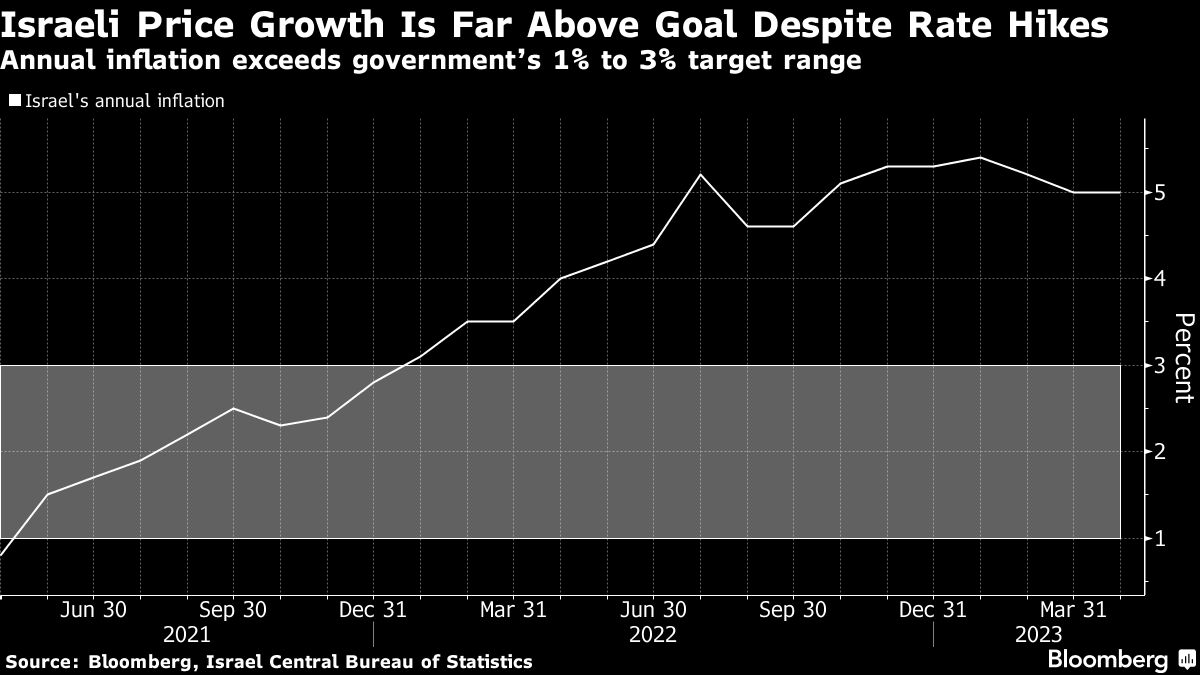
A record monetary tightening cycle is close to peaking despite falling short of taming inflation that’s on track to exceed the government’s target for the second year.
Continued weakness in the local currency is among factors fanning price growth.
But as the Bank of Israel follows its counterparts around the world in contemplating if rates are already high enough, policymakers will be mindful of an economy that’s headed for its slowest expansion since contracting during the global pandemic.
Last Tuesday, the Finance Ministry reduced this year’s outlook to 2.7% growth from a previous 3%.
The International Monetary Fund in a report this month similarly saw the economy gaining just 2.5% — from 6.5% in 2022 — and warned that continued uncertainty around the government’s contentious proposal to weaken the courts presents a risk.
The upshot for economists and the market is that with a global recession still seen looming, Israel will likely taper off monetary tightening in the coming months.
Israel’s one-year currency swaps indicate investors see the base rate rising near 5% a year from now.
“The economic weakness that is taking shape in Israel and, moreover, worldwide, is expected to deepen significantly in the coming weeks and months, leading central bankers across the world to halt their rate hikes — ultimately forcing the Bank of Israel’s hand, too,” Guy Beit-or, chief economist at Psagot Investment House, said before the rate announcement.
Until now the focus for Governor Amir Yaron has been on inflation, which he’s said the Bank of Israel is “determined” to bring to the government’s 1% to 3% target range.
Price growth in April unexpectedly didn’t slow and remained at 5% from a year earlier, driven by higher costs for housing rentals, produce and outbound travel.
On a monthly basis, it reached 0.8%, double what economists had anticipated.
Given that the shekel is more than 3.5% against the dollar this year, Goldman Sachs Group Inc. said that “without the support of the exchange rate, it will be much harder for the central bank to achieve its inflation objective.”
–With assistance from Harumi Ichikura.
More stories like this are available on bloomberg.com
©2023 Bloomberg L.
P.