
(Bloomberg) — The speed of Japan’s recovery from a record economic contraction will partly depend on how quickly an uptick in virus infections can be contained, with policy makers insisting there can be no blanket return to pre-virus ways of life.
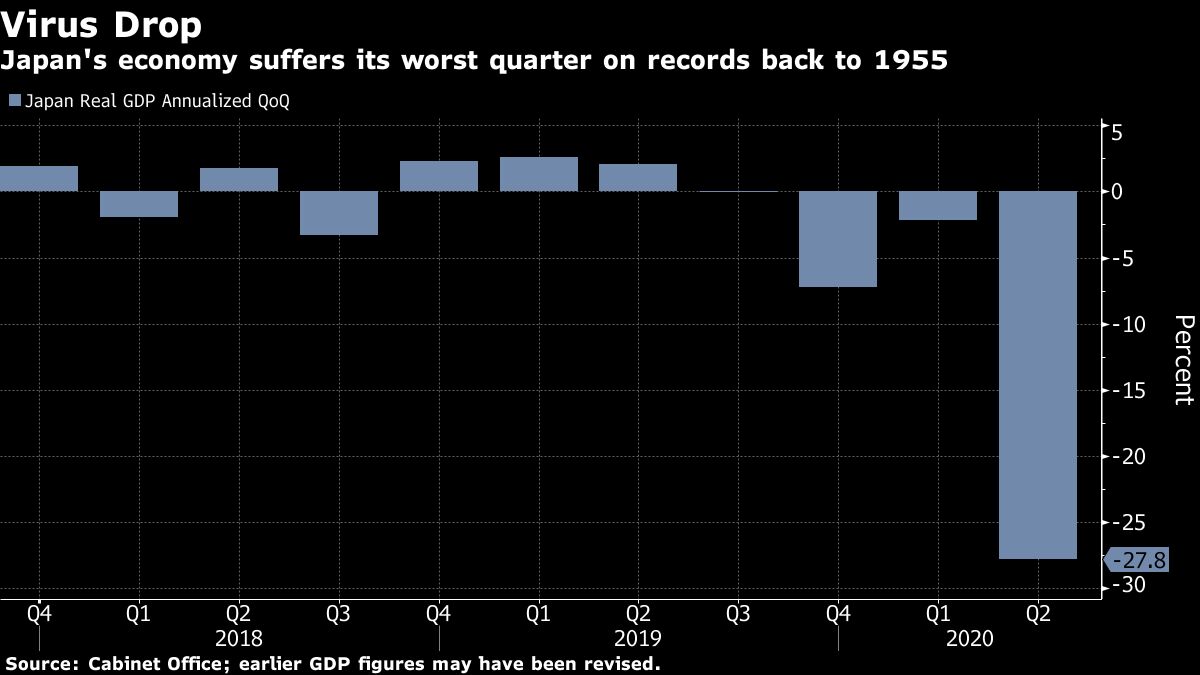
The world’s third-largest economy contracted an annualized 27.8% in the three months through June from the previous quarter as a state of emergency and lockdowns in the country’s major export markets hammered consumer spending, production and exports.
Until the pandemic, the economy’s worst single quarter for data back to 1955 was during the global financial crisis, when gross domestic product shrank around 18%.
While more recent monthly figures show signs of a recovery in retail sales and factory output, the nascent recovery will lose momentum if the number of infections prompts the government to re-tighten limits on economic activity.
The likelihood and nature of future government support measures will also depend on whether consumers and companies are ready to ramp up spending and production.
“If we just go back to the way we used to live, infections will rise,” said economy minister Yasutoshi Nishimura, calling on people and companies to think about ways to prevent transmission of the virus while at the same time increasing economic activity.
Nishimura said the government would do all it could to protect jobs and livelihoods and defended the administration’s efforts to support the economy, pointing out that other major countries had suffered more.
Still, he said it was possible the government would re-introduce a state of emergency if infections jump.
The figures showed:
- Private consumption fell an annualized 28.9% from the previous quarter, accounting for almost 60% of the slide in GDP.
- Business investment dropped 5.8%, faring much better than analysts expected.
- Net exports of goods and services subtracted 3 percentage points from GDP, on a non-annualized basis.
Government Help
Massive government stimulus worth about $2 trillion, including cash handouts, worker-retention subsidies and loan guarantees for businesses, have helped prevent a surge in bankruptcies or the jobless rate.
While the support should assist the economy’s recovery over the coming months, economists still expect the government to unleash more help, either drawing on reserves set aside for extra measures or with an additional extra budget.
“While it may not be large in scale, the government may put together a third extra budget by the end of this year or early next year.
Still it’s difficult to focus on demand revitalization at this point,” said Harumi Taguchi at IHS Markit. “The emphasis must first be placed on keeping businesses afloat if increases in infections aren’t contained.”
What Bloomberg’s Economist Says
“A flicker of hope was evident in a relatively mild drop in private capex — a sign that the powerful policy support from the government and central bank curbed some damage.
We expect GDP to rebound to growth in 3Q. That said, downside risks are growing significantly as another wave of Covid-19 infections in Japan threatens to impede the recovery.”
–Yuki Masujima, economist
Click here to read more.
(Adds more details, economist comment.)
For more articles like this, please visit us at bloomberg.com
©2020 Bloomberg L.
P.