
(Bloomberg) — Japan confirmed the scale of its record economic contraction last quarter with figures that were slightly worse than first estimated, highlighting the enormous challenge facing the country as the ruling party officially starts its campaign for a new leader Tuesday.
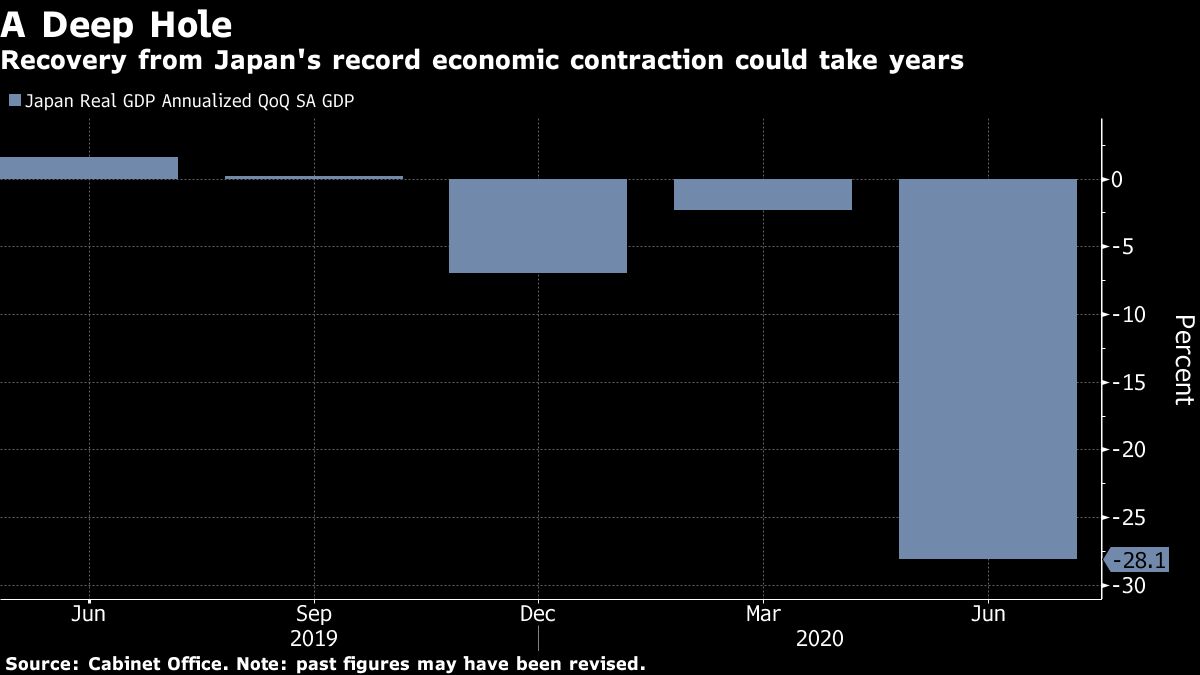
Gross domestic product slid an annualized 28.1% from the previous quarter in the three months through June, according to revised data from the Cabinet Office.
While the overall figure was largely in line with a first estimate, the data indicated business investment was more than three times weaker than first thought. The figures also showed stockpiles of unsold goods building up, adding to signs that the world’s third-largest economy is heading for a slow recovery.
Confirmation of Japan’s biggest GDP slide in records going back to 1955 comes as the Liberal Democratic Party prepares to pick a new prime minister to replace Shinzo Abe, whose resignation last month for health reasons shocked the country.
Abe’s most likely successor, longtime aide Yoshihide Suga, faces the tough balancing act of trying to contain the virus while restoring economic activity.
“The next prime minister will have to set coronavirus measures as the first priority,” said economist Masaki Kuwahara at Nomura Securities Co. “The economy should see a double-digit rebound, but the recovery pace will be slow.”
The LDP is set to vote on its new leader on Sept. 14 and then use its majority in parliament to elect that person as the next prime minister on Sept. 16.
Japan Ruling Party Election Starts With Deck Stacked for Suga
The current chief cabinet secretary, Suga, would be a continuity pick.
He wants to stick to the Abenomics path that includes massive monetary stimulus and a flexible spending approach, but would also take more action if needed to save jobs.
Among the key decisions for the new leader will be when and how aggressively to switch from emergency lifeline support for businesses and households to stimulating the economy.
A separate report Tuesday showed declines in household spending steepening in July, falling 7.6% below last year’s level as consumers cut back on travel and eating out amid a spike in virus cases, an indication of the difficulty of expanding activity without setting back the recovery.
Wages fell for a fourth month in July compared with the previous year, adding to the downward pressure on consumption.
Japan’s Continuity Candidate Suga Could Also Dial In Reform
Analysts see GDP rebounding about 13% this quarter, a big jump but not enough to make up for three straight quarters of contraction.
Bloomberg Economics argues the economy may never regain its pre-pandemic size because the crisis has further delayed critical reforms needed before Japan’s shrinking population causes longer-term declines.
At next week’s meeting, the Bank of Japan is likely to raise its economic assessment to indicate that Japan’s slump has bottomed, without expressing optimism about the outlook, people familiar with the matter said.
Still, BOJ officials see little need to take further policy action now because financial markets are stable and companies have access to credit, the people said.
What Bloomberg’s Economist Says
“Going forward, spending is likely to remain under pressure, given a range of negatives, from the virus to weak wages and concerns about jobs. A slow recovery in the economy will be a headache for Prime Minister Shinzo Abe’s successor, even as the Bank of Japan continues to put a prop under corporate Japan.”
–Yuki Masujima, economist
Click here to read more.
For more articles like this, please visit us at bloomberg.com
©2020 Bloomberg L.
P.