
(Bloomberg) — The European Central Bank should pursue forceful increases in borrowing costs at its October and December meetings, according to Governing Council member Klaas Knot.
The Dutch central bank chief said Wednesday that euro-area interest rates are “still way below neutral” — referring to the level at which policy is neither stimulative nor restrictive.
“We need at least two more significant hikes before we enter the range of plausible estimates for neutral,” Knot told Bloomberg Television on the sidelines of the International Monetary Fund annual meetings in Washington. “That’ll take us into next year.”
The ECB is gearing up for another rate hike this month after delivering two big increases in July and September.
With a recession looming over the euro-area economy, policy makers may face a closing window for such out-sized moves.
Knot argued that although growth is expected to slow, that’s unlikely to bring inflation down sufficiently without further efforts by the ECB.
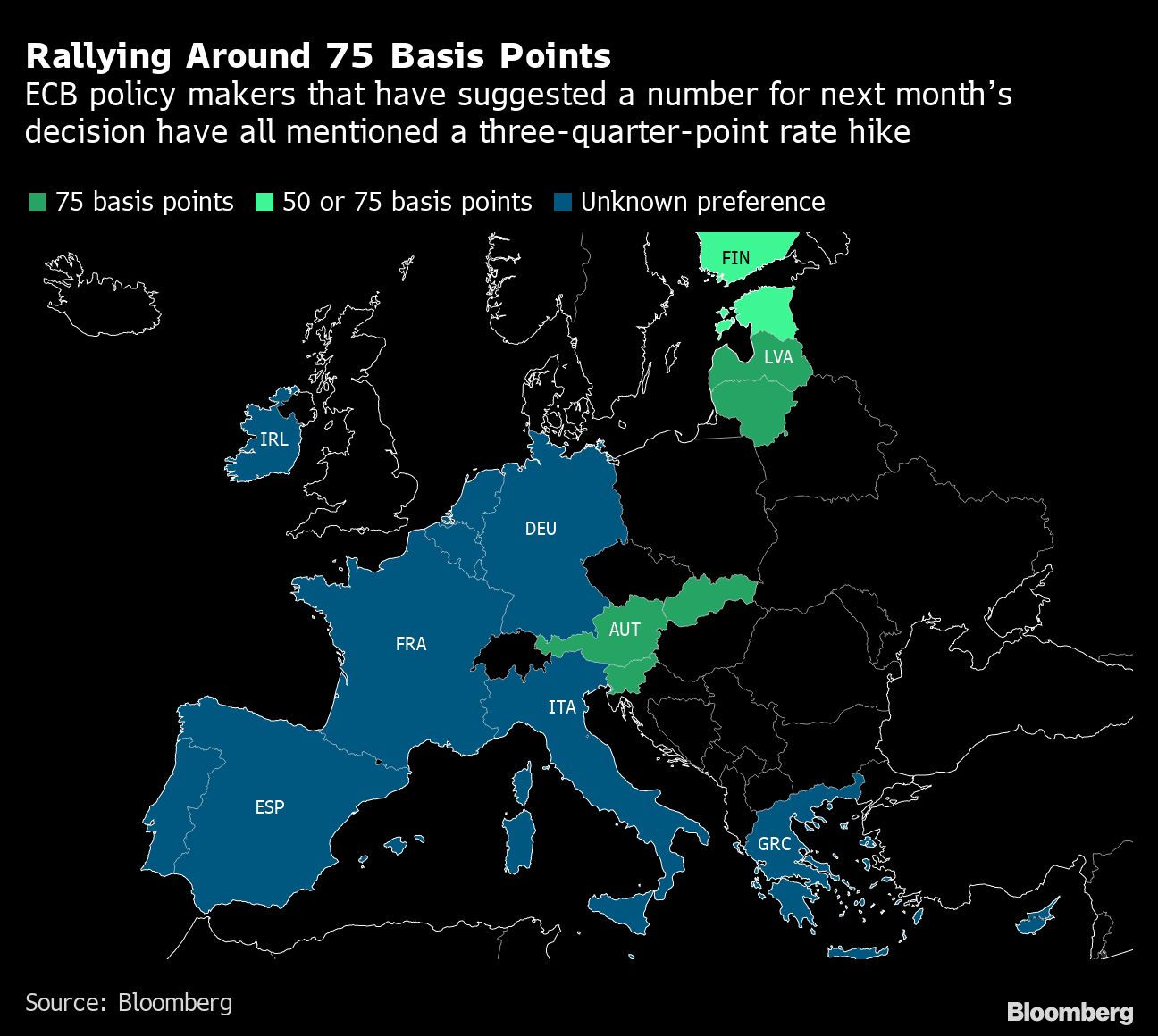
Markets are betting the ECB will deliver a repeat of September’s historic 75 basis-point step on Oct. 27 — a move that’s been backed by some of Knot’s colleagues, including Latvia’s Martins Kazaks and Lithuania’s Gediminas Simkus.
That would bring its deposit rate to 1.5%.
“This problem will not go away with a little of slowdown in the economy — it will require continued effort from our side, and the Council is unanimous on that,” he said. Commenting on how restrictive policy should ultimately become, he said officials will “cross that bridge when we get there.”
At a separate event on Wednesday, Knot signaled he wasn’t in favor of lifting rates by more than a three-quarter point.
“I have no indication that with steps up to 75 basis points we would not be able to achieve our price stability mandate of 2% inflation over the medium term,” he said at a conference by the Institute of International Finance.
Quantitative Tightening
Earlier this week, the central banker urged his Governing Council colleagues to finish the “normalization” of borrowing costs before contemplating how to shrink the trillions of euros of bonds purchased during recent crises — a process known as quantitative tightening.
Knot cited the experience of the US Federal Reserve as a “fairly successful” example of how to do that.
“The way the Fed is dealing with QT — that’s clearly also going to be an example for us, they managed to move it into the background very quickly,” Knot said. “A process like QT — it should be predictable, it should be gradual, it should be even a little bit boring.”
While the ECB will need to be cautious in how those future moves might impact bond markets, Knot also warned that fiscal authorities must be aware of how sensitive bond markets are to their actions in the current environment.
“Bond markets have become much, much more sensitive to debt sustainability issues,” he said. “That puts a burden on our fiscal authorities to also continue to pursue responsible fiscal policies with a medium term orientation and with debt sustainability being front-and-center of their concerns.”
(Updates with further comments starting in eighth paragraph)
More stories like this are available on bloomberg.com
©2022 Bloomberg L.
P.