
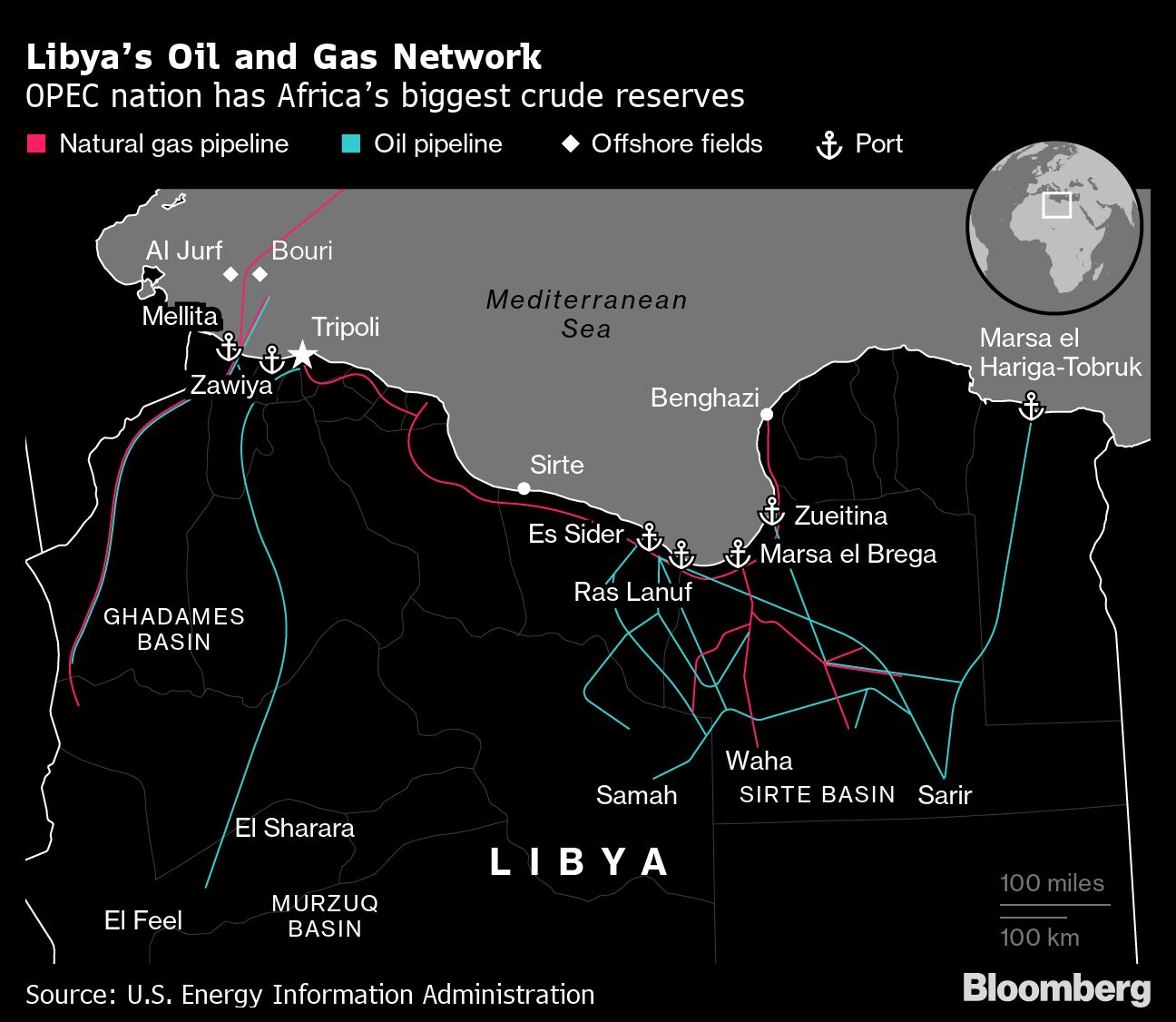
(Bloomberg) — Repeated shutdowns of Libya’s oil facilities amid a civil war could leave the country producing at just half its total capacity in the coming years, the National Oil Corp. said.
The OPEC member is “on track for a precipitous decline over the next year and a half as a result of the illegal blockades,” the state oil firm said Tuesday in a statement. “Continuing the blockade only makes our long-term problems worse.
It is vital that we resume oil production as soon as possible.”
Without rapid maintenance and repairs, the North African country may only be able to produce 650,000 barrels a day by 2022, the company said. That’s barely half the level Libya was pumping in January before supporters of Khalifa Haftar — who is battling the United Nations-recognized government based in Tripoli in the west — halted oil operations in the east, home to many of the largest fields and ports.
The NOC has said talks involving the U.
S. and regional powers are underway to allow output to resume.
On Wednesday, the company lifted force majeure at the eastern Es Sider port to allow a tanker to load crude from storage, according to a person familiar with the matter. It earlier asked “foreign mercenaries and armed groups to leave.”
The NOC has instructed port authorities to allow the ship, Delta Ocean, to pick up crude immediately.
On July 4, the Suezmax-class vessel indicated that it would arrive at Es Sider this week. It then changed its signal to show it is waiting for orders, according to tanker-tracking data compiled by Bloomberg and people familiar with the situation.
Last week, the NOC said force majeure, a legal status protecting a party from liability if it can’t fulfill a contract for reasons beyond its control, remained in place for all shipments.
However, it added that oil companies should prepare for a resumption of operations in light of the U. S.-backed negotiations.
Nine years of civil war have caused repeated closures of oil facilities in Libya, which has Africa’s largest crude reserves.
“Some of the damage we have suffered is permanent and can never be repaired,” NOC Chairman Mustafa Sanalla said in the statement.
Closing fields means they suffer “mechanical, structural, chemical and even microbiological changes,” the NOC said.
Bacterial growth can increase the levels of sulfur in the crude, “making it less valuable,” it said.
The central bank has said Libya’s lost oil revenue this year amounts to $7 billion.
Between 160 and 260 wells will have to undergo repairs at a cost of between $50 million and $100 million, according to the NOC. Fixing its pipeline network, which covers more than 6,760 kilometers (4,200 miles), will require additional funds.
(Updates with Es Sider tanker being ordered to load in fifth paragraph.)
For more articles like this, please visit us at bloomberg.com
©2020 Bloomberg L.
P.