
(Bloomberg) — Markus Soeder’s bid to lead Angela Merkel’s conservative bloc into September’s German election is gathering pace, with Monday’s imminent announcement by the Greens of their chancellor candidate adding to pressure to end the deadlock.
Just over a week after formally declaring his candidacy, Bavaria Premier Soeder has been trying to persuade members of Merkel’s Christian Democratic Union that his ability to connect with voters makes him a better bet to hold on to the chancellery than Armin Laschet, the party leader they elected barely three months ago.
If the CDU does decide to go with Soeder, who heads its smaller Bavarian sister party, it will mark a surprising departure for the alliance that has dominated German politics since World War II, and could presage more dramatic shifts in the way the country is run.
As Soeder looks to force Laschet to capitulate on Monday, the Greens will announce their chancellor candidate at 11 a.m. in Berlin.
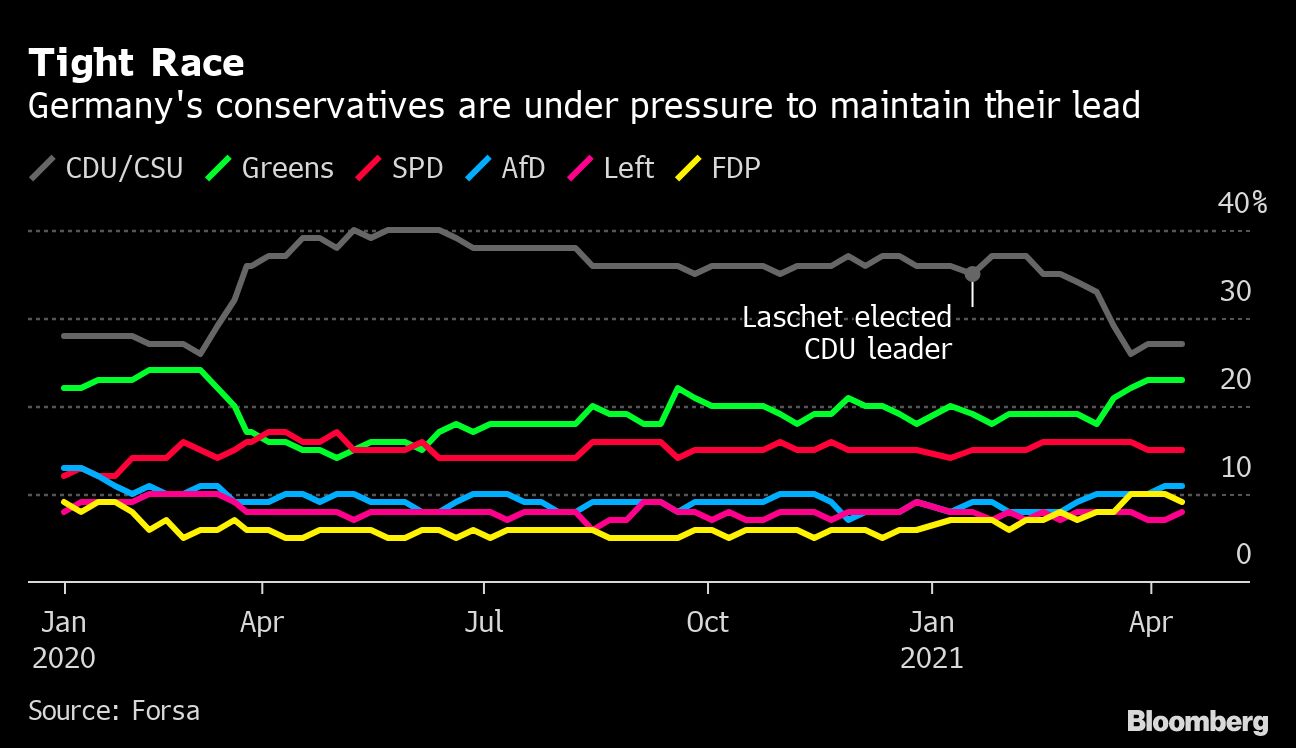
With the party in second place behind the CDU/CSU in opinion polls, their pick — one of two co-leaders Annalena Baerbock and Robert Habeck — is likely to play a significant role in the next administration.
The Greens are calling for Germany to continue the deficit spending that has helped to keep businesses afloat during the coronavirus lockdowns of the past 12 months in order to drive the transition to a zero-carbon economy.
With Merkel stepping aside after 16 years in power and the aftermath of the pandemic still unfolding, the election offers a new generation of politicians a chance to start the next chapter for Europe’s biggest economy.
Soeder, 54, and Laschet, 60, talked for about three hours until around 2 a.m. Monday morning, according to a CDU party official. The meeting took place at a Bundestag office and other CDU and CSU leaders were present, said the official, who asked not to be identified discussing confidential matters.
Soeder is on his way back to Bavaria, news agency DPA reported.
Earlier Sunday, Laschet’s authority was further undermined when the CDU’s youth wing voted in favor of Soeder’s candidacy. Three CDU state premiers — from Saxony-Anhalt, Saarland and Saxony — have broken ranks with the rest of the party leadership and put their weight behind the Bavarian.
Despite those blows, Laschet refused to throw in the towel, dragging the contest out for at least another a day.
Party leaders are concerned that the drawn-out, public battle for the nomination is damaging their election prospects.
Read More: Merkel Succession Race Turns Nasty With Mudslinging and Threats
Sven Schulze, the CDU chairman in Saxony-Anhalt, said one option to break the deadlock could be a vote in the joint CDU/CSU parliamentary caucus. Another could be to ask the district party heads to choose.
“Then we would have a decision that is also backed by the party base,” Schulze said Monday in an interview with DLF radio. “We need a swift solution to the chancellor question, and if the two of them don’t manage it, then it will have to be done another way.”
In the latest Kantar poll, the CDU/CSU bloc is only 7 percentage points ahead of the Greens.
Both Soeder and Laschet have insisted that they want a decision before the Greens’ announcement — though they had also suggested that last Friday was the deadline.
Polls have consistently showed that Soeder could help to revive support for the CDU/CSU in September, while Laschet, chosen to run the CDU in January, would be an electoral liability.
Yet Soeder represents a gamble for the conservatives all the same.
He has a reputation as an opportunist, has been accused of flip-flopping on key issues like immigration and has shown a mix of disinterest and dislike for the European Union.
Read More: Merkel Is Starting to See a Former Troublemaker Could Become Chancellor
In the past, he’s warned that Germany shouldn’t give away too much authority to Brussels and repeatedly criticized the European Central Bank’s bond-buying program.
In November 2019, he said the federal government should compensate savers who suffered from negative interest rates and in 2012, as Bavarian finance minister, he called for Greece to be expelled from the euro area.
Pressure on Laschet to step aside has been mounting since the two candidates made their case to the group’s lawmakers last week. CDU lawmaker Christian von Stetten said in an interview on Sunday that Laschet’s leadership bid would be rejected by the CDU/CSU caucus in a vote on Tuesday if the issue isn’t resolved before then.
Last week, von Stetten put together a list of 70 CDU lawmakers who were demanding a vote.
The number has increased over the weekend, as members of the party openly revolted against Laschet, he said.
(Updates with details on meeting in sixth paragraph)
For more articles like this, please visit us at bloomberg.com
©2021 Bloomberg L. P.