
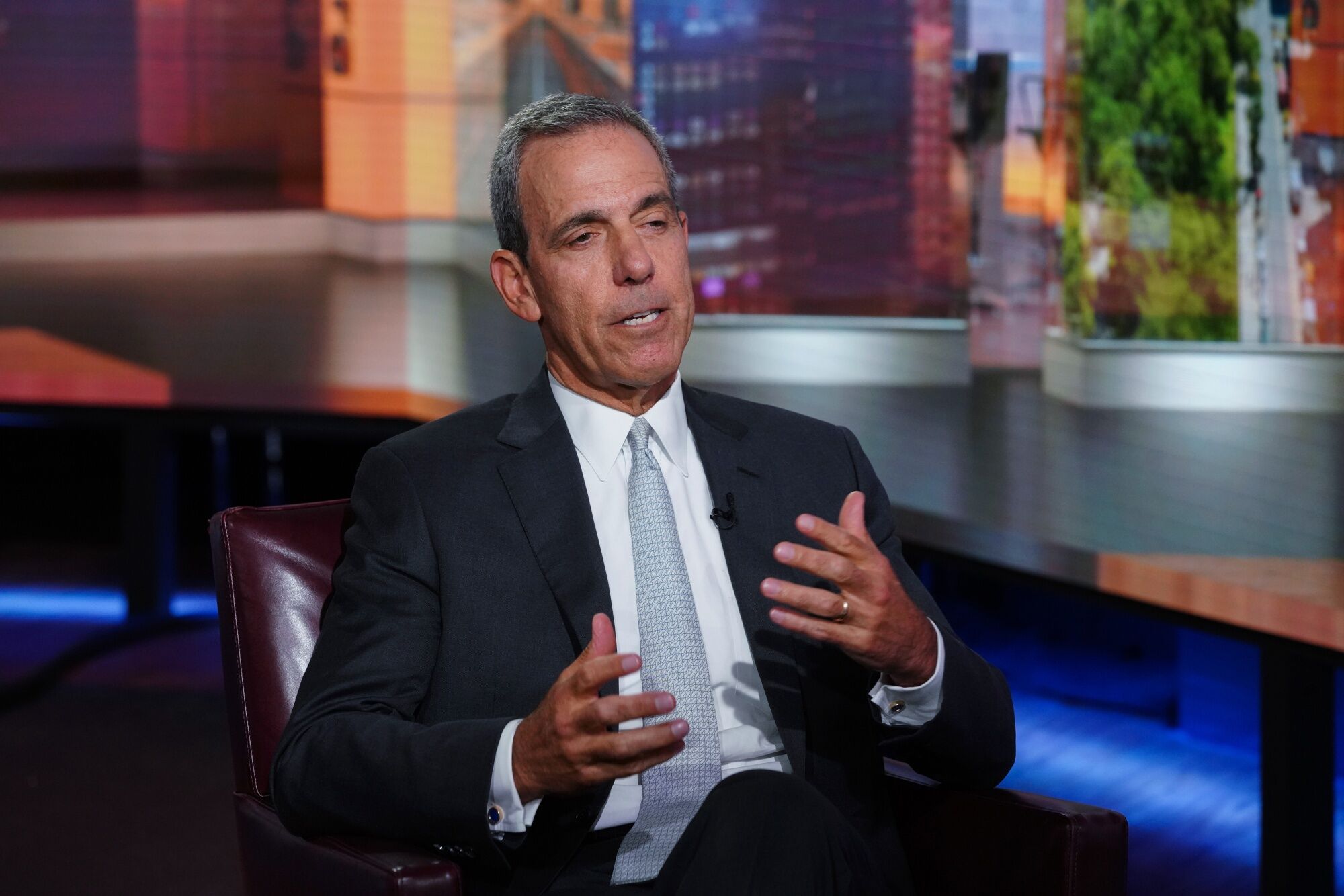
(Bloomberg) — The Milken Institute Global Conference is in its second day in Beverly Hills, bringing together an eclectic mix of attendees, from dealmakers to celebrities.
Tuesday’s roster of speakers includes Wells Fargo & Co. Chief Executive Officer Charlie Scharf and Anne Walsh, chief investment officer for fixed income at Guggenheim Partners Investment Management.
Apollo’s Drescher Says 60/40 Model Has Been Challenged (2:15 p.m.
ET)
Individual investors no longer have to stick to stocks and bonds, according to Stephanie Drescher, chief client and product development officer at Apollo Global Management Inc.
“The 60/40 model has been challenged,” she told Bloomberg Television at the conference.
The Apollo senior partner spoke to Bloomberg the same day the firm said it’s opening some of its funds to individual investors in Europe, Asia and Latin America as it continues to grow its wealth management business.
Read more: Apollo Opens Private Market Funds to Wealthy Investors in Europe
“We wanted to ensure that everyone could have access to that potential additional return,” Drescher said, adding that “ensuring that we can provide that diversification for the individual — not only the institution — is critical.”
Scharf Says Regulators Acted Correctly on Banks (2 p.m.
ET)
Wells Fargo & Co. Chief Executive Officer Charlie Scharf said US banks such as his shouldn’t be required to “unconditionally” cover the failures of other financial institutions.
Regulators functioned as they were supposed to as three banks — Silicon Valley Bank, Signature Bank and, most recently, First Republic Bank — failed over the past two months, Scharf said Tuesday during a panel discussion at the conference.
The Federal Deposit Insurance Corp. stepped in when required, he said.
Scharf’s remarks come a day after JPMorgan Chase & Co. agreed to acquire First Republic in a government-led deal for the failed lender, putting to rest one of the biggest troubled banks remaining after turmoil engulfed the industry in March. Wells Fargo was one of 11 banks that had tried to keep First Republic afloat by pledging $30 billion of fresh deposits on March 16, with Scharf’s company kicking in $5 billion.
The majority of banks that Wells Fargo is monitoring at the moment are “strong,” Scharf said.
Vista’s Breach Looking for Deals in Public Market (1:30 p.m.
ET)
Vista Equity Partners President David Breach said his tech-buyout firm is looking to acquire publicly traded companies amid the recent market turmoil.
“The real opportunities right now are in the public market,” Breach said in a Bloomberg Television interview at conference. His firm recently purchased insurance-software business Duck Creek Technologies and cybersecurity training provider KnowBe4.
While buyout shops are finding discounts in public markets, it’s harder for them to wrangle a deal with closely held startups, many of which are reluctant to accept the prices buyers are willing to pay.
Breach said valuations have further to drop.
“Later this year they’re going to start to feel pressure,” he said, “and they are going to have to accept the market they’re in.”
Citadel’s Mecane Sees ‘Robust Pipeline’ for Going Public (1:30 p.m. ET)
Activity in the public markets could pick up as more firms choose to list their shares on a stock exchange, according to executives at the conference.
“There is definitely a robust pipeline of companies looking to go public, which is reassuring,” Joe Mecane, head of execution services at Citadel Securities, the market-making firm founded by Ken Griffin, said on a panel discussing the capital markets.
A growing number of security filings are showing plans to flip “from private to public, and people are looking for that window,” he said.
Firms looking to go public are spending more time engaging with investors early, according to Ashley Walker, head of equity syndicate and privates at Jefferies.
“We’ve got a deal that’s going to launch in June,” Walker said. “There’s a lot of testing the waters going on right now, because the market has been closed for so long.”
Jefferies’s Roop Says SVB Reminded Him of Bear Stearns (1 p.m.
ET)
Fallout from the regional-banking crisis has continued to sully public markets and sentiment for transactions.
The demise of Silicon Valley Bank and First Republic Bank is ultimately just “another check mark in the uncertainty box,” Candice Choh, partner at global law firm Gibson, Dunn and Crutcher LLP, said on a panel at the conference about about mergers and acquisitions.
Jefferies LLC’s head of Americas M&A, Chris Roop, said “the Sunday of SVB felt very similar” to when Bear Stearns & Co. collapsed during the financial crisis.
Roop spent his early career working in Bear Stearns’s investment-banking group, his LinkedIn profile shows.
While deal activity has slowed from a record two years ago, panelist said the appetite is still there. Activity could emerge in the form of restructurings, they said.
Mark McMaster, global head of mergers and acquisitions at Lazard Ltd., said even companies with high multiples can still do deals that work.
Market valuations are down but so are those of the potential targets, he said, so transactions can get done without leveraging up balance sheets.
Wynn, Carnival CEOs Say Travel Demand Is Surging (12:30 p.m. ET)
Demand for travel and related services is soaring from the lows reached during the pandemic, according to panelists at the conference including Wynn Resorts CEO Craig Billings and Carnival Corp.
CEO Josh Weinstein.
Travelers emerging from lockdowns are also asking for more personalized experiences relating to seamless airport check-ins, destination choices and other hospitality services driven by technological improvements, panelists said.
The discussion also featured Clear CEO Caryn Seidman-Becker and Singapore Tourism Board’s Keith Tan.
Guggenheim’s Walsh Sees Rising Credit Risks (12:30 p.m.
ET)
The default rate across speculative-grade credits could rise to 5%, Walsh at Guggenheim said.
“It is going to be pretty painful as downgrades increase,” Walsh said on a panel discussion at the conference.
A significant amount of private debt will need to be refinanced over the next two years, Michael Patterson, a governing partner at HPS Investment Partners, said during the panel discussion.
Higher interest rates — which make loans more expensive — stand to increase financing and liquidity needs, especially in sectors such as technology, Patterson said.
Dragoneer’s Stad Sees Reckoning for Private Markets (12 p.m.
ET)
Private markets are facing a major reckoning following speculative deals in industries such as crypto, according to Marc Stad, founder and managing Partner of Dragoneer Investment Group.
“Let’s be clear, there are companies valued in the billions in the venture world at scale,” Stad said in a panel discussion at the conference. “They’re going to go to zero. They aren’t worth it.”
But Dana Settle, co-founder and managing partner at Greycroft, sees a lot of promise in artificial intelligence, an area that she says isn’t over-hyped despite the massive buzz around it.
“I’m sure somebody was counting to see how long it would take for us to mention AI,” she said, adding that companies are already embracing the technology and using it to improve their businesses.
Carlyle’s De Benedetti Sees Europe Opportunities (11:40 a.m.
ET)
Despite recession concerns in the US, there are still “very interesting opportunities” in Europe, according to Marco De Benedetti, co-head of Europe private equity at Carlyle Group Inc., who sees the continent doing better than some have predicted.
Europe will benefit from more tourism from Asia, and the luxury market will be more resilient in the event of an economic slowdown, De Benedetti said in a Bloomberg TV interview at the conference.
De Benedetti also said private credit will take a larger share of financing because banks have been suffering, especially as European lenders are “not as concerning” as US-based ones. “I don’t see financing as the biggest concern in the ability to do deals,” he said.
KKR’s Pietrzak Sees Volatility Through Year-End (11 a.m.
ET)
Daniel Pietrzak, partner and co-head of private credit funds at KKR & Co., said the debt-ceiling impasse will cause short-term volatility.
“The debt ceiling will be the conversation short-term,” Pietrzak said in a Bloomberg TV interview at the conference. “I suspect it will get solved, but it will create volatility the market doesn’t like.”
Pietrzak said volatility will continue through the end of the year, but it’s a time when private credit managers can shine.
Speaking about regional-bank turmoil, it “will play out for several quarters if not several years,” Pietrzak said. “I think the market needs to get comfortable on what returns they can generate going forward.”
Vistria’s Anadu Sees Regional-Bank Risks (10:45 a.m.
ET)
Margaret Anadu, senior partner at Vistria Capital, said regional banks are a major concern for the real estate market because they are so interconnected.
People think about capital coming into commercial real estate from the big banks, but more than 80% of the lending in the US is from banks with $250 billion in assets or less, Anadu said in a Bloomberg TV interview at the conference. “It’s causing a lot of concern, and it should.”
There’s opportunity in focusing on low- and moderate-income Americans who plan to remain in their homes and not move from places like New York to Florida on a whim, she said.
Hunter Point Cites ‘Asymmetric’ Bank Risk (10:35 a.m.
ET)
Hunter Point Capital co-founder and Executive Chairman Bennett Goodman said the regional banking crisis is probably not yet over as the banking system faces “asymmetric risk.”
JPMorgan Chase & Co., Bank of America Corp. and other major US banks have become “systemically too important to our economy and they cannot ever fail,” Goodman, a co-founder of Blackstone Inc.’s credit arm, said in a Bloomberg TV interview at the conference.
Meanwhile, “the same cannot be said of some of the regional banks.”
“We need to figure out how to level that playing field,” Goodman said as regional banking stocks slid.
–With assistance from Allan Lopez, John Sage, Natalie Harrison, Paige Smith, Daniel Taub, Richard Annerquaye Abbey, Taryana Odayar, Dawn Lim, Erin Fuchs, Dayana Mustak, Michael B. Marois, Olivia Raimonde, Sydney Maki, Katherine Doherty and Francesca Maglione.
More stories like this are available on bloomberg.com
©2023 Bloomberg L.
P.