
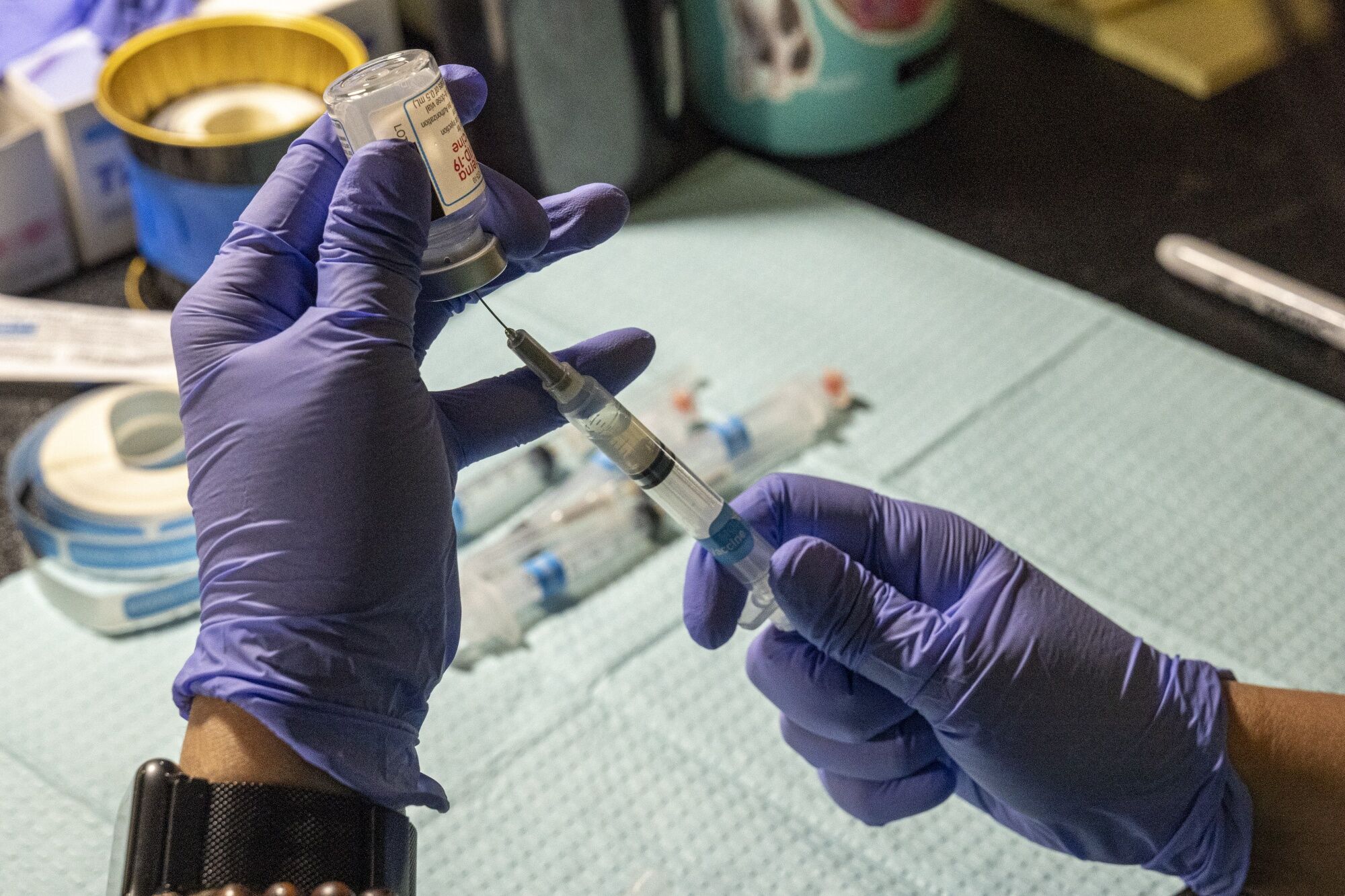
(Bloomberg) — Moderna Inc. said it will deliver less Covid-19 vaccine than planned to the U. K., Canada and other countries this quarter due to a shortfall in doses in its European supply chain. China is planning to approve its first foreign vaccine before July, according to people familiar with the matter.
German Chancellor Angela Merkel got her first shot of the AstraZeneca vaccine, despite possible links to rare blood clots that have led to its use being limited in some countries.
The EU probably won’t renew its contracts with AstraZeneca and Johnson & Johnson, France’s industry minister said on Friday.
India’s new variant, which has a so-called double mutation, is thought to be fueling the country’s deadlier new wave of infections that’s made it the world’s second worst-hit country, surpassing Brazil.
Key Developments:
- Global Tracker: Cases pass 139.2 million; deaths approach 3 million
- Vaccine Tracker: More than 848 million shots given worldwide
- J&J’s limbo status crimps U.
S. vaccine drive at a pivotal moment
- U. S. South is fast closing country’s widest Black vaccine gap
- Covid is much deadlier in Brazil than India and no one knows why
- Don’t write off China’s vaccines: Bloomberg Opinion
Subscribe to a daily update on the virus from Bloomberg’s Prognosis team here. Click CVID on the terminal for global data on cases and deaths.
Moderna Cuts Supply to U.
K., Canada (11:13 a.m. NY)
Moderna Inc. said it will deliver less Covid-19 vaccine than planned to the U. K., Canada and other countries this quarter due to a shortfall in doses in its European supply chain.
Deliveries to the U. K. will be reduced from this month, just days after the vaccine was rolled out in Britain, which will affect the overall number of doses previously expected to be supplied by the end of June.
Moderna is working with Lonza Group AG to make the shots in Europe.
“The trajectory of vaccine manufacturing ramp-up is not linear, and despite best efforts, there is a shortfall in previously estimated doses,” Moderna said in a statement Friday.
Kenya to Finish First Vaccine Phase (11:04 a.m. NY)
Kenya expects to complete its first phase of vaccination in 10 days’ time, said Willis Akhwale, chairman of the Covid-19 vaccine advisory task force.
The current vaccination rate averages 40,000 shots daily, Akhwale said.
Inoculations in East Africa’s biggest economy began on March 5 after the arrival of 1.02 million doses from the Covax facility, and a further donation of 100,000 doses from the Indian government.
U. S. to Track Variants More Closely (11:03 a.m. NY)
President Joe Biden’s administration is allocating $1.7 billion in funding to track the spread of Covid-19 variants, which are proving dangerous as they spread quickly and risk dragging out the pandemic.
Biden will direct $1 billion to genomic sequencing, which helps federal agencies and states track which version of the virus is spreading.
They also announced $400 million for epidemiological research and $300 million for health data and training.
The announcement, with funding from the aid package Biden signed a month ago, comes as mutations of the virus fuel new outbreaks across the U. S. — especially in the upper Midwest.
Italy Eases Lockdown (11:01 a.m NY)
Prime Minister Mario Draghi said many business activities in much of Italy can resume starting April 26 in a bet on an economic rebound fueled by what he called “good debt.”
Government and regional leaders on Friday decided to ease Italy’s lockdown, reintroducing so-called yellow risk areas where restaurants with open-air seating can reopen and residents have more freedom of movement, Draghi told reporters in Rome.
All schools will reopen in medium-risk and lower-risk areas as the coronavirus contagion slows.
Merkel Gets Astra Shot (10:01 a.m. NY)
Chancellor Angela Merkel got her first shot of the AstraZeneca vaccine on Friday as Germany’s immunization drive continued to gather pace after a sluggish start.
Vice Chancellor and Finance Minister Olaf Scholz was also due to get the AstraZeneca shot Friday, with both opting for the company’s vaccine despite possible links to rare blood clots that have led to its use being limited in some countries, including Germany.
Merkel earlier defended her plan to take greater control over Germany’s pandemic restrictions to break a “very serious” wave.
In a statement to the lower house of parliament in Berlin on Friday, Merkel pushed back against opposition to a law that would give the federal government the authority to impose local restrictions such as curfews and closing schools and non-essential stores.
India Worries Over Double Mutation (9:32 a.m. NY)
As India’s daily tally of Covid-19 infections surged by a record 200,000-plus cases on two consecutive days, public health experts worry that a new — possibly more virulent — coronavirus variant could be racing through the crowded nation of more than 1.3 billion people.
The new variant, which has a so-called double mutation, is thought to be fueling India’s deadlier new wave of infections that has made it the world’s second worst-hit country, surpassing Brazil, and has already begun to overwhelm its hospitals and crematoriums.
The Asian nation has reported more than 14 million cases so far and more than 174,300 fatalities.
Sinovac Efficacy Reported at 67% (9:30 a.m. NY)
A Chilean study said Sinovac Biotech Ltd.’s vaccine was 67% effective in preventing symptomatic Covid-19 infections, the first such evidence from a mass vaccination program.
The report also said the vaccine was 85% effective in preventing hospitalizations, 89% effective in preventing people from entering intensive care units and 80% effective in preventing fatalities.
U.
K. Population Growth Slows (8:22 a.m. NY)
The U. K. population grew at its slowest pace since 2003 in the year through the middle of 2020 and may have fallen since then as the coronavirus prompted a departure of foreign workers, a preliminary government estimate shows.
Prime Minister Boris Johnson’s spokesman told reporters the U. K. is monitoring variants, including a strain first identified in India.
A total of 41 million Covid vaccine doses have now been administered in the U.
K., according to data collected by Bloomberg News and Johns Hopkins University. At this rate, it will take a projected four months to cover 75% of the population with a two-dose vaccine.
China to Approve First Foreign Shot (8:07 a.m. NY)
China is planning to approve its first foreign Covid-19 vaccine before July, according to people familiar with the matter, as pressure mounts from domestic scientists and the foreign business community to expand beyond the country’s own roster of shots.
Chinese officials have been scrutinizing clinical-trial data for the coronavirus vaccine made by Germany’s BioNTech SE and are expected to green light domestic distribution of the shot within the next 10 weeks, people privy to these discussions say.
Separately, Chinese President Xi Jinping called for deeper collaboration with Germany and France in combating the pandemic during a video conference held Friday among leaders of the three countries.
Germany Allows U.
K. Travelers (7:03 a.m. NY)
Germany’s Robert Koch Institute has taken the U. K. off its list of virus risk areas, meaning travelers will no longer have to quarantine upon arrival in Germany. At the same time, Argentina was upgraded to a high-incidence area, while the UAE were downgraded from a high incidence to a risk area.
J&J Reached Out to Rivals (7 a.m. NY)
Johnson & Johnson privately reached out to Covid-19 vaccine rivals to ask them to join an effort to study the risks of blood clots and speak with one voice about safety, but Pfizer Inc. and Moderna Inc. declined, Dow Jones reported, citing people familiar with the matter.
Communities across the U.
S. are revamping their vaccination campaigns to adjust to an indefinite halt in J&J’s doses.
A hold on the use of the vaccine could stretch out for several weeks, according to the head of an advisory panel that’s expected to make a recommendation about whether shots should resume. The Centers for Disease Control and Prevention’s Advisory Committee on Immunization Practices is tentatively scheduled to reconvene on Thursday or Friday next week.
Anthony Fauci, President Biden’s top medical adviser, said he’s concerned about any prolonged delay in the review.
South Africa Vaccine Spats (6:10 a.m.
NY)
Pharmaceutical companies supplying South Africa with Covid-19 vaccines are pressing the country to stop trying to loosen patent protections related to the inoculations, a person familiar with the situation said.
South Africa and India are calling for a broad waiver of World Trade Organization rules on the production and export of vaccines and other medical goods needed to combat the coronavirus, a move that could increase access to treatment for developing nations.
The tension is manifesting itself in spats between the government and Johnson & Johnson and Pfizer Inc. over terms in their supply contracts, the person said, asking not to be identified as the parties have given little detail on their talks.
U.
S. South Narrows Vaccine Race Gap (6 a.m. NY)
Now that almost all adults in the U. S. are eligible for Covid vaccines, the racial and ethnic disparities among those getting shots should narrow.
Bloomberg has been tracking the demographics of vaccinations in the U. S. since February, and starting today we can show which states are closing vaccination gaps among races and ethnicities fastest, and which aren’t.
EU Sours on Astra, J&J (2:50 a.m.
NY)
The EU “most probably” won’t renew its coronavirus vaccine contracts with AstraZeneca and Johnson & Johnson, French Industry Minister Agnes Pannier-Runacher said on BFM TV on Friday.
“The decision has not been taken as of today, but I can tell you we haven’t initiated discussions with AstraZeneca and Johnson & Johnson about another contract, whereas we have already started discussions about contracts with BioNTech, Pfizer and Moderna,” Pannier-Runacher said.
A delay to J&J’s vaccine could push EU efforts to vaccinate three-quarters of its population back to December, from the end of September, Airfinity estimates.
Denmark Speeds Reopening (2:41 a.m.
NY)
Denmark will speed up its reopening plans following weeks of low contamination figures. Bars and restaurants will open from Wednesday April 21, weeks ahead of schedule. Some restrictions for the oldest students are eased, museums reopen and fans are allowed back to stadiums for sports events.
Japan Seeks Shots for Olympics (2:08 a.m. NY)
Japanese Prime Minister Yoshihide Suga is set to call Pfizer’s Chief Executive Officer Albert Bourla to seek an agreement on extra supplies of its coronavirus vaccine, broadcaster Fuji TV reported.
Pfizer’s vaccine is so far the only one approved for use in Japan, and the inoculation process has been slow.
Fewer than 2 million doses have been administered to its population of about 126 million.
Separately, the Japanese government plans to reimpose restrictions on areas around Tokyo to control the latest surge, Economy Minister Yasutoshi Nishimura told an advisory panel Friday.
Japan’s worsening outlook and its slow pace of vaccinations has prompted questions from the public, medical experts and the media about the feasibility of holding the Olympics in July.
Vietnam Sizes Up Virus Damage (12:35 a.m.
NY)
The pandemic economically hurt 9.1 million Vietnamese during the first quarter, according to the government. The nation’s labor force in 1Q shrank by 1.1 million workers from the previous quarter.
Separately, the head of Vietnam’s Health Ministry Preventive Medicine Department proposed the government reduce its quarantine period for international visitors who have been vaccinated to seven days from the current 14 days, VnExpress news website reported, citing the official.
Young Risk Reinfection (6:31 p.m.
NY)
Young adults previously infected with Covid-19 are still at risk of catching the disease again, according to a study of U. S. military personnel that highlights the importance of vaccinating even those who have tested positive for the virus.
About 10% of 189 people who had been infected once, most of them 18- to 20-year males, later became reinfected, according to a study of 2,346 U.
S. Marine Corps members published Thursday in The Lancet Respiratory Medicine journal.
Separately, the U. S. has found 5,800 “breakthrough” cases of Covid-19, in which a fully vaccinated person was infected, the Centers for Disease Control and Prevention said. The nation has fully vaccinated more than 75 million people.
For more articles like this, please visit us at bloomberg.com
©2021 Bloomberg L.
P.