
(Bloomberg) —
Gilead Sciences Inc.’s treatment remdesivir showed only a limited benefit in a large trial. Moderna started a Phase 2 study of its experimental vaccine, while Eli Lilly dosed patients in a study evaluating a potential antibody treatment for the disease.
Wuhan’s push to break hidden virus transmission chains through aggressive testing appears to have succeeded, as no new asymptomatic cases were found for the first time in two months.
Protests spread across the U. S., fueling concerns of a renewed spike in infections and more economic pain.
Hong Kong banned a vigil to commemorate the 1989 crackdown on activists in Beijing’s Tiananmen Square, citing the threat to public health from the coronavirus. Apple Inc. is poised to reopen its biggest stores in Japan and Barclays Plc will begin returning about 700 staff to offices next month.
Key Developments:
- Virus Tracker: Cases near 6.2 million; deaths exceed 372,000
- How China tested 11 million people in just two weeks
- A startup is testing sewage to trace the U.
S. spread of Covid
- Google helps place ads on sites amplifying Covid conspiracies
- European manufacturing emerges from lockdown with Italy in lead
- The buy-side trader is getting outsourced in the pandemic
Subscribe to a daily update on the virus from Bloomberg’s Prognosis team here. Click VRUS on the terminal for news and data on the coronavirus. For a look back at this week’s top stories from QuickTake, click here.
Lufthansa Board Approves $10 Billion Bailout (9:41 a.m.
NY)
The supervisory board of Deutsche Lufthansa AG approved Germany’s 9 billion-euro ($10 billion) bailout proposal, paving the way for the airline to receive the lifeline should shareholders accept the deal.
Monday’s breakthrough comes after the German government agreed that Lufthansa will reduce its presence at airports in Frankfurt and Munich by four aircraft each.
The bailout will set a precedent for Air France-KLM and other airlines that could force them to give up slots in exchange for government support to survive the pandemic, European Union Competition Commissioner Margrethe Vestager said earlier in an interview.
Scania to Cut Jobs to Counter Truck Demand Slump (9:32 a.m.
NY)
Scania AB plans to reduce its workforce after the pandemic led to a slump in demand that the Swedish truck maker expects to last for some time. The unit of Volkswagen AG’s Traton SE has about 5,000 more employees than it needs, according to a statement on Monday. That’s about 10% of the total workforce. Scania will review the positions of about 1,000 staff at its head office in Södertälje.
Scania is the latest in a slew of European car and truck makers to have announced large-scale job losses in the wake of the outbreak.
Gilead Drug Has Only Modest Benefit in Large Trial (8:52 a.m.
NY)
The result may shift perceptions of the first therapy cleared for use in severe cases of Covid-19. In the phase 3 trial, a group of moderately ill, hospitalized patients getting the drug for five days showed a modest improvement compared to those getting the standard of care, the company said in a statement. But another group getting the drug for 10 days didn’t show a statistically significant improvement, which is likely to raise questions about why a longer course doesn’t help more.
Separately, Altimmune Inc. climbed in premarket trading after the FDA gave the company the go-ahead to start a Phase 1/2 study of T-COVID, an experimental therapy.
The single dose intra-nasal medicine is meant to be administered at the first onset of symptoms.
Vietnam May Delay Loan Payments to Year End (8:47 a.m. NY)
Vietnam’s central bank is seeking comments on a plan that would exempt, reduce or delay loan interest payments in an effort to help businesses hurt by the pandemic, according to a posting on the government’s website.
Fauci Says Meetings With Trump Are Less Frequent: Stat (8:23 a.m.
NY)
Anthony Fauci, the top U. S. infectious disease expert, said he used to meet with President Donald Trump four times a week about a month ago, and now those meetings “have been dramatically decreased,” according to an interview with Stat.
A Covid-19 vaccine by the end of the year is “aspirational, but it’s certainly doable,” Fauci also said, adding that “there’s no guarantee that it’s going to be effective.”
Dutch Bars, Restaurants Reopen (8:06 a.m.
NY)
Dutch bars, restaurants and cinemas reopened under certain social distancing restrictions. Customers must make reservations, and no more than 30 people are allowed inside venues. Wearing a face mask is mandatory on public transport.
Half of U. K. Families Won’t Send Children Back to School (7:30 a.m. NY)
Boris Johnson’s plans to get the stalled U. K. economy moving again face a significant challenge, with many parents choosing to keep their children at home even though they could send them back to school.
Some classes for primary school children in England are due to re-start this week after being closed for more than two months during the coronavirus lockdown, but head teachers expect almost half of families to shun the offer, according to a survey.
Prime minister Johnson announced that from Monday, some retailers including car showrooms will be able to reopen, and people will be able to meet in groups of six from different households outdoors.
Scientists have raised concerns that the lockdown easing may be too risky, with high numbers of new infections being reported daily.
Barclays to Return About 700 Staff to Offices (7:23 a.m. NY)
Barclays Plc will begin returning about 700 staff to offices in the U. K., the U. S. and India starting next month. The London-based bank told staff in a memo that the rest of its employees will work from home at least until the end of September, according to people with knowledge of the matter.
The employees who will go back to offices over the summer will be mostly traders and others who can’t work from home, and they comprise less than 1% of global headcount, the people said.
A spokesman at Barclays declined to comment.
Moderna Climbs After Starting Second Stage of Testing (7:02 a.m. NY)
Moderna shares rose 6% in premarket trading after the company started a Phase 2 study of its experimental Covid-19 vaccine. Analysts remained upbeat about prospects for the biotech’s results, while investors await a fuller disclosure on how all 45 patients fared in the first stage of testing.
Full results will be published by the National Institutes of Health in a peer-reviewed publication, likely this month.
Lilly Starts Study of Antibody Treatment (6:55 a.m.
NY)
Eli Lilly said patients have been dosed in what it said was the world’s first study of a potential antibody treatment designed to fight Covid-19. The placebo-controlled study will assess safety in patients hospitalized with the disease and results are expected by the end of June.
“Later this month, we will review the results of this first human study and intend to initiate broader efficacy trials,” the company said. “At the same time as we are investigating safety and efficacy, we also are starting large-scale manufacturing.”
Singapore Plans Overhaul of Worker Dorms (6:52 a.m.
NY)
Singapore, which has been coping with an outbreak of coronavirus infections among its foreign workers living in tightly spaced dormitories, plans to build additional facilities with better standards. They will not come cheap, and some will be located closer to residential areas in the tiny island nation, the government cautioned.
The country plans to create extra space to house around 60,000 workers by the end of this year, the ministries of national development and manpower said Monday in a joint statement.
Longer term, there will also be new purpose-built dormitories to house up to 100,000 workers to replace the short- to medium-term housing, they said.
Emirates Can’t Commit to Order Book (6:25 a.m. NY)
Gulf airline Emirates said it’s unable to commit to outstanding aircraft orders in light of the coronavirus crisis, casting doubt on a backlog worth tens of billions of dollars to Boeing Co. and Airbus SE.
“All bets are off,” Tim Clark, the Dubai-based carrier’s president, said in a online forum Monday. “We are nowhere near confident enough that the economics, the cash flows, the bottom line will put us in a good position to be able to guess if we’ll buy a hundred of this or a hundred of that.”
Russia to Ship Covid-19 Drug to Hospitals (6 a.m.
NY)
Russia is preparing to provide hospitals with a coronavirus drug developed with the sovereign wealth fund’s backing after gaining initial approval from the Health Ministry. The medicine will be shipped to hospitals starting June 11 and exports may follow once domestic demand is met, according to the Russian Direct Investment Fund, which is producing the antiviral in a joint venture with the ChemRar Group.
The treatment, Avifavir, is based on a generic version of Fujifilm Holdings Corp.’s drug Avigan, which Japan’s government is still looking to approve for treatment of coronavirus.
Final-stage clinical trials of Russia’s Avifavir involving 330 patients are continuing, according to the wealth fund. Avifavir is the second drug, after Remdesivir, to show promising results against Covid-19 and ChemRar Group will deliver 60,000 doses this month, RDIF CEO Kirill Dmitriev said on a conference call Monday.
Hong Kong Bans Tiananmen Vigil (5 p.m. HK)
Hong Kong’s police for the first time banned people from gathering on June 4 to commemorate the 1989 crackdown on activists in Beijing’s Tiananmen Square, fueling concerns about the Asian financial hub’s dwindling autonomy.
Lee Cheuk-yan, chairperson of the event’s organizing body, confirmed the ceremony had been outlawed this year.
Authorities cited the “significant threat” to the lives and health of the public given the high risk of transmission of the coronavirus, local news site HK01 reported, citing a letter issued by the police. A representative for the police didn’t immediately comment when reached by phone.
In anticipation of the order, the organizer said Sunday that it planned to conduct the event online.
The ceremony, which has regularly drawn tens of thousands to Victoria Park, has been a fixture in Hong Kong since 1990, underscoring the contrast in liberties between the city and its mainland patron, where the event is censored from all media.
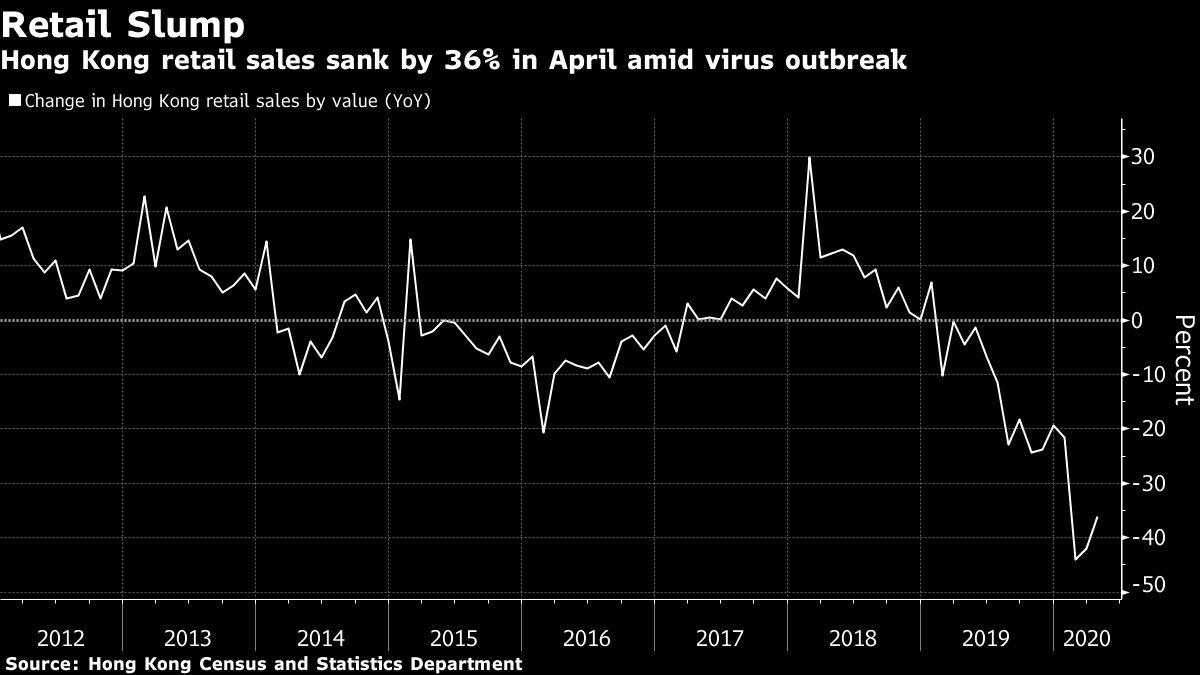
Hong Kong’s Retail Slump Continued in April (4:49 p.m. HK)
Hong Kong’s retail activity extended a decline in April as the coronavirus pandemic continued to constrain global travel.
The city’s retail sales by value fell 36.1% from year-ago levels to HK$24.1 billion ($3.1 billion), for a 15th consecutive monthly decline, according to a government release. That’s ahead of the median forecast of economists for a 40% slump.
Turkey State Banks Go All In to Boost Economy (4:36 p.m. HK)
Turkey unveiled its most expansive credit incentive scheme in four years to help the economy recover from the coronavirus slump.
The nation’s three largest state-owned banks will begin offering mortgages, loans for used cars, credit for home appliances, holiday packages and other products at annual interest rates running below inflation, they said in a joint statement on Monday.
Separately, Saudi Arabia plans to pump 50 billion riyals ($13.3 billion) into the banking system to help manage the fallout from the coronavirus pandemic and the drop in oil prices.
The move by the Saudi Arabian Monetary Authority, or SAMA, as the central bank is known, will support financial stability and boost credit facilities to the private sector, it said in a statement on Monday.
Euro-Area Manufacturing Downturn Eases (4:05 p.m. HK)
Measures of manufacturing activity across the 19-nation region pointed to a noticeable easing in the pandemic-induced downturn in May, even though output and orders continued to decline, according to a survey by IHS Markit.
Italy recorded the smallest contraction, while Germany fared worst.
The data are some of the last European Central Bank officials will receive before they set monetary policy on Thursday. Economists expect them to announce an increase in emergency asset purchases by 500 billion euros ($555 billion) to cushion a slump that President Christine Lagarde expects to be between 8% and 12%.
Meanwhile, data released earlier on Monday showed that Asia’s factory managers remained downbeat about the world’s trade engines in May, even as battered economies start to reopen across the region.
Armenian Premier Tests Positive Amid Surge (4:02 p.m.
HK)
Armenian Prime Minister Nikol Pashinyan said he’s tested positive for the coronavirus amid a surge in infections after his government largely ended lockdown restrictions.
“I will work in isolation,” Pashinyan said Monday in a video posted on Facebook, adding that his wife and three daughters also have the virus. He said he doesn’t have Covid-19 symptoms and “I hope not many people became infected from me in the government.”
Confirmed coronavirus cases in the Caucasus nation of 3 million have quadrupled since the government announced May 3 that it was ending most restrictions on businesses and people’s movement.
South Korea Unveils Spending Plan (3:39 p.m.
HK)
The South Korean government unveiled a 76 trillion won ($62 billion) “New Deal” spending plan to reshape the economy in the aftermath of the pandemic after cutting its growth forecast for the year.
The plan, first outlined in April by President Moon Jae-in, aims to refocus the economy through 2025 by supporting job growth and new industries. It will partly be funded by a third extra budget now being drafted, according to a statement on the policy outlook for the second half.
The extra spending will help an economy forecast to grow by just 0.1% this year, the slowest expansion since the 1998 Asian financial crisis.
German New Cases, Deaths Decline (3 p.m.
HK)
There were 221 new cases in the 24 hours through Monday morning, bringing the total to 183,410, according to data from Johns Hopkins University. That compares with 267 the previous day and almost 7,000 at the peak of the outbreak in late March. Fatalities increased by 10 to 8,540. The daily death toll has remained below 100 for more than two weeks.
The reproduction factor of the virus, known as R-zero, rose to 1.04 on Sunday from 1.03 the day before, according to the latest estimate from the Robert Koch Institute.
Apple Reopening Flagship Tokyo Stores (2:10 p.m.
HK)
Apple’s stores in the shopping districts of Omotesando, Ginza and Shibuya are all opening their doors from midday on Wednesday, with the biggest and latest outlet in Marunouchi joining them.
All 10 of Apple’s stores in Japan will be open by midweek, after the company tentatively resumed sales at two of them a week ago.
Separately, data from the Japan Automobile Dealers Association showed that sales of cars, trucks and buses slumped 40% in May from a year earlier, the biggest drop since the 2011 earthquake and tsunami disaster.
The country has seen 200 bankruptcies related to the coronavirus as of June 1, a survey by researcher Teikoku Databank showed.
Wuhan Finds No Asymptomatic Cases (11:48 a.m. HK)
Wuhan authorities said they found no cases of asymptomatic infections among 60,000 people tested on Sunday. It was the first time in almost two months that new cases of “silent spreaders” trickled to a halt.
The presence of infected people who show no outward signs of being sick but can nonetheless infect others has been an obstacle in worldwide efforts to contain the coronavirus, and a major reason why the pandemic spread so widely and quickly.
Japan Weighs Eased Entry Limits: Yomiuri (7:52 a.m.
HK)
Japan’s government may relax entry restrictions on people from Thailand, Vietnam, Australia and New Zealand amid signs that coronavirus infections have fallen in those countries, Yomiuri said, citing government officials.
Entry limits may be relaxed as early as in summer, the newspaper reported Sunday. The visitors would be required to carry documentation showing that they had tested negative for the virus before leaving their countries, and would need to be re-tested when they arrive in Japan, according to the report.
U.
K. Mulls New Stimulus: FT (6:30 a.m. HK)
The U. K. government is preparing an economic stimulus package to be unveiled in July as it steps up attempts to lessen the depth of the recession caused by the coronavirus pandemic, the Financial Times reported, citing unidentified officials.
Chancellor of the Exchequer Rishi Sunak is working on proposals to invest in training programs, infrastructure and help for technology firms, it said.
He will also encourage people back to work as the lockdown to limit the virus leads to a surge in unemployment.
The Treasury on Friday announced an incremental tapering of its job support program in a bid to avert a mass wave of unemployment.
For more articles like this, please visit us at bloomberg.com
©2020 Bloomberg L. P.