
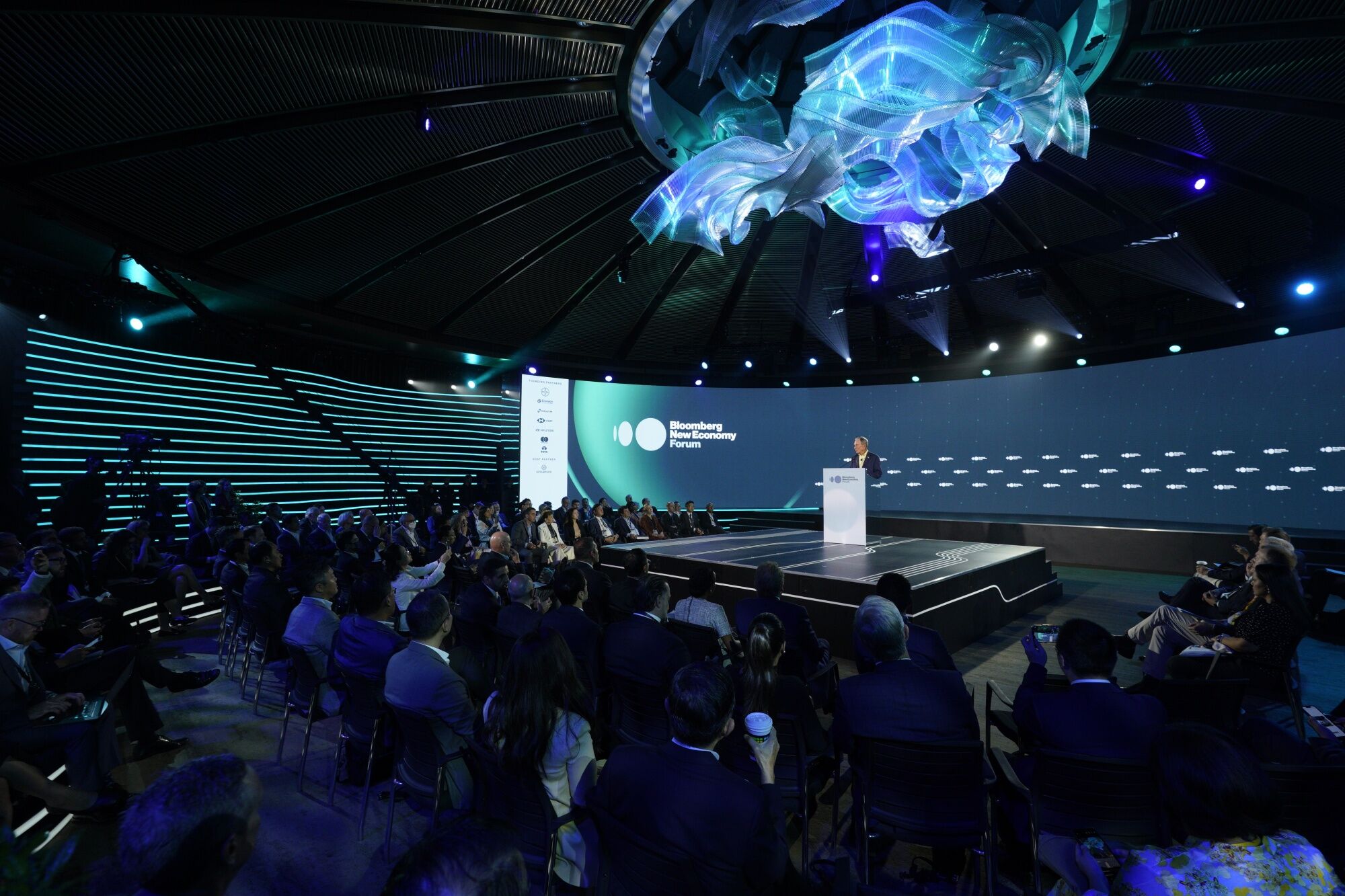
(Bloomberg) — Geopolitics dominated the start of the second day of the Bloomberg New Economy Forum in Singapore, with world leaders reacting to a missile hitting Polish territory near the border with Ukraine, raising concerns about a spillover from Russia’s war.
The rapid downfall of crypto exchange FTX, distrust of big data and changes in China’s venture capital market were all key issues discussed in the day’s opening panels and in interviews on the sidelines of the meeting.
Later sessions at the NEF on Wednesday will hear from chief executive officers or top officials from TikTok Inc., Standard Chartered Plc, HSBC Holdings Plc, Hillhouse Capital Group, Cargill Inc. and Temasek Holdings Pte.
FTX is Crypto’s Lehman: bitFlyer Chief (10:28 a.m.
SGT)
The meltdown of Sam Bankman-Fried’s digital-assets empire FTX is a “Lehman shock” to the industry, potentially causing more crypto firms to fail, said the chief executive officer and co-founder of major Japanese crypto exchange bitFlyer Inc.
“It’s a huge impact,” Yuzo Kano said in an interview with Bloomberg Television at the New Economy Forum, adding that the turmoil may push other firms into bankruptcy. “It may actually continue a little bit.”
Sequoia China Chief on Venture Capital (9:50 a.m.
SGT)
Neil Shen, founder and managing partner of Sequoia Capital China, said there are seismic changes going on in the venture capital market. He pointed out that the industry had a run of easy years in which startup valuations would rise every six to nine months.
“The market has changed completely,” said Shen, whose firm is considered one of the elite players in the Chinese market. “Now you have to roll up your sleeves.”
He made the case that consultants and bankers have been active in the venture business in recent years, but a core skill is operational experience.
If you’ve started a company, then you can make substantial contributions and help entrepreneurs get their businesses off the ground. That kind of hard work is essential in the current market.
“That’s the only way venture capital can create value and create returns,” Shen said at NEF.
Geopolitics in Focus (9:05 a.m. SGT)
Great-power politics dominated the first session on day two, with panelists including James Crabtree of the International Institute for Strategic Studies saying it has been a “bad week” for Putin, and that US-China tensions over Taiwan aren’t going away.
Despite a positive meeting between Presidents Xi Jinping and Joe Biden this week in Bali, Crabtree said “I don’t think we’ll have to wait very long before we have the next crisis over Taiwan.” The tensions that followed House Speaker Nancy Pelosi’s visit to Taipei in August “will become more common.”
Nisid Hajari, a Tokyo-based foreign affairs specialist on Bloomberg’s editorial board, said a NATO-style military bloc probably isn’t needed to deter China, and would struggle for support regardless.
Tradeshift Warns on Supply Lines (8:15 a.m.
SGT)
Christian Lanng, the chief executive officer of supply chain specialist Tradeshift, said it would take decades for the west to recreate China manufacturing, if there was even any appetite for doing so. Pivoting supply chains takes five to 10 years and cannot be hurried.
Elevated interest rates are imposing an invisible financial strain on supply systems, which are generally quite fragile and weren’t prepared for global shocks like we’ve seen over the past year, he said on the sidelines of the NEF.
Any new trade sanctions on Russia are unlikely to have a material effect, Lanng said during an interview broadcast on Bloomberg Radio.
The New Economy Forum is being organized by Bloomberg Media Group, a division of Bloomberg LP, parent company of Bloomberg News.
–With assistance from Takashi Nakamichi, Joyce Koh, Adrian Kennedy, Bill Faries, Tom Redmond, Vlad Savov, Juliette Saly, Michelle Jamrisko, Jane Zhang and Peter Elstrom.
More stories like this are available on bloomberg.com
©2022 Bloomberg L.
P.