
(Bloomberg) — OPEC+ agreed to a one-month extension of its record output cuts and adopted a more stringent approach to ensuring members don’t break their production pledges.
The deal will underpin the oil market recovery, easing the financial pain felt by resource-dependent emerging economies, shale explorers in Texas, and blue-chip companies like Royal Dutch Shell Plc.
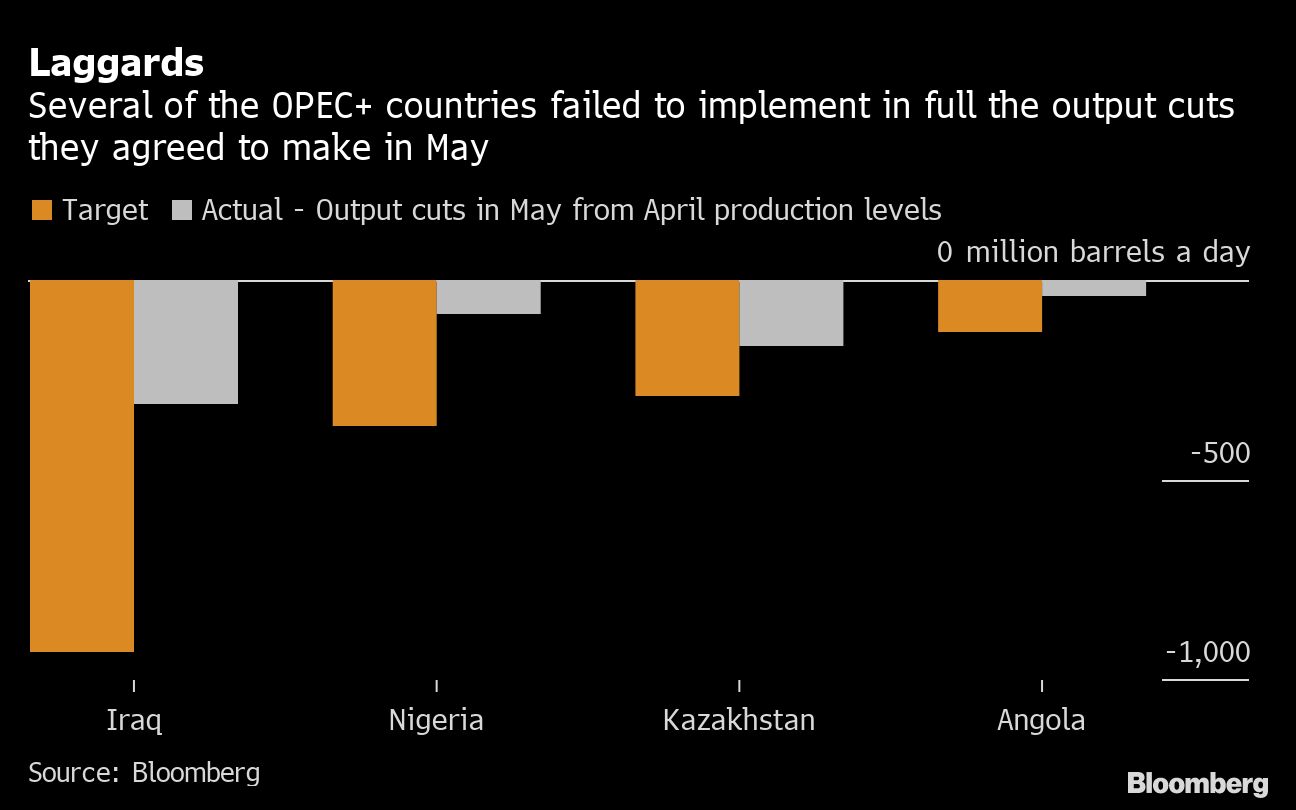
It’s a victory for Saudi Arabia and Russia, who put a destructive price war behind them to successfully cajole Iraq, Nigeria and other laggards to fulfill their obligations.
The two leaders of OPEC+ showed that they intend to keep a close watch on the oil market, meeting every month to assess the evolving balance between supply and demand amid an uncertain economic recovery from the global pandemic.
With the cartel’s video conference still under way, delegates said all nations had signed off on the new deal. The group will maintain its production cut of 9.7 million barrels a day to the end of July, instead of easing it to 7.7 million after this month as planned.
In addition, the approved communique states that any member that doesn’t implement 100% of its production cuts in May and June will make extra reductions from July to September to compensate for their failings.
Those promises are a particular vindication for the kingdom’s Energy Minister Prince Abdulaziz bin Salman, who has consistently pushed fellow members to stop cheating on their quotas since his appointment last year.
But they could also add an element of risk.
The entirety of the 23-nation production agreement, which runs until April 2022, is now contingent on every member making 100% of their pledged cuts, according to the communique. That’s something rarely achieved in the 3 1/2 years that OPEC+ has existed, or indeed the decades-long history of the Organization of Petroleum Exporting Countries itself.
Daunting Challenge
Oil has just posted a sixth weekly gain in London, more than doubling to $42.30 a barrel since April as traders anticipate tighter supplies as demand recovers from the coronavirus lockdowns.
U. S. President Donald Trump on Friday hailed the cuts from OPEC and its allies for saving the American energy industry.
“Despite the progress achieved to date, we cannot afford to rest on our laurels,” Mohamed Arkab, Algeria’s energy minister and current OPEC president, said at the start of the meeting. “The challenge that we face remains daunting.”
The group hopes to build on its success by pushing the market into a supply deficit next month, using a price structure called backwardation to start to chip away at the billion barrels of oil stockpiles that built up during the pandemic.
Read: OPEC+ Tries Novel Strategy to Turn Oil Price Curve Upside Down
The cartel will meet again in the second half of June for another review of the oil market.
Talks are scheduled on June 18 for the Joint Ministerial Monitoring Committee, which could recommend a further extension if it’s deemed necessary, pushing the deep production cuts into August, a delegate said. That panel will meet every month until December, according to the draft communique.
The next full ministerial OPEC+ meeting has been scheduled for Nov. 30 to Dec. 1, delegates said, although the communique notes that a conference could be held whenever it is required.
Cutting production is always painful for oil-dependent states.
Iraq in particular needs every penny because it’s still rebuilding its economy following decades of war, sanctions and Islamist insurgency.
The country made less than half of its assigned cutbacks last month, so compensating fully would require it to slash production by a further 24% to about 3.28 million barrels a day, according to Bloomberg calculations. Accepting such terms could risk a backlash from Iraqi parliamentarians and rival political parties for bowing to foreign pressure.
Read: Oil’s Fragile Peace Is Threatened by Iraq’s Desperate Reality
The traditional shirkers in OPEC+ have promised many times before to do better.
Some analysts were skeptical that this occasion will be any different.
“Everyone saves face with this agreement,” Jan Stuart, global energy economist at Cornerstone Macro LLC, said on Friday after a tentative deal was in place. “But it begs the question: What is the enforcement mechanism? I’m very curious to see how the organization is going to elicit greater compliance from the cheaters.”
There’s also a risk that future OPEC+ curbs could be undermined by a return of Libyan oil.
The civil war there halted more than 1 million barrels a day of production, helping OPEC+ rebalance the market, but a cease fire now opens the door for a gradual recovery of supply.
For now at least, members of OPEC+ can enjoy the price gains resulting from their deal.
“The oil market is on its way to recovery,” said Ann-Louise Hittle, oil analyst at consultant Wood Mackenzie Ltd. “Supply has shifted dramatically already”
(Updates with details of draft communique in third paragraph.)
For more articles like this, please visit us at bloomberg.com
©2020 Bloomberg L.
P.