
(Bloomberg) — Brazil reported a record day for infections, making it the world’s fastest-growing virus hot spot, and President Donald Trump is considering a ban on Brazilians traveling to the U. S. Russia added the fewest cases since the start of the month and recoveries outpaced new infections for the first time.
Chinese doctors are seeing the virus manifest differently in its new cluster of cases, suggesting that the pathogen may be changing and complicating efforts to stamp it out.
Millions were evacuated in India and Bangladesh before the biggest cyclone in two decades, hampering efforts to curb the outbreak.
Trump said the U. S.’s 1.5 million cases were a “badge of honor” for the country’s testing efforts. Republicans are pushing for the World Health Organization’s director-general and China’s ambassador to the U. S. to testify before the House virus oversight subcommittee.
Key Developments:
- Virus Tracker: Cases top 4.8 million; deaths exceed 323,000
- The struggles of homeschooling in the world’s tiniest apartments
- Australia’s closed borders harken back to pre-global economy
- Boris Johnson has a Brexit problem with workers staying home
- China’s new outbreak shows signs the virus could be changing
Subscribe to a daily update on the virus from Bloomberg’s Prognosis team here.
Click VRUS on the terminal for news and data on the coronavirus. See this week’s top stories from QuickTake here.
Johnson Promises U. K. Track-And-Trace System By June (7:26 a.m. NY)
Prime Minister Boris Johnson said the U. K. will have a track-and-trace system in place by June 1 capable of dealing with 10,000 new coronavirus infections a day. Johnson has previously said that a system of tracing infections is essential to lifting the U.
K.’s lockdown. Answering questions in Parliament on Wednesday, he didn’t refer to the mobile phone app that the government is developing and which is now overdue, instead focusing on hiring thousands of people to work as contact tracers.
“There will be 25,000 trackers,” Johnson said. “They will be able to cope with 10,000 new cases a day.” He said new infections were currently running at a rate of 2,500 a day.
Danish Lawmakers Push PM to Reopen Borders (7:05 a.m.
NY)
Danish lawmakers are pushing Prime Minister Mette Frederiksen to open the country’s borders by the end of this month. “The opening of the border has the biggest impact on the Danish economy,” Jakob Ellemann-Jensen, leader of the Liberals, told reporters. The party joined lawmakers representing a majority in Parliament in a joint statement urging the government to act now.
The borders have been closed since March 14.
Frederiksen, who’s in talks with neighboring Germany, Sweden and Norway about reopening, has said she plans to decide no later than June 1. Despite facing pressure internally and from Germany, which plans to reopen its borders on June 15, Frederiksen has been reluctant to follow for fear that increased travel would unleash a new wave of Covid-19 cases.
Inovio Vaccine Tested in Mice, Eyes Phase 2/3 by August (7 a.m.
NY)
Inovio soared after highlighting results for its experimental Covid-19 vaccine in mice and guinea pigs, published in the peer-reviewed journal Nature Communications, “demonstrating robust neutralizing antibody and T cell immune responses against coronavirus SARS-CoV-2.” The company is targeting a Phase 2/3 efficacy trial to start in July or August pending regulatory approval.
Inovio’s vaccine platform uses DNA which is more “scalable,” for mass production, according to Kate Broderick, Inovio’s SVP of R&D.
She notedin a phone call before the results that “from the perspective of DNA medicine we’ve had a very benign safety profile which will make it easier to scale up to trials.”
Separately, Aldeyra Therapeutics said it will advance the investigational new HSP90 inhibitor ADX-1612 to clinical testing for Covid-19.
WTO Sees Contraction in Global Trade Continuing (6:24 .m. NY)
World merchandise trade volume is likely to fall “precipitously” in the first half of 2020 due to the impact of the pandemic on global trade flows, according to the World Trade Organization.
The Goods Trade Barometer, a forward-looking measure, fell to 87.6 in March, well below the 100 level that indicates volumes in line with the medium-term trend.
“The barometer captures the initial phases of the Covid-19 outbreak and shows no sign of the trade slump bottoming out yet,” the Geneva-based body said.
Dutch to Screen Mink Farms (5:29 p.m. HK)
The Netherlands will start checking all mink farms in the country for the coronavirus after research from an ongoing probe found a person probably caught it from an infected animal.
Screening of mink for antibodies will be mandatory in “the interest of the health of employees,” the Dutch government said in a statement late Tuesday. A farm worker was infected with a strain that was genetically similar to one circulating among mink, suggesting the animals were the source.
The semi-aquatic, carnivorous mammals are raised for their soft pelts on more than 130 Dutch farms.
The pandemic virus was probably introduced by an infected person originally. Authorities are monitoring the outbreak to gauge its persistence, said Marion Koopmans, head of the viroscience department at the Erasmus University Medical Center in Rotterdam.
Moderna Partner Brings Production Muscle (5:12 p.m. HK)
Drugmakers racing to make Covid-19 vaccines and therapies are seeking out specialized manufacturers such as Moderna Inc.’s partner Lonza Group AG that can scale up production to billions of doses needed to supply the world.
After the first batches of Moderna’s vaccine are produced in the U.
S. in July, Lonza expects to produce initial “commercial volumes” at a site in Portsmouth, New Hampshire, in December, followed by a location in Visp, Switzerland, in February, Chairman Albert Baehny said in an interview. Each line could make as many as 100 million doses a year.
Innovative biotechnology companies like Moderna lack the size and experience to produce in bulk, and Lonza has been contacted by scores of other developers that need its services.
“We’ve had more than 100 inquiries, maybe 120, 140, I don’t know,” Baehny said.
While Lonza has agreed with Moderna to make as many as 1 billion doses a year, Baehny said the company still can take on more production and expects to reach a few more collaboration pacts.
U. K. Needs Flexible Furlough Plan (4:51 p.m. HK)
U. K. businesses need flexibility from the government’s furlough plan if they’re to successfully restart, Adam Marshall, director general of the British Chambers of Commerce, said in an interview on Bloomberg Television.
Companies are “partly ready to reopen, but not completely,” he said. A BCC survey shows 37% of members are prepared to restart fully, 45% partially and 10% are not ready.
The government should continue to top up wages as the U. K. reopens, Marshall said. With some employees working perhaps as little as one day a week, companies need time for their cash flow to recover, he said. More than 70% of BCC members are using the Coronavirus Job Retention Scheme, which helps pay workers’ wages during the virus lockdown.
Germany Aims to Crack Down on Meat Packers (4:40 p.m.
HK)
Germany may introduce tougher standards for the domestic meat industry after coronavirus hot spots at slaughterhouses prompted reports of inadequate working and hygiene standards.
Chancellor Angela Merkel’s cabinet is discussing the measures after Labor Minister Hubertus Heil called for a “clean-up” of conditions he said pose “dangerous health risks.” Among the shortcomings that need to be addressed are overcrowded and overpriced living quarters for workers, violations of coronavirus regulations and of minimum-wage legislation, Heil said earlier this week.
More than 1,000 workers at European slaughterhouses have contracted Covid-19, highlighting the growing challenges the global meat industry faces from the pandemic.
Ireland’s meat-processing sector has had 828 positive Covid-19 cases during the past two months, industry group Meat Industry Ireland said earlier on Wednesday, citing the latest figures from the nation’s health service.
Cambridge University Moves Lectures Online Until 2021 (4:21 p.m. HK)
Cambridge University is moving all face-to-face lectures online for the coming academic year and said that it may be possible to host smaller groups in person, as long as they conform to requirements around social distancing. “This decision has been taken now to facilitate planning, but as ever, will be reviewed should there be changes to official advice on coronavirus,” a spokesperson said in an email.
Cyclone Threatens to Displace Millions in India, Bangladesh (4 p.m.
HK)
Authorities along India’s east coast and neighboring Bangladesh have evacuated millions and shut factories as the biggest cyclonic storm in two decades is set to make landfall later on Wednesday.
Apart from the storm threatening lives, authorities face another risk — evacuating millions of people during a pandemic may lead to a jump in infections. Bangladesh is evacuating 2.2 million people from coastal districts.
In India’s West Bengal, almost 300,000 people have been moved into relief centers, Chief Minister Mamata Banerjee said.
“We will try to maintain social distancing as much as possible,” Banerjee said. India’s federal government has also directed states to follow social distancing rules to contain the coronavirus pandemic. Infections in India have been rising at the fastest pace in Asia and have topped 100,000.
Russia Recoveries Surpass New Cases for First Time (3:45 p.m.
HK)
The number of confirmed new coronavirus infections in Russia rose by 8,764 over the past day, the lowest since May 1, taking total cases to 308,705. As many as 9,262 people recovered in the same period, bringing the total to 85,392. The number of deaths increased by a record 135 to 2,972.
Cases in Russia have tripled since the end of April, making the country the new hotspot for the coronavirus in Europe.
Infections surged this month, as new cases topped 10,000 every day for more than a week, but the rate has since slowed.
U. K. Inflation Rate Drops Below 1% (3:06 p.m. HK)
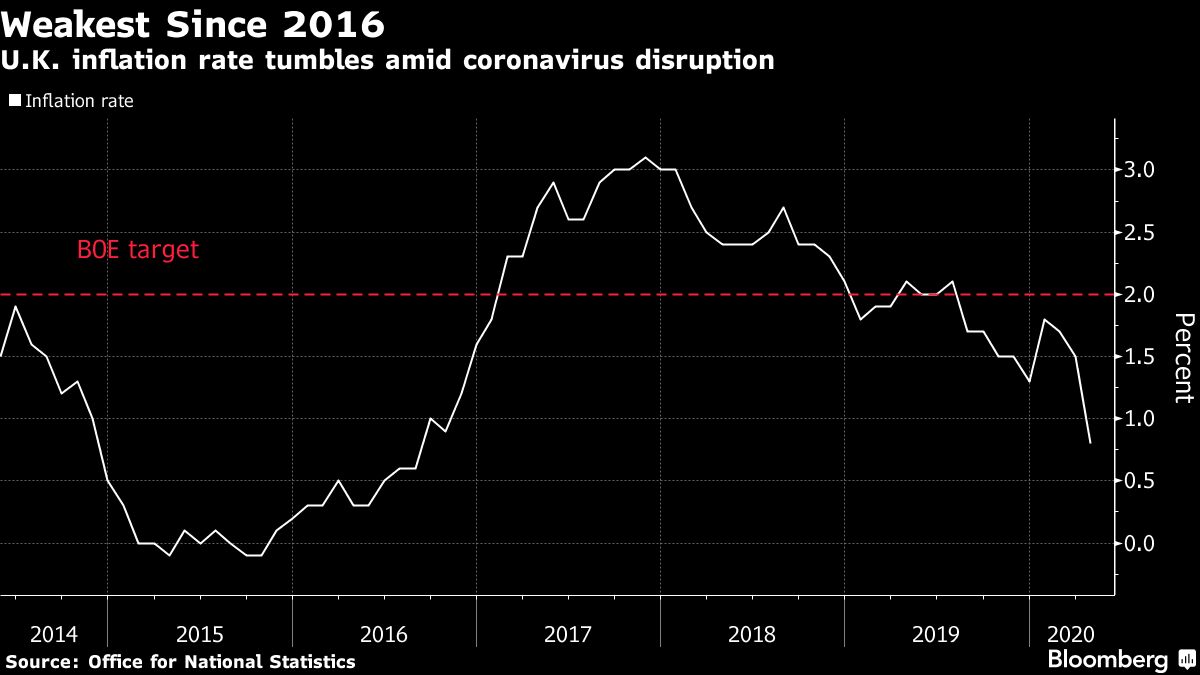
U. K. inflation slowed to the weakest level since 2016 in April as energy prices fell and the coronavirus lockdown put the brakes on economic activity.
The prospect of persistently low inflation will fuel speculation that more action is needed from the Bank of England, intensifying the debate over taking rates below zero for the first time.
Governor Andrew Bailey faces questions from lawmakers later on Wednesday. While the lockdown means it’s hard to interpret the data, the report gives more of a flavor of the impact the virus is having on the economy.
Lufthansa Warns of Urgent Need for Bailout (3:02 p.m. HK)
Deutsche Lufthansa AG’s management said the need for a multibillion-euro coronavirus bailout was becoming “urgent” as talks with the government in Berlin drag on.
In a letter to employees, the airline said cash reserves continued to shrink while it negotiates the 9 billion-euro ($9.9 billion) rescue package.
Lufthansa’s board said it hoped the government would find the “political will” for a deal that would keep the carrier competitive against international airlines and meet with European Union approval. The company is running out of time and money, burning through 800 million euros each month after the coronavirus grounded most of its fleet.
Latvia Wants to Lift State of Emergency in June (2:48 p.m.
HK)
Latvia’s goal is to lift a state of emergency after June 9, while leaving in place some restrictions to control the pandemic, Prime Minister Krisjanis Karins said on Latvian TV. Latvia may adopt a law allowing the government to take additional measures to fight the virus after lifting the state of emergency.
Rolls-Royce Moves to Cut 9,000 Jobs (2:35 p.m. HK)
Rolls-Royce Holdings Plc Chief Executive Officer Warren East’s five-year bid to revive earnings has been shattered by the coronavirus crisis as the U.
K. engineering giant moves to scrap 9,000 jobs. Jet-engine-maker Rolls will cut 17% of its workforce amid a travel slump prompting airlines to scale back years of jetliner purchases, the company said in a statement.
Rolls-Royce is particularly exposed because of its focus on larger aircraft facing a reduced role in global fleets as the pandemic depresses economies and alters travel habits. East said before the outbreak that the London-based company was turning a corner after years of restructuring.
South Africa Says It Doesn’t Meet WHO Criteria to Lift Curbs (2:28 p.m.
HK)
The rate of new coronavirus infections in South Africa must slow before the country can lift a nationwide lockdown in line with World Health Organization guidelines, Health Minister Zweli Mkhize said. The government’s Covid-19 modeling team presented forecasts showing a peak in active cases in early July under the pessimistic scenario, or a peak in early August under the optimistic scenario.
South Africa, which has the highest number of confirmed infections on the continent, eased some restrictions on May 1, almost five weeks after imposing a stringent lockdown.
Schools will be allowed to reopen gradually from June 1.
For more articles like this, please visit us at bloomberg.com
©2020 Bloomberg L. P.