
(Bloomberg) — Peloton Interactive Inc. tumbled as much as 16% after the company delivered a weaker forecast for the current quarter than Wall Street was predicting, even as management declared that it was beating its own timeline for turning around the fitness company.
Sales will be $700 million to $725 million in the fiscal second quarter, which runs through December, Peloton said in a statement Thursday.
That’s down about 37% from a year earlier and well below the $869 million average analyst estimate.
The outlook suggests Peloton is still struggling to recover from a post-pandemic hangover. The company had seen sales surge during Covid-19 lockdowns, only to suffer a glut of inventory after consumers went back to offices and gyms. Chief Executive Officer Barry McCarthy took the helm in February and launched a comeback plan but has yet to win over investors.
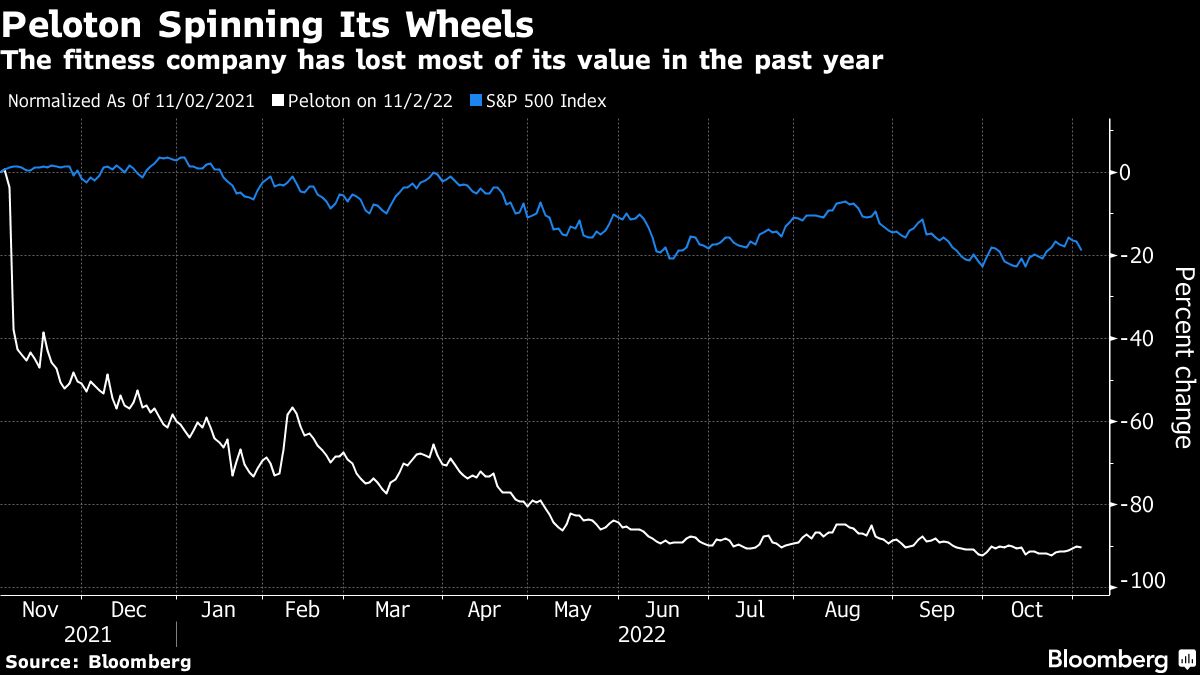
Peloton fell to a low of $7.24 in New York on Thursday morning.
The shares have lost about 90% of their value over the past 12 months.
He acknowledged in a letter to shareholders that Peloton’s turnaround remains a “work in progress,” saying the New York-based company is still figuring out how to better deliver its bikes to consumers and improve customer service. But he said Peloton is moving toward his goal of generating free cash flow, with a “stable underlying business.”
“Considering our progress over the last seven months, the substantial changes we’ve made to our business model, and the infusion of additional talent on the leadership team, I believe our 1Q23 results make a strong case that we will beat the one-year timeline and deliver on our turnaround goal,” McCarthy said.
In the fiscal first quarter, revenue declined 23% to $616.5 million, missing the average estimate of $641 million.
Revenue from subscriptions climbed 36%, but the money generated from Peloton’s hardware products — like its bikes and treadmills — fell nearly 60%. The adjusted loss before interest, taxes, depreciation and amortization was $33.4 million.
While subscription revenue increased, overall app subscriptions declined from the year-ago quarter and fell 11% from the fourth quarter of last year to 875,000 subscribers.
Connected fitness subscriptions — the monthly service for viewing Peloton content on the company’s hardware — rose 19%. Overall, Peloton members grew 6% on an annual basis, but fell 3% from last quarter.
In the second quarter, Peloton’s adjusted loss will be $100 million to $115 million. That’s a bit worse than the $97 million loss analysts had predicted. One bright spot of the forecast was gross margins, which are poised to improve to about 36%, versus roughly 25% a year earlier.
Despite generally missing estimates, McCarthy declared that the “ship is turning” and the company is now in position for “sustained growth and scale.”
To lower the company’s costs, Peloton moved in recent months to outsource manufacturing, customer service and deliveries.
It also laid off thousands of employees globally, including 500 jobs last month. As part of the belt-tightening, the company plans to shutter the majority of its retail stores in North America next year.
McCarthy’s comeback plan has involved broadening Peloton’s distribution as well. It recently launched partnerships with Amazon.com Inc., Hilton Worldwide Holdings Inc. and Dick’s Sporting Goods Inc.
In the letter, Peloton said it expects “continued pressure” on the company’s app subscription count as it works to revamp its strategy early next year.
Peloton said that revenue for the first quarter missed its own guidance, in part, because of a $26.5 million charge related to the recall of its Tread+ treadmill and its anticipation that more users will request refunds as part of a recent program extension.
Due to the shaky economy, the company believes that demand for Peloton hardware is “likely to remain challenged” in the second quarter.
“While macroeconomic uncertainty and concerns about a potential recession impacting consumer spending levels are real, we take comfort in knowing fitness spending has proven to be resilient during previous recessionary periods,” he said.
McCarthy remained steadfast that the company is on the right track.
His goal is to reach the break-even point for free cash flow by the second half of fiscal 2023.
“When we reach our goal, investors can stop talking about the financial viability of the business and focus instead on growth,” he said.
(Updates with share reaction in fourth paragraph)
More stories like this are available on bloomberg.com
©2022 Bloomberg L.
P.