
(Bloomberg) — Australia’s central bank found that its forward guidance delivered during the pandemic resulted in “substantial communication challenges” and decided it would be more flexible in future.
“Given inherent uncertainty in the world, forward guidance should be flexible and is not always required,” the Reserve Bank said in a review of the communication tool released on Tuesday. “Forward guidance can be used to help inform the public and markets, but it is best to avoid being too prescriptive.”
The evaluation is part of a series of internal assessments the RBA has conducted of its pandemic-era policies and comes ahead of an independent, government-ordered review.
The latter is considering everything from a board shakeup to amending its objectives, with the three-member panel’s final report due in March.
The RBA faced criticism early in the pandemic for being slow to implement unconventional policies and then later for being slow to unwind stimulus programs. A key source of complaint was Governor Philip Lowe’s statement that, based on wages and inflation forecasts, interest rates were unlikely to rise before 2024.
Lowe delivered this forward guidance when the RBA first responded to the Covid outbreak as he sought to instill confidence in the community as Australia’s economy lurched into recession for the first time since 1991.
“Together with other policy measures, the RBA’s stronger forward guidance worked to lower funding costs and support the economy early in the pandemic,” the review found. “The policy response helped shore up confidence during a period of significant uncertainty and disruption.”
The criticism, though, is how long the governor stuck with it.
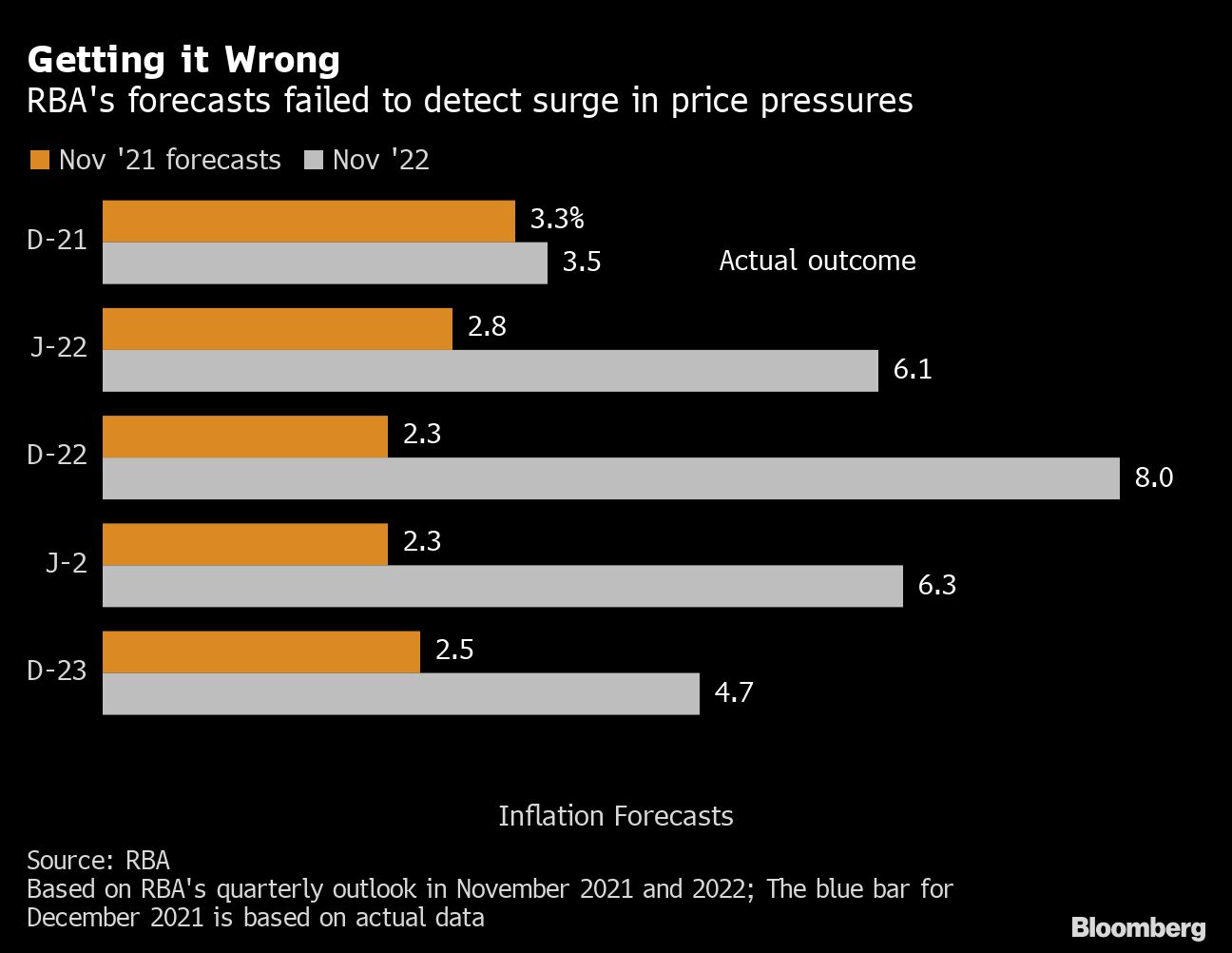
Lowe was still delivering the 2024 message in September last year — when markets and some economists were already predicting rate rises in the period ahead. By mid-December, Lowe had conceded a little and amended his view to no hike in 2022.
Yet less than five months later he was raising rates. It was a sharp tightening, too, with the cash rate hitting 2.85% this month from a record-low 0.1% in May as the RBA raced to contain soaring prices.
It has signaled further rate increases ahead with inflation forecast to peak at 8% in the current quarter.
RBA Prepared to Pause or Return to Outsized Hikes, Minutes Show
“The time-based element of the guidance was very prominent in media and market commentary, and came to dominate the interpretation of the forward guidance,” the review showed. “The RBA attracted extensive criticism when the cash rate was increased much earlier.”
Based on the review, the RBA’s board decided that its approach to forward guidance will henceforth be based on the following considerations:
- Where forward guidance is appropriate, ordinarily it will be “qualitative in nature”
- Forward guidance on interest rates will not always be provided
- The board does not intend to publish its own forecasts of the expected policy path
- When policy rates are at, or near, the effective lower bound, a stronger form of forward guidance will be considered
Earlier this year, the RBA released findings of an internal assessment of its yield target policy.
It concluded that a disorderly exit from that program damaged the central bank’s credibility.
The message about the likely timing of future cash rate increases “was complicated” by the central bank’s three-year yield target at 0.1%, today’s review said.
“The time-based element of guidance and the term for the yield target were mutually reinforcing. Neither were well suited to respond to the unprecedented global events.”
A separate review of its bond-buying policy showed there were some benefits in tripling the bank’s balance sheet to about A$650 billion ($435 billion).
(Updates with further details, chart.)
More stories like this are available on bloomberg.com
©2022 Bloomberg L.
P.