
(Bloomberg) — Covid-19 cases surpassed 24 million worldwide with India seeing a record spike and South Korea, Italy and France reporting the most new daily infections in months. Leaders of Europe’s major economies are ruling out new broad movement restrictions as they try to support economic recoveries.
Moderna Inc. presented new safety data from an early trial that provides evidence of how its vaccine candidate stimulates the immune systems of older people.
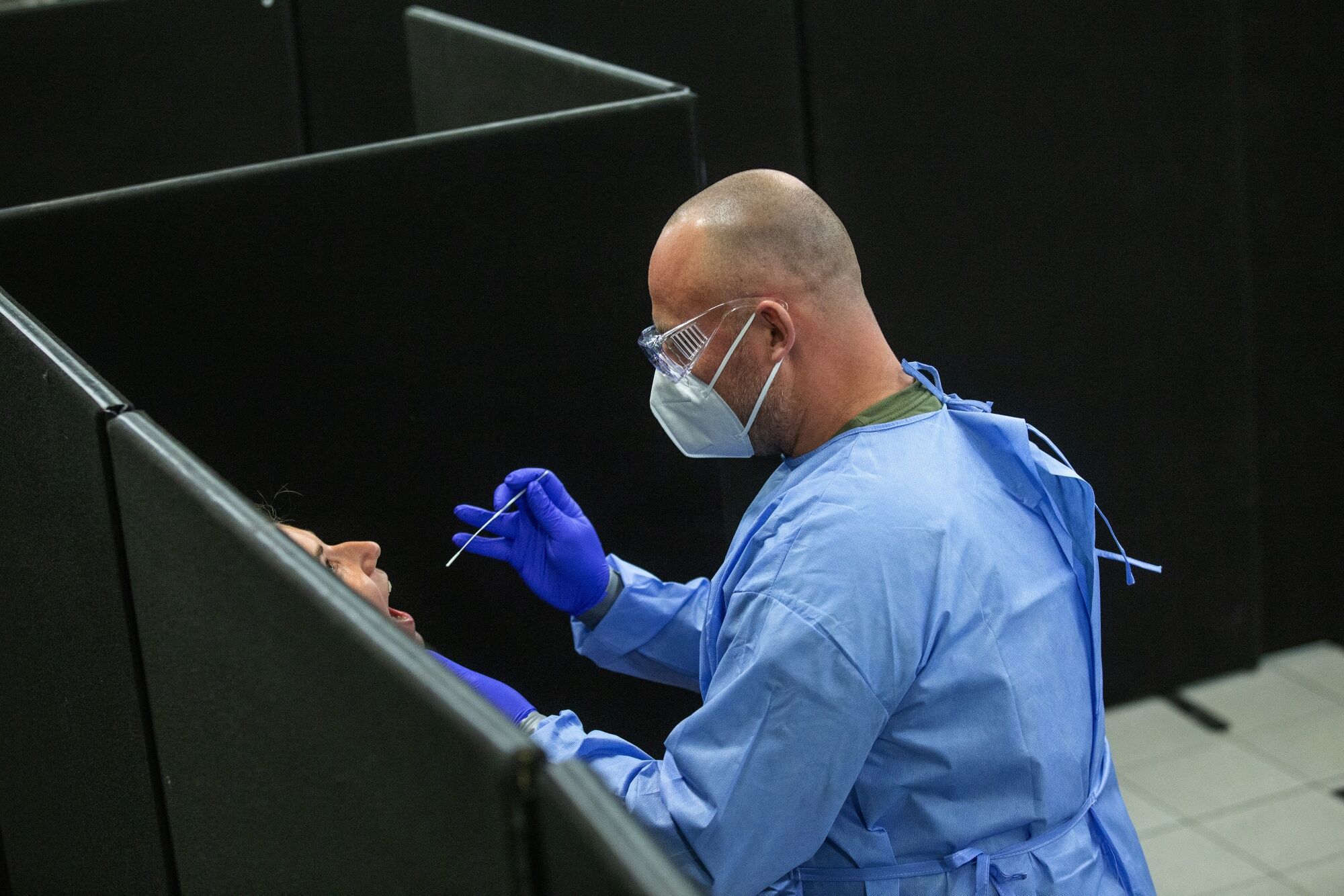
Abbott Laboratories won U. S. clearance for a 15-minute Covid test that will be priced at just $5.
A shift in guidelines on U. S. testing drew criticism from state leaders and public-health experts, while a top Trump administration official defended the move. The European Union’s trade chief stepped down after growing criticism that he broke virus regulations in his native Ireland.
Key Developments:
- Global Tracker: Cases top 24 million; deaths pass 825,000
- Italy, Spain, France reject lockdowns despite rising cases
- White House vaccine program hedges bets on different technologies
- Virus in vacant apartment suggests role of toilets in spread
- Surging demand for China flights gives travel industry hope
- Vaccine Tracker: Where we are in the race for protection?
- Here’s how experts say people catch Covid-19
Subscribe to a daily update on the virus from Bloomberg’s Prognosis team here.
Click CVID on the terminal for global data on coronavirus cases and deaths.
U. K. to Pay People on Low Incomes If Self-Isolating (4:05 p.m. HK)
U. K. Health Secretary Matt Hancock said the government will pay workers on low incomes 13 pounds ($17) a day if they are self-isolating during the pandemic.
The payments will begin on a trial basis from Sept. 1 in Blackburn and areas of northwest England that currently have additional social distancing-rules in place to contain local outbreaks, the Department for Health said in a statement.
Indonesia Sees Record Jump in New Cases (4:04 p.m.
HK)
Indonesia reported a record surge in new cases on Thursday, bringing the total to 162,884, official data showed. New infections jumped by 2,719 in 24 hours while the death toll rose by 70 to 7,064.
Japan’s Virus Wave Is Easing (3:45 p.m. HK)
Japan’s most recent and largest wave of infections is showing signs of subsiding, despite a lack of heavy intervention from the government to bring it under control.
After peaking at the start of August, the country is on track for a sixth consecutive day where new cases are below 1,000.
The seven-day average of cases is falling in almost every hotspot, including in Tokyo where the 250 cases reported Thursday are about half of the peak level found earlier this month. The test positivity rate in the capital has been below 5% for three days.
South Korea Extends Short-Selling Ban Amid Virus Flareup (3:32 p.m. HK)
South Korean regulators extended a ban on short-selling of shares listed on some exchanges for another six months, as the nation grapples with the vagaries of the coronavirus outbreak.
Betting with borrowed shares will be prohibited for stocks on the benchmark Kospi, tech-heavy Kosdaq and small-cap Konex index until March 15, 2021, the Financial Services Commission said in an emailed statement on Thursday.
The initial banwas imposed after the Kospi plunged more than 8% on March 13 amid a surge in virus cases.
The country had 441 more cases confirmed in the past 24 hours, the biggest gain since early March, according to data from the Korea Centers for Disease Control & Prevention.
Record Daily Case Rise in India (2:55 p.m. HK)
India had its biggest single-day jump in new cases on Thursday, with 75,760 infections confirmed, as the disease’s spread continues to accelerate through the world’s second most populous country.
With 3.3 million cases in total India currently has the world’s third largest outbreak, though its epidemic is now growing faster than both the U. S. and Brazil’s, the countries that have the most and second-most cases.
Indian infections have continued to accelerate as the disease spreads out of its globally connected cities which were first hit, and into the country’s vast hinterland where most of the population lives.
India’s new case tally on Thursday is its first 24-hour period to rival some of the worst days of the pandemic seen in both the U. S. and Brazil.
Germany’s New Infections Hold Steady (2:30 p.m. HK)
Germany recorded 1,431 new cases in the 24 hours through Thursday morning, little changed from the previous day’s figure of 1,457, according to data from Johns Hopkins University. That brought the total to 239,010.
The reproduction factor — the average number of people infected by one person with the virus — fell to 0.85 on Wednesday from 0.90 the previous day.
Merkel Bloc Quarrels Over Quarantine (2:20 p.m. HK)
A spat has broken out between senior officials in Chancellor Angela Merkel’s conservative bloc over coronavirus rules for travelers arriving in Germany from areas designated as risky.
Health Minister Jens Spahn announced this week that arrivals from risk areas will have to enter a 14-day quarantine, which can be ended after five days if a negative test result is provided.
Due to a lack of capacity, a requirement for people to be tested on arrival will be scrapped when the changes take effect some time after the middle of next month.
Further details will be discussed when Merkel holds talks with leaders from Germany’s 16 states later on Thursday, as officials try to deal with an uptick in infections in Europe’s biggest economy in recent weeks.
Swiss Take Smaller Economic Hit Than Neighbors (2:10 p.m.
HK)
Switzerland’s economy saw less damage from the coronavirus lockdown than its larger neighbors, recording a smaller-than-expected contraction in the second quarter. While gross domestic product fell 8.2% in the three months through June, the most since at least 1980, the decline was less than the 9.7% in Germany and the double digit slumps in France and Italy.
Asian Air Traffic Collapse Continues (1:40 p.m.
HK)
Airlines in the Asia Pacific region carried only 844,000 passengers on international flights in July versus 33.4 million in the same month last year due to border closures and travel restrictions, according to the Association of Asia Pacific Airlines. That’s a fall of 97%.
Demand for international cargo was relatively stable following a modest recovery in global manufacturing, though freight tonne kilometers were still down 16% on an annual basis, the association said.
Several states and industry bodies are evaluating Covid-19 testing regimes that could facilitate international air travel without blanket quarantine requirements, AAPA Director General Subhas Menon said.
Japan Virus Jump Hitting Economy (11:25 a.m. HK)
Japanese Economy Minister Yasutoshi Nishimura said a jump in virus cases from July and heavy rains are dragging on the nation’s economy and he didn’t know yet whether the outbreak has peaked.
He told a parliamentary committee the economy’s overall recovery trend is not yet back. Nishimura said on Wednesday a second wave of the virus now spreading in Japan is bigger than the one that caused the government to declare a state of emergency in April.
WHO Team Didn’t Visit Wuhan, FT Says (8:50 a.m. HK)
A World Health Organization team that was meant to investigate the origin of the coronavirus concluded their trip to China without a visit to Wuhan, the Financial Times reported, citing the UN agency.
The WHO told the FT that its advance team had remote conversations with senior scientists from the Wuhan Institute of Virology but declined to comment on whether the team had planned to visit the city. The organization said the initial team had been laying groundwork before a larger international investigation but didn’t provide details on whether the bigger task-force would travel to Wuhan. China’s foreign ministry called concerns over the credibility of the inquiry “totally unjustified,” according to the FT.
Abbott Cleared for $5, 15-Minute Test (6:40 a.m.
HK)
A 15-minute Covid test from Abbott Laboratories that will be priced at just $5 won emergency authorization for use in the U. S., a breakthrough that could ease the bottleneck that has crimped much of the nation’s testing capacity.
The product, dubbed BinaxNOW, works without relying on laboratory equipment at a time when labs can take as long as two weeks to produce results. It uses a nasal swab and a small reactive card, and it can be administered by a range of health-care workers, including pharmacists, at almost any location.
Abbott will start shipping the test within two weeks and intends to manufacture 50 million tests a month by the end of October.
Fauci Concerned Over New Test Guidelines: CNN (6:20 a.m.
HK)
Anthony Fauci, the top U. S. top infectious disease doctor, told CNN that he is concerned that the CDC’s new coronavirus testing guidelines will make people believe “that asymptomatic spread is not of great concern, when in fact it is.”
Fauci said in the CNN interview that he was in surgery when the new testing recommendations were discussed.
EU Trade Chief Quits After Virus-Rule Breach (4:55 p.m.
NY)
The European Union’s trade chief, Phil Hogan, stepped down after growing criticism that he broke virus regulations in his native Ireland.
Hogan was under pressure over his attendance at a golf dinner last week that violated coronavirus regulations as well as his behavior during quarantine upon arrival in his home country. The resignation came a day after Ireland’s government said that Hogan’s “delayed and hesitant” response impaired public confidence.
Moderna Vaccine Produces Antibodies in Trial of Older People (10:51 a.m.
NY)
Moderna Inc. presented new safety data from an early trial that provides the first evidence that its Covid-19 vaccine stimulates the immune systems of older people.
In a phase 1 trial, Moderna’s coronavirus vaccine produced “consistently high levels” of neutralizing antibodies — a key component of the body’s protective response — in older adults, the company said in a statement.
Antibody levels produced in people more than 55 years old were comparable to those seen in younger adults, the company said in a statement.
The findings are important because older adults often don’t respond as well to vaccines as younger adults.
For more articles like this, please visit us at bloomberg.com
©2020 Bloomberg L. P.