
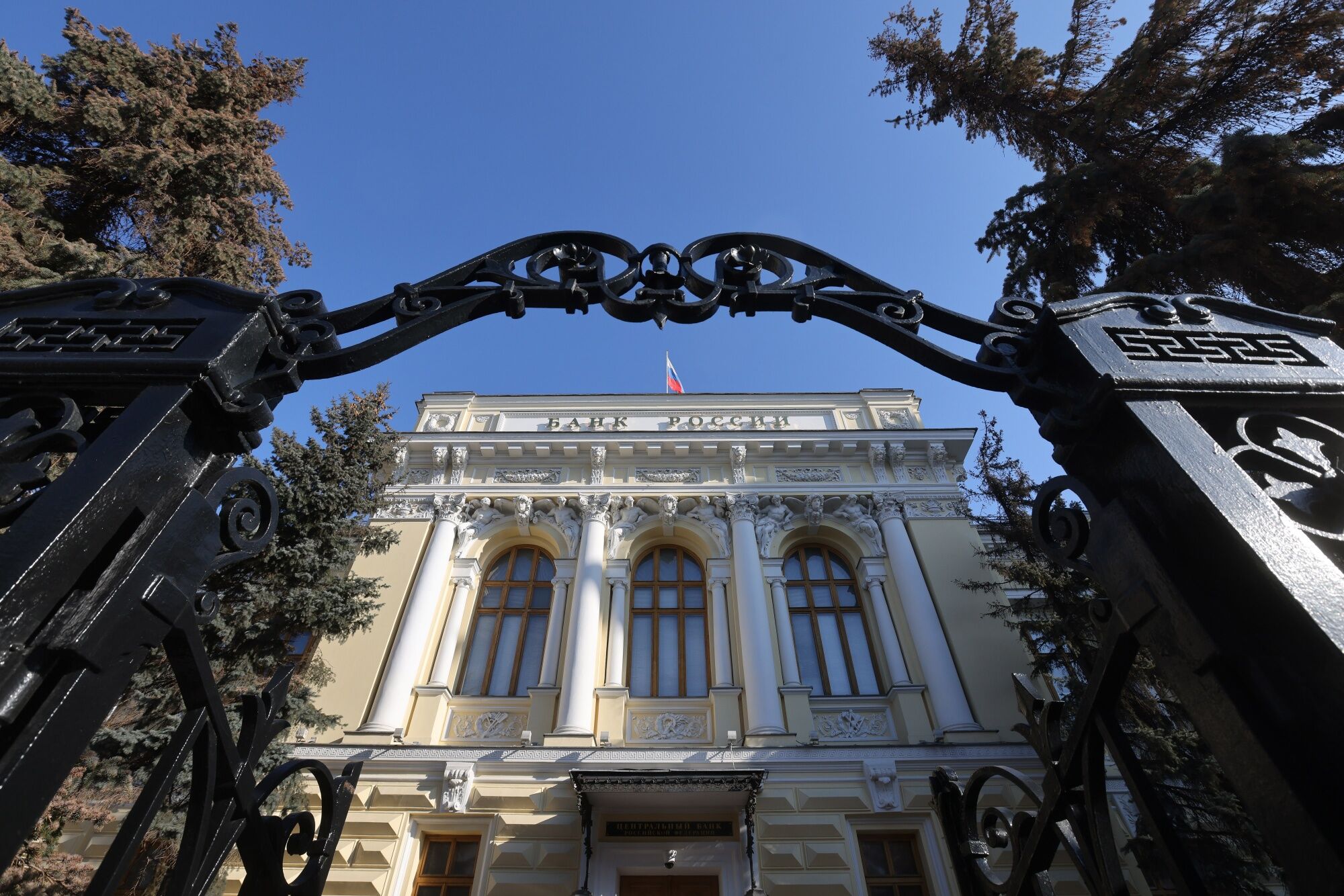
(Bloomberg) — Russia’s central bank delivered the smallest interest-rate cut since it started easing monetary policy after the invasion of Ukraine, as renewed risks to inflation prompt more caution.
Policy makers led by Governor Elvira Nabiullina lowered their benchmark to 7.5% from 8% on Friday, in line with the forecasts of most economists surveyed by Bloomberg. In a statement accompanying its decision, the central bank omitted its customary guidance hinting at what its next move will be, describing current monetary conditions as “overall neutral.”
“The Russian central bank views inflationary and disinflationary risks as balanced in the short term,” said Tatiana Orlova at Oxford Economics. “This may be a hint that a pause is coming in October, but the central bank is willing to allow itself some flexibility.”
The ruble held losses after the rate announcement, trading 0.2% weaker against the dollar.
Nabiullina will hold a news conference at 3 p.m. in Moscow.
With borrowing costs already below their level before the invasion of Ukraine, the urgency to revive the economy after the shock of international sanctions is giving way to worry that consumer costs could be harder to contain in the months ahead. The central bank on Friday singled out looser fiscal policy as a concern, following a dollop of stimulus by the government.
What Bloomberg Economics Says…
“The Bank of Russia may have overdone easing or is close to doing so.
There are three developments suggesting the rate cut at the September meeting will sew the seeds for higher prices this year: rising inflation expectations, government guidance for expansionary fiscal policy and a hot labor market.”
–Alexander Isakov, Russia economist. Read more here
Renewed threats to prices are coming to the forefront of attention for Nabiullina as the economy skirts a severe downturn.
In their latest statement, policy makers struck an upbeat tone about the economy, expecting this year’s contraction at the upper end of their forecast range of minus 6% to minus 4% and saying more companies are adapting to life under sanctions.
‘Somewhat Tougher’
“The rhetoric has become somewhat tougher, and this approach is explained by the uncertainty of how the inflationary picture evolves,” said Olga Nikolaeva, senior analyst at ITI Capital in Moscow. “What’s more, risks are starting to materialize more clearly in budget policy.”
Though monthly declines in consumer prices stretched through the summer, their deceleration on a weekly basis has slowed.
Inflationary expectations, a major factor for policy makers, picked up for a second month.
Nabiullina has previously she’s ready to tolerate inflation “slightly above” the central bank’s target of 4% as the economy adjusts.
On Friday, however, policy makers warned that “in case of a further budget deficit expansion, tighter monetary policy may be required to return inflation to target in 2024 and keep it close to 4% further on.”
For this year, the central bank revised down its outlook for inflation, saying it may reach 11%-13% by the end of 2022.
Annual price growth eased to 14.3% in August, down from nearly 18% in April.
Economists expect the key rate won’t budge lower until the first quarter of 2023 after ending this year at 7.5%.
“Further decisions by the central bank seem likely to turn even more cautious — we cannot rule out that it may take some pause,” said Natalia Lavrova, economist at BCS Financial Group. “Now a lot will really depend on the budget stimulus and whether it will be able to support demand.”
(Updates with analyst comments starting in third paragraph.)
More stories like this are available on bloomberg.com
©2022 Bloomberg L.
P.