
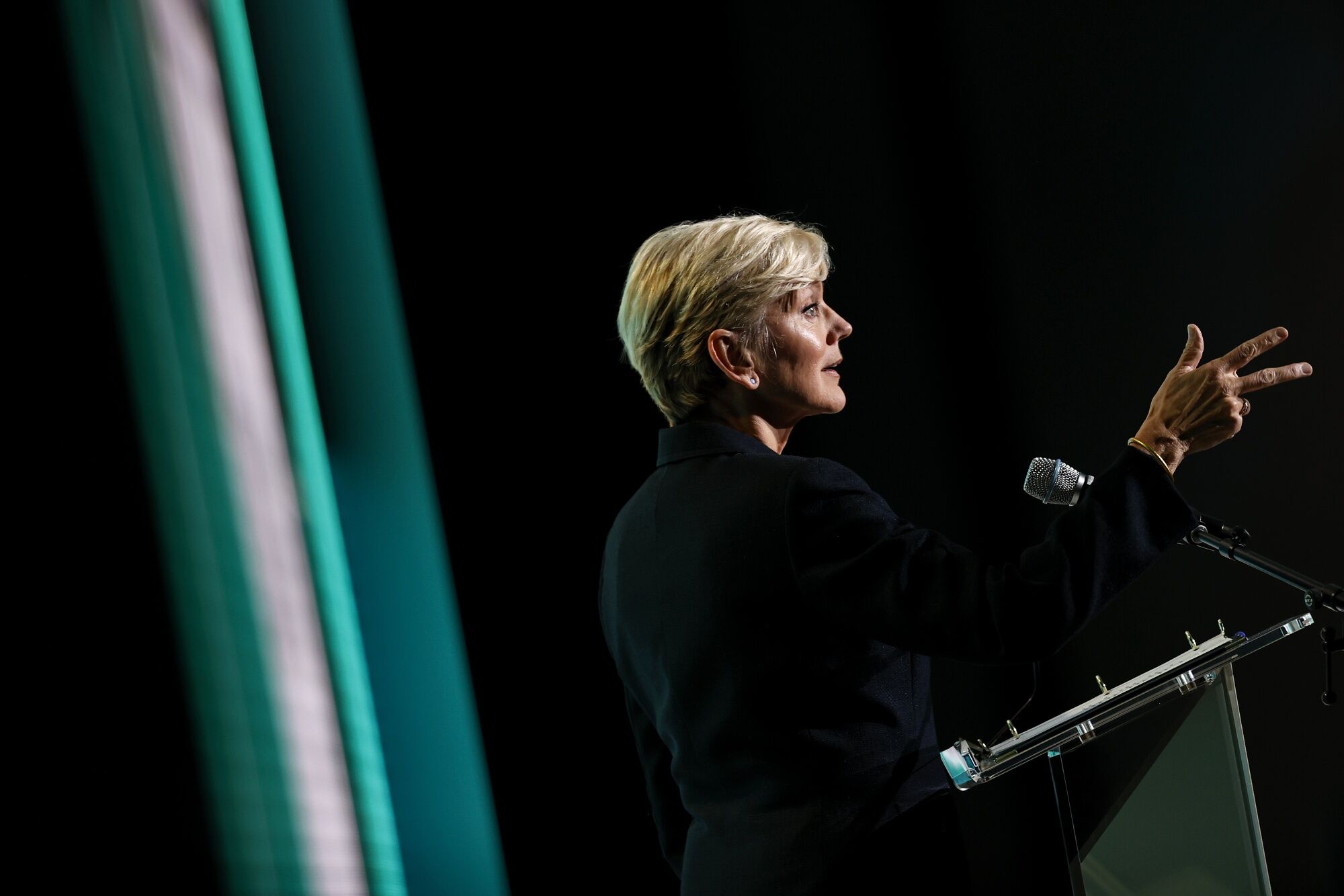
(Bloomberg) — It’s day four of CERAWeek by S&P Global in Houston. Yesterday was heavy on discussions of electricity and natural gas. US Energy Secretary Jennifer Granholm’s keynote address struck a friendly tone as she sought to mend ties between the fossil-fuel industry and the Biden administration.
Today is mostly about power and electrification. Highlights will include discussions on carbon markets, energy efficiency and the big challenges in connecting renewable energy sources to the grid.
Shell Plc Chief Executive Officer Wael Sawan spoke early in the morning. Willie L. Phillips, chairman of the US Federal Energy Regulatory Commission, made remarks midday. And Michael Regan, administrator of the US Environmental Protection Agency, will speak later this afternoon.
For more CERAWeek coverage, sign up now for our Elements newsletter, a daily guide to the energy and commodities markets.
All time stamps are Houston.
Power Sector Can Cut 90% of Emissions Now: AES Clean Energy Head (12:50 pm)
It is possible to decarbonize about 90% of the power sector with existing clean energy sources such as wind, solar and energy storage with “reasonable economics,” said Leo Moreno, president of AES Clean Energy.
He spoke during a panel discussion on the challenges and opportunities around the sourcing of clean power.
Smaller, private companies will need their customers to push for decarbonization just like investor pressure from the likes of Larry Fink at Blackrock pushed large public companies to commit to net zero pledges, Moreno said at CERAWeek.
“That is the path that will decarbonize the supply chain,” he said
Shell CEO Predicts Oil Prices Likely to Rise (12:20 pm)
Shell Plc CEO Wael Sawan, in an interview on Bloomberg TV, said oil prices are “more likely to be on the higher side than the lower side” over the coming months due to “tight” supply and demand balances in global markets.
Demand is expected to hit a new record this year, propelled by China, while OPEC and other major producers have shown little sign of ramping up output to meet it, the CEO said while attending CERAWeek in Houston.
Shell is unlikely to unleash capital spending on new production growth, said Sawan, who’s preparing for a strategic update in June.
Performance and discipline will be the two key goals to put Shell shares once again on par with US rivals, Sawan said.
Shell currently trades at about half the price-to-earnings multiple of Exxon and Chevron.
FERC Chairman Warns Power Companies on Environmental Justice (12:47)
Environmental justice needs to be addressed “up front” to ensure that natural gas and power projects don’t just get approved, but actually built, Federal Energy Regulatory Commission Chairman Willie Phillips said at CERAWeek.
Timelines will be shorter, he said, if project decisions aren’t later reversed or remanded because of a failure to consider affected parties’ issues.
FERC has been criticized for taking too long to approve natural gas pipelines and export projects, some of which have ended up in lengthy court battles with judges sending decisions back to FERC for more review.
Transmission Reform Is Coming, FERC Chair Promises (11:35 am)
The Federal Energy Regulatory Commission, the top power regulator, is pulling “every possible lever to do transmission reform” to enable the energy transition, Chairman Willie Phillips said at CERAWeek.
The agency needs to tackle reforms to speed up so-called interconnection queues, where renewable and other power supply projects are struggling to connect to grids because of long delays.
FERC currently has four commissioners instead of a full slate of five, and those four are evenly split with two Democrats and two Republicans. Phillips said that presents an “opportunity” to build consensus rather than have one party push through decisions on a 3-2 vote, as would normally happen with a full slate.
New Smart Tech for Homes Could Cut 20% Off Power Demand (11:11 am)
Smart technologies for use in the home have been around for a while now.
But in their latest form, they could potentially cut household power demand by as much as 20%, according to the CEO of NRG Energy Inc., one of the country’s biggest electricity providers.
The US is projected to have 1,000 gigawatts of peak power demand come 2030, so theoretically the adoption of smart tech could mean a reduction of up to 200 GW at those times, Mauricio Gutierrez told the CERAWeek conference.
The vast number of smart meters that have already been installed are under-utilized because of regulatory roadblocks, he said.
IRA Will ‘Shape US Energy Landscape’ for Next Decade (11:00 am)
Investing in renewables in the US was never bad, but with the Inflation Reduction Act “it was taken to another level,” Markus Krebber, CEO of RWE Ag, said at a CERAWeek panel discussing the future of power markets.
“The IRA will shape the US energy landscape for the next decade,” he said in referring to the $437 billion climate and tax law.
US Did ‘Fabulous Job’ With IRA (10:50 am)
Chief executives of power and renewable energy companies in the US, Europe and the Middle East lauded the US Inflation Reduction Act for leveling the playing field throughout the energy sector.
Andres Gluski, boss of US power firm AES, said during a CERAWeek panel discussion Thursday that the legislation passed last year brought certainty to the market because of its clear definitions over taxes and credits.
Mohamed Jameel Al Ramahi, CEO of Abu Dhabi’s clean energy company Masdar, said the US did a “fabulous job” with the IRA.
“With this new policy, that enables acceleration of new technology because it’s essential and needed,” Al Ramahi said during the panel.
By contrast, European government leaders have been outspoken about their dislike of the IRA — calling it an unfair subsidy for American companies — even as energy executives have called on them to match the measure.
US Urges Agreement on “Responsibly Sourced” Gas Label (10:00 am)
The Energy Department extolled the virtues of a transparent framework around the marketing and sale of so-called responsibly sourced gas in a Thursday morning meeting on the sidelines of CERAWeek with gas producers, exporters and third-party methane assessors.
The roundtable, which brought together more than two dozen industry officials and environmental advocates, centered around a two-page draft framework for differentiated gas as energy companies and the administration seek to increase confidence in the certification of some US gas as having fewer associated methane emissions.
The meeting was billed as the start of a process that could unfold over several months. Participants and observers in the session included representatives from ConocoPhillips, EQT Corp., Project Canary, Sempra Infrastructure and the Oil and Gas Climate Initiative.
The Energy Department may not have authority to pursue new rules, but it can help shape common principles and criteria for what constitutes responsibly sourced gas.
The regime could also be buttressed by accreditation and certification programs.
Carbon Capture Seen as Key to Reducing Grid Emissions (10:00 am)
Natural gas-fired power plants equipped with carbon capture, utilization and storage, or CCUS, is the only way to decarbonize the last 20% of the grid, Thad Hill, CEO of independent power producer Calpine, said in a media briefing at CeraWeek.
The economics “almost” work with Inflation Reduction Act incentives, he said. “I am hopeful that next year we will commit” to an actual project, Hill said.
Calpine is conducting a full study at four plants in Texas and California, Hill said. Small nuclear reactors are not an option right now, he added.
EQT Boss Rice Says Permitting Reform Inevitable (9:00 am)
One of the hot topics at CERAWeek has been reforming the permitting process.
While rather dry sounding, it’s actually crucial if the US energy industry is to grow and lower its overall emissions. Toby Rice, the CEO of natural gas producer EQT Corp., said he’s optimistic that it will become easier to build major new pipelines and other infrastructure as the government, the oil and gas sector and even the renewables industry become increasingly aligned on the issue.
“Permitting reform is inevitable in this country,” he said in an interview.
Rice added that EQT’s experience during the winter storm that briefly hit its Appalachian gas production just before Christmas illustrated why it’s vital that the company be allowed to expand in the region. “It’s not about winterization,” he said of the lessons to be drawn from that experience. “It’s about building redundancy.
And that means more infrastructure to be able to do that.”
Shell CEO Has Tough Words for Enviros: CERAWeek Update (8:30 am)
Shell CEO Wael Sawan said Europe must stop “depending on luck as a strategy” and focus on developing all forms of energy, especially natural gas, as it responds to the supply crunch caused by the war in Ukraine.
Sawan said at CERAWeek by S&P Global that Shell’s new strategy will “play to our strengths” in providing all forms of energy, including oil and gas.
The energy transition will be driven more by demand patterns rather than efforts to reduce or change supply, he said.
“Simply starving the world of that supply, that production of oil or for that matter for gas is going to result in the massive volatility and spikes in prices that we saw in 2021, exacerbating the issues we see right now with cost of living around the world,” Sawan said.
The company no longer has any ambition to become the largest power producer in the world, he said.
Energy Dept.: ‘Open to All’ Loan Applicants (8 am)
Jigar Shah, the Energy Department official who is looking to award billions of dollars in loan guarantees, has a message for executives at CERAWeek by S&P Global: We’re open to all. “I don’t care whether it’s a $30 billion application or a $2 billion application,” Shah, the director of the Loan Programs Office, said. “We treat everyone exactly the same, whether it’s in fossil or nuclear or renewables or advanced technology vehicles manufacturing.”
Shah hinted that may even include companies planning to redevelop fossil fuel infrastructure.
Shah said he is hearing from refinery owners who would like to co-locate hydrogen and sustainable aviation fuel processing on site, and pipeline operators who see an opportunity to transport ammonia or carbon dioxide.
As long as an applicant meets statutory requirements, Shah said, “we would like for you to apply.” Even in wind and solar, people are coming to the office seeking possible support as they pursue new battery chemistries that aren’t yet bankable.
Ultimately, the goal is to nurture these projects so they can succeed on their own. “We really do want to kick the kids out of the house,” Shah said. “Once we pay for their education,” they can “go off and prosper.”
More stories like this are available on bloomberg.com
©2023 Bloomberg L.
P.